


Quick recommendations
| Use case | Top pick | Price | Accuracy |
|---|---|---|---|
| Drinking water and home well water | HM Digital COM-100 | ~$50 | ±2% |
| RO systems and reef aquariums | Apera TDS20 | ~$50 | ±2% |
| Hydroponics and aquaculture | Bluelab Combo Meter | ~$185 | ±2% (TDS via EC) |
| Industrial process monitoring | Hach SC4500 with 3700 sc conductivity sensor | ~$2,500 | ±0.5% |
Need to test for what’s actually in your water, not just total dissolved solids? A KELP water test kit identifies pH, lead, PFAS, copper, nitrate, and total hardness, the contaminants TDS readings cannot see. Order a KELP test kit →
What a TDS meter does (and what TDS actually means)
A TDS meter (total dissolved solids meter) is an electronic instrument that estimates the combined concentration of dissolved inorganic salts and small amounts of organic matter in water. The reading is reported in parts per million (ppm) or milligrams per liter (mg/L). A TDS reading represents the total ionic content of a water sample, not the identity of any specific dissolved substance.
How a TDS meter actually works
Most consumer and commercial TDS meters do not measure dissolved solids directly. They measure electrical conductivity (the ability of water to carry an electrical current, which depends on the ions dissolved in it) and apply a conversion factor (typically 0.5 for natural water, 0.7 for fertilizer-rich solutions) to produce a TDS estimate. The conversion factor is an approximation, which is why two TDS meters reading the same water sample can show different values if they use different conversion factors.
The reference method for actual TDS measurement is gravimetric: evaporate a known volume of water, weigh the residue, and report the result in mg/L. Lab analysis uses this method (ASTM D5907). Field TDS meters trade absolute accuracy for speed and convenience.
What a TDS reading tells you, and what it doesn’t
A TDS reading tells you the total ionic load of the water. Higher TDS generally means more dissolved minerals, salts, or contaminants. The EPA’s secondary maximum contaminant level recommends TDS below 500 ppm for drinking water. Water above that level is more likely to taste salty, mineralized, or unpleasant.
What TDS does not tell you: which dissolved solids are present. Two water samples with identical TDS readings of 300 ppm can differ entirely in composition. One could be calcium and magnesium from limestone aquifers, which are harmless and often beneficial. The other could include lead, copper, nitrate, or arsenic at levels that exceed health-based limits. TDS is a useful starting indicator, but identifying which contaminants are present requires different tools. The sections below cover both how to choose a TDS meter and where TDS measurement alone is insufficient.
TDS meter types compared
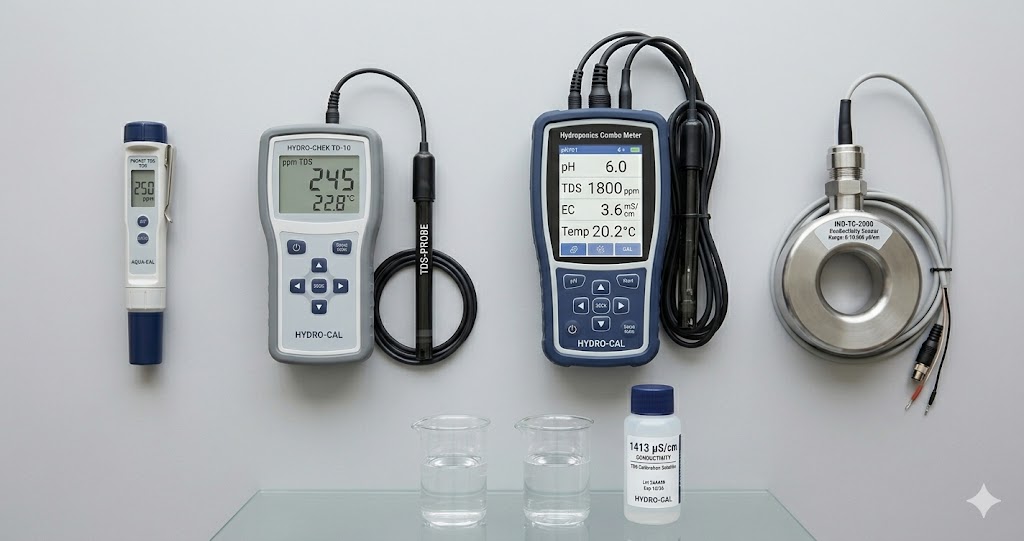
TDS meters span four common form factors. The table below summarizes typical accuracy, price, and probe life based on US pricing from HM Digital, Apera Instruments, Hanna Instruments, Bluelab, and Hach.
| Type | Typical accuracy | Typical price (USD) | Best for | Calibration frequency | Sensor life |
|---|---|---|---|---|---|
| Pocket / pen-style | ±2 to ±5% | $15–$50 | Home water testing, RO systems, aquariums | Monthly with calibration solution | 6–18 months, full unit replacement common |
| Handheld waterproof | ±1 to ±2% | $50–$200 | Field work, small commercial, hydroponics, brewing | Weekly to monthly | 12–24 months, replaceable probe |
| Combo (TDS + EC + pH + temp) | ±2% (TDS via EC) | $150–$500 | Hydroponics, aquaculture, irrigation | Weekly | 12–24 months |
| Inline / industrial | ±0.5 to ±2% | $1,500–$5,000+ | Continuous process monitoring, water treatment, drinking water systems | Auto or quarterly | 12–24 months |
A pocket TDS meter handles a homeowner spot-checking RO membrane performance or a hydroponic grower checking nutrient solution. Its ±5% error margin is acceptable when the question is “is the TDS roughly correct” rather than “what is the precise dissolved-solids level for compliance reporting.” Industrial process monitoring requires inline conductivity-based meters that log continuously. For applications where TDS alone won’t answer the underlying question (drinking water safety, contamination diagnostics, regulatory compliance), multi-parameter testing covers more ground.
Concerned about contaminants in your water?
Get water testing from KETOS KELP using EPA-certified methodology, results you can trust, backed by real data.
Order a Water Test →The best TDS meters by use case
Best TDS meter for drinking water and home well water
For checking drinking water at the tap, well water from a private source, or municipal water before and after a filter, the HM Digital COM-100 at around $50 is the strongest pick in the consumer category. It reads TDS, conductivity, salinity, and temperature in one waterproof handheld unit, ships with 1413 µS/cm calibration solution, holds calibration through dozens of measurements, and uses a replaceable probe rather than an integrated electrode that requires full unit replacement.
Runner-up: the HM Digital TDS-3 at around $15 if budget is the priority. It is the most popular consumer TDS meter on the market and accurate enough (±2%) to confirm whether your RO membrane is still working. Limitations: not waterproof, no conductivity reading, single-button operation only.
Where to buy: HM Digital (manufacturer direct), Amazon, Home Depot.
A TDS reading from your tap or well water tells you whether the dissolved-solids load is roughly normal for your supply. It will not tell you whether lead is leaching from old pipes, whether PFAS has crossed into your aquifer, or whether nitrate from agriculture is contaminating your well. Multi-parameter test kits like KELP cover TDS alongside lead, PFAS, copper, nitrate, and hardness in one lab analysis using EPA-certified methodology.
Best TDS meter for RO systems and reef aquariums
Reverse osmosis system owners and reef-tank hobbyists need a TDS meter that measures both incoming and product water with ±2 ppm precision, since the goal is verifying that the RO membrane is rejecting 95% or more of the dissolved solids. The Apera TDS20 at around $50 delivers ±2% accuracy with automatic temperature compensation and IP67 waterproof rating, which matters because aquarium and RO testing involves frequent water contact.
Runner-up: the Hanna HI98301 DiST 1 at around $60 for buyers who prefer the Hanna ecosystem and want a waterproof pen with single-point calibration.
Where to buy: Apera Instruments, Bulk Reef Supply, Marine Depot, Amazon.
For RO systems, two TDS readings (one from the source water and one from the RO output) are the standard performance check. A working RO membrane should reject 90% or more of the dissolved solids; if the rejection rate falls below that, the membrane is exhausted or fouled.
Best TDS meter for hydroponics and aquaculture
Hydroponic growers and aquaculture operators need TDS measurement that is integrated with electrical conductivity (EC), since EC is the more precise measurement for nutrient solution management. The Bluelab Combo Meter at around $185 combines pH, conductivity in millisiemens per centimeter, and temperature into one unit, and converts EC to TDS via a switchable 0.5 / 0.7 conversion factor. Daily-use durable, three-year battery life on a single 9V, replaceable double-junction probe.
Runner-up: the Hanna HI98318 GroLine at around $200 for growers who prefer the Hanna build quality and want a meter rated specifically for nutrient solution management.
Where to buy: Bluelab (manufacturer direct), Hydrobuilder, Hanna Instruments.
A note on TDS versus EC for hydroponics: most growers and most fertilizer manufacturers specify nutrient solutions in EC (mS/cm) rather than TDS (ppm), because the conversion factor varies by salt mixture. If you measure the same nutrient solution with two TDS meters using different conversion factors (0.5 vs 0.7), you will see two different ppm values for the same actual conductivity. EC eliminates that ambiguity. Continuous monitoring platforms used at commercial-scale hydroponic operations integrate EC, pH, dissolved oxygen, and water temperature into a single dataset rather than relying on handheld point-checks.
Best TDS meter for industrial process monitoring
Industrial process facilities measuring TDS typically do so via inline conductivity sensors that calculate TDS using a programmable conversion factor. The Hach SC4500 controller paired with a 3700 sc inductive conductivity sensor at around $2,500 (controller + sensor + cabling) is the standard for US drinking water utilities, food and beverage production lines, and cooling tower applications. The sensor uses inductive (toroidal) measurement rather than contacting electrodes, which eliminates fouling and drift in aggressive process water.
Runner-up: the Endress+Hauser CLS50D Memosens conductivity sensor at around $3,000 for facilities standardizing on Memosens digital sensor protocol across multiple parameters.
Where to buy: Hach.com, Endress+Hauser US, Grainger industrial.
Inline conductivity measurement solves the TDS continuity problem for one parameter. The harder problem for most industrial facilities is doing the same for 20 to 30 parameters at once with consistent EPA-method compliance, automated calibration, and centralized data logging. KETOS SHIELD is a continuous water quality monitoring platform that measures conductivity (and the derived TDS reading) alongside 30+ parameters in real time, with EPA-method-compliant logging and SCADA integration.
When a TDS reading is not the right answer
A TDS reading gives you one number representing total ionic content. Three classes of buyer regularly need more than that.
For homeowners diagnosing water quality
If you are testing your home water because you suspect contamination from sources like lead in aging pipes, PFAS in groundwater, nitrate from septic systems, or agricultural runoff, a TDS meter is the wrong tool. A high TDS reading tells you something is dissolved in your water. It does not tell you what. Two homes with identical 350 ppm TDS readings could have radically different contaminant profiles: one carrying calcium and magnesium from limestone aquifers, the other carrying lead and copper from corroding service lines.
A KELP water test kit ships pre-paid sample bottles to your home, a lab using EPA-certified methodology analyzes the sample, and you receive a quantitative report covering pH plus 12 other parameters including lead at sub-ppb detection limits, six PFAS compounds, copper, nitrate, arsenic, and total hardness. For under $200, you get a contaminant-identification report rather than a single ambiguous TDS number. Order a KELP test kit →
For utilities and municipal water operators
Utilities operating drinking water systems need TDS data integrated with the parameters that actually drive compliance and public health: free chlorine, total chlorine, pH, turbidity, lead, copper, and disinfection byproducts. A standalone inline TDS meter does not generate the audit-ready, multi-parameter, time-stamped record that the 2024 EPA Lead and Copper Rule Improvements (LCRI) and other compliance frameworks expect.
Continuous water quality monitoring platforms like KETOS SHIELD generate EPA-method-compliant readings across 30+ parameters at intervals appropriate to the system, ship data to a central dashboard, and provide the documentation trail compliance officers need during regulator audits. Schedule a SHIELD demo →
For industrial facilities running multi-parameter processes
For a single inline TDS measurement at one point in a process line, a Hach SC4500 with a 3700 sc inductive sensor does the job. The continuous-monitoring problem starts when a facility needs:
- TDS plus 20+ other parameters at once
- Centralized data across multiple sample points or sites
- Automated calibration and self-diagnostic alerts
- SCADA or DCS integration for real-time process control
- Audit-ready, EPA-method-compliant data exports
A KETOS SHIELD deployment replaces or supplements a discrete network of single-parameter inline meters with one platform that measures conductivity (and derived TDS) alongside 30+ other parameters with full data integration.
What to look for when buying a TDS meter
Five specs separate a TDS meter that gives reliable readings from one that drifts after a few weeks.
Accuracy and conversion factor
Pocket TDS meters typically deliver ±2 to ±5% accuracy. Handheld waterproof meters reach ±1 to ±2%. Inline industrial meters achieve ±0.5 to ±2%, depending on the specific application and process water. The important spec is whether the meter lets you change the conversion factor (the value used to convert measured EC to estimated TDS): standard freshwater uses 0.5, fertilizer solutions use 0.7, and seawater uses different factors entirely. If your meter has a fixed factor and you change applications, your readings will be biased.
Calibration solution and frequency
Two-point calibration with NIST-traceable conductivity standards (typically 1413 µS/cm and 12.88 mS/cm) is the minimum for daily commercial use. Most consumer pocket meters ship with a single calibration packet and don’t accept easy multi-point calibration. Calibration solutions cost $10 to $25 per bottle and last 6 to 12 months once opened. The conductivity standard expires; once a bottle is open and exposed to atmospheric CO2, the calibration value drifts.
Automatic temperature compensation (ATC)
Conductivity, and therefore TDS, varies significantly with temperature, about 2% per degree Celsius. ATC corrects the reading to a 25°C reference. A meter without ATC reads accurately only at its calibration temperature; a 5°C swing produces a 10% error. Verify that the meter has ATC and that the temperature sensor is integrated into the probe rather than a separate component you have to position correctly.
Probe replacement and total cost of ownership
Conductivity probes are consumables. Pocket TDS meter probes typically last 6 to 18 months and the unit is replaced. Handheld and benchtop probes are replaceable at $30 to $150 per probe. Calibration solutions cost $40 to $60 per year. Over a five-year ownership horizon, probe replacement and calibration consumables often equal or exceed the original meter purchase price for daily-use applications.
Frequently asked questions about TDS meters
What is a good TDS level for drinking water?
The EPA’s secondary maximum contaminant level recommends TDS below 500 mg/L for drinking water. Below 50 mg/L is considered low (some bottled waters), 50 to 250 mg/L is typical for treated municipal water, and 250 to 500 mg/L is acceptable but may taste mineralized. Above 500 mg/L the water tends to taste salty or unpleasant. TDS is a secondary standard, not a health-based regulation; high TDS does not necessarily mean unsafe water.
How accurate are TDS meters?
Accuracy depends on the meter type. Pocket testers typically deliver ±2 to ±5% TDS accuracy. Handheld waterproof meters reach ±1 to ±2%. Lab and inline meters operate at ±0.5 to ±2%. Real-world accuracy depends heavily on calibration freshness, the conversion factor matching your application, and consistent temperature compensation. ASTM D5907 is the reference test method for actual TDS measurement (gravimetric, lab-based). Field meters trade absolute accuracy for speed.
What is the difference between TDS and EC?
EC (electrical conductivity) is the direct measurement: how well water conducts an electrical current, reported in microsiemens per centimeter (µS/cm) or millisiemens per centimeter (mS/cm). TDS (total dissolved solids) is calculated from EC by applying a conversion factor (typically 0.5 for natural water, 0.7 for fertilizer solutions). Two meters reading the same water sample can show different TDS values if they use different conversion factors, but they will agree on the underlying EC. For applications where the salt mixture varies, including hydroponics, brewing, and water treatment, EC is the more reliable specification.
Can a high TDS reading be dangerous?
A high TDS reading by itself is not a health risk. TDS is a measure of total dissolved ions, most of which are harmless minerals like calcium, magnesium, and sodium. A high TDS reading can indicate that the water has high mineralization or that contamination has changed the water’s composition, but TDS alone does not identify which dissolved solids are present. To assess health risk, test specifically for the contaminants of concern: lead, copper, nitrate, arsenic, PFAS, pesticides, and microbial indicators.
How do you calibrate a TDS meter?
Most TDS meters calibrate using a single-point conductivity standard, typically 1413 µS/cm. Place the probe in calibration solution at room temperature, allow the reading to stabilize, and press the calibrate button until the meter accepts the value. Higher-end handheld and inline meters accept two-point or three-point calibration with additional standards (84 µS/cm and 12.88 mS/cm). Calibrate before each measurement session for compliance work, weekly for daily-use commercial meters, and monthly for occasional home use.
Why does my TDS meter show different readings on the same water?
Three common reasons. First, the conversion factor: if your meter uses 0.5 and another meter uses 0.7, you will see different ppm values for identical water. Second, temperature: TDS readings change about 2% per degree Celsius without temperature compensation. Third, calibration drift: probes coated with biofilm or scale, or calibration solutions exposed to atmospheric CO2 for too long, produce shifted readings. Re-calibrate with fresh solution and clean the probe before assuming the meter is faulty.
Does a TDS meter detect lead or PFAS?
No. A TDS meter measures the total dissolved-ion content of water; it cannot identify or quantify any specific contaminant. Lead at the EPA action level of 10 ppb adds approximately 0.01 ppm to a TDS reading, far below the noise floor of any consumer TDS meter. PFAS compounds typically occur at parts-per-trillion concentrations, completely undetectable in TDS. To test for lead or PFAS, use a water test kit that runs EPA-certified methodology in an accredited lab or send a sample to an accredited environmental lab.
How often should I replace my TDS meter?
The meter electronics last for years, while the conductivity probe ages. Pocket meters typically deliver 6 to 18 months of reliable readings before the probe degrades enough that calibration no longer holds. Handheld waterproof meters with replaceable probes last 12 to 24 months per probe, and the meter itself lasts 5+ years with regular probe replacement. A meter that drifts after fresh calibration with new solution is a sign the probe needs replacement.
When should I use continuous TDS monitoring instead of a handheld meter?
A handheld meter measures TDS at the moment you sample. Continuous monitoring tracks TDS around the clock and flags excursions that occur between sampling events. Use continuous monitoring for compliance reporting, drinking water treatment plants, food and beverage production where TDS affects product quality, distribution-system monitoring, and any application where missing a TDS excursion has consequences. KETOS SHIELD provides continuous monitoring across conductivity (and derived TDS) plus 30+ other water quality parameters in real time.
Choosing your TDS meter: a 60-second decision flow
If you are checking your home water for general dissolved-solids load or verifying RO system performance, an HM Digital COM-100 or Apera TDS20 at around $50 covers daily use. If you suspect contamination from lead, PFAS, nitrate, or other health-relevant contaminants, TDS is the wrong measurement; multi-parameter lab analysis identifies what is actually in your water.
If you are running hydroponics or aquaculture, a Bluelab Combo Meter at $185 measures EC alongside pH and temperature, which is what nutrient solution management actually requires. As operations scale, continuous monitoring platforms remove the gap between sampling events.
If you are operating an industrial process line (water treatment, food and beverage, cooling tower management), an inline conductivity sensor like the Hach 3700 sc paired with an SC4500 controller delivers continuous TDS data at the precision required for process control.