


Quick recommendations
| Use case | Top pick | Price | Range / accuracy |
|---|---|---|---|
| Hydroponics and aquaculture | Apera EC60 | ~$80 | 0–20 mS/cm, ±1% |
| Drinking water and home / RO | HM Digital COM-100 | ~$50 | 0–9.99 mS/cm, ±2% |
| Industrial process and water treatment | Hach SC4500 with 3700 sc inductive sensor | ~$2,500 | 0–2,000 mS/cm, ±0.5% |
| Lab and research | Mettler Toledo SevenCompact S230 | ~$1,300 | 0.001 µS/cm–1,000 mS/cm, ±0.5% |
Need to test what is actually in your water, not just total ionic load? A KELP water test kit identifies pH, lead, PFAS, copper, nitrate, conductivity, and total hardness in one lab analysis using EPA-certified methodology. Order a KELP test kit →
What a conductivity meter does (and what conductivity means)
A conductivity meter is an electronic instrument that measures the ability of water to carry an electrical current. The reading is reported in microsiemens per centimeter (µS/cm) or millisiemens per centimeter (mS/cm). Higher conductivity means more dissolved ions in the water, including salts, minerals, and some industrial contaminants. The measurement is direct and instantaneous, which is why conductivity is one of the most common parameters in field, industrial, and lab water analysis.
How a conductivity meter works
A conductivity meter passes a small alternating current between two electrodes immersed in the water sample and measures the resulting voltage drop. The ratio of current to voltage gives the sample’s electrical conductance, which the meter converts to specific conductivity by accounting for the geometry of the electrodes (the cell constant, K). Cell constants come in three common values: K=0.1 for low-conductivity samples like deionized water, K=1.0 for typical drinking and surface water, and K=10.0 for high-conductivity samples like seawater or wastewater. Most modern meters auto-detect cell constant based on calibration solution.
What conductivity tells you, and what it doesn’t
A conductivity reading tells you the total ionic load of the water. Pure water at 25°C has a conductivity of about 0.055 µS/cm. Treated municipal drinking water typically reads 50 to 500 µS/cm. Natural surface water ranges from 50 to 1,500 µS/cm depending on geology. Seawater is around 50,000 µS/cm. Higher-than-normal conductivity often indicates contamination (mining runoff, road salt, agricultural drainage) or process changes (RO membrane failure, brine intrusion, fertilizer overfeed in hydroponics).
What conductivity does not tell you: which dissolved ions are present. Two water samples with identical 400 µS/cm readings can differ entirely in composition. One could be calcium and bicarbonate from a limestone aquifer, harmless and even beneficial. The other could include lead, copper, nitrate, or industrial contaminants at levels that exceed health-based limits. Conductivity is a useful early indicator and an excellent process-control parameter, but identifying which contaminants drive the reading requires separate testing for specific ions.
Conductivity meter types compared
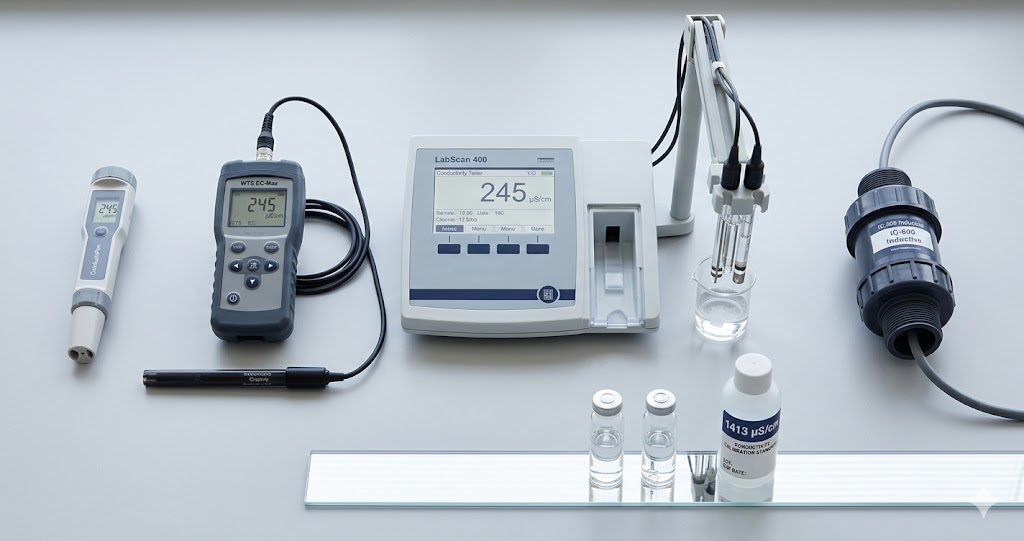
Conductivity meters span four common form factors. The table below summarizes typical accuracy, price, and electrode life based on US pricing from Apera Instruments, HM Digital, Hanna Instruments, Mettler Toledo, Hach, and Endress+Hauser.
| Type | Typical accuracy | Typical price (USD) | Best for | Cell type | Calibration |
|---|---|---|---|---|---|
| Pocket / pen-style | ±2 to ±5% | $25–$120 | Home water testing, RO systems, aquariums, fieldwork | 2-electrode contact | Single-point, monthly |
| Handheld waterproof | ±1 to ±2% | $80–$500 | Field surveys, hydroponics, brewing, small commercial | 2- or 4-electrode contact | Two-point, weekly |
| Benchtop laboratory | ±0.5% | $800–$2,500 | Lab QC, research, ultra-pure water, ISO compliance | 4-electrode or platinum-black | Multi-point with NIST-traceable standards |
| Inline / process | ±0.5 to ±2% | $1,500–$5,000+ | Water treatment, food and beverage, cooling towers, boiler water | Inductive (toroidal) or 4-electrode | Auto or quarterly |
A pocket conductivity meter handles a homeowner verifying RO membrane performance or a field engineer spot-checking surface water. Its ±5% error margin is acceptable when the question is whether conductivity is in the expected range. Industrial process applications need inline inductive sensors that resist electrode fouling in aggressive water. Lab applications operating at parts-per-billion conductivity (ultra-pure water) require benchtop meters with platinum-black or 4-electrode cells. For applications needing both broader parameter coverage and continuous data, multi-parameter platforms cover more ground than any single-parameter conductivity meter.
Concerned about contaminants in your water?
Get water testing from KETOS KELP using EPA-certified methodology, results you can trust, backed by real data.
Order a Water Test →The best conductivity meters by use case
Best conductivity meter for hydroponics and aquaculture
Hydroponic growers and aquaculture operators measure conductivity (EC) as the primary indicator of nutrient solution strength. The Apera EC60 at around $80 is a strong pick for daily hydroponic use. It covers 0 to 20 mS/cm at ±1% accuracy, includes automatic temperature compensation, ships with two calibration solutions for two-point calibration, and uses a replaceable graphite electrode rather than a sealed platinum sensor that requires full-meter replacement. IP67 waterproof rating handles the splashing typical of nutrient solution tanks.
Runner-up: the Bluelab Combo Meter at around $185 for growers who need pH plus EC plus temperature in one handheld. The combo meter remains the standard answer for commercial hydroponic operations because three parameters in one unit reduces calibration overhead.
Where to buy: Apera Instruments (manufacturer direct), Bluelab, Hydrobuilder, Amazon.
Hydroponics adds a second conductivity question: the conversion to TDS or PPM. Most fertilizer suppliers specify nutrient strength in EC (mS/cm) because TDS conversion factors vary by salt mixture (0.5 for KCl-based standards, 0.7 for fertilizer solutions). If you measure the same nutrient solution with two TDS-converting meters using different conversion factors, you will see two different ppm values for the same actual conductivity. Working in EC eliminates that ambiguity.
Best conductivity meter for drinking water and home / RO use
For homeowners verifying RO membrane performance, checking well water conductivity, or spot-checking water-softener output, the HM Digital COM-100 at around $50 covers daily use. It reads conductivity, TDS, salinity, and temperature in one waterproof handheld with ±2% accuracy, ships with 1413 µS/cm calibration solution, and uses a replaceable graphite probe.
Runner-up: the Apera EC400 at around $50 for buyers who prefer the Apera ecosystem and need slightly tighter accuracy at low conductivity ranges typical of RO product water.
Where to buy: HM Digital, Apera Instruments, Amazon, Home Depot.
For RO systems, two conductivity readings (one from the source water and one from the RO output) are the standard performance check. A working RO membrane should reject 90% or more of the dissolved ions; if the rejection rate falls below that, the membrane is exhausted or fouled.
Best conductivity meter for industrial process and water treatment
Industrial process facilities measuring conductivity continuously do so via inline sensors that survive aggressive process water without electrode fouling. The Hach SC4500 controller paired with a 3700 sc inductive (toroidal) conductivity sensor at around $2,500 (controller, sensor, and cabling) is the standard for US drinking water utilities, food and beverage production lines, and cooling tower applications. The inductive sensor design uses two coils rather than electrodes in contact with the water, eliminating polarization and fouling at the sensor face.
Runner-up: the Endress+Hauser Indumax CLS50D at around $2,500 for facilities standardizing on the Memosens digital sensor protocol across multiple parameters, or the Hach 3422 sc digital contacting conductivity sensor for higher-precision low-conductivity applications like boiler feedwater monitoring.
Where to buy: Hach.com (manufacturer direct), Endress+Hauser US, Grainger industrial, Yokogawa US.
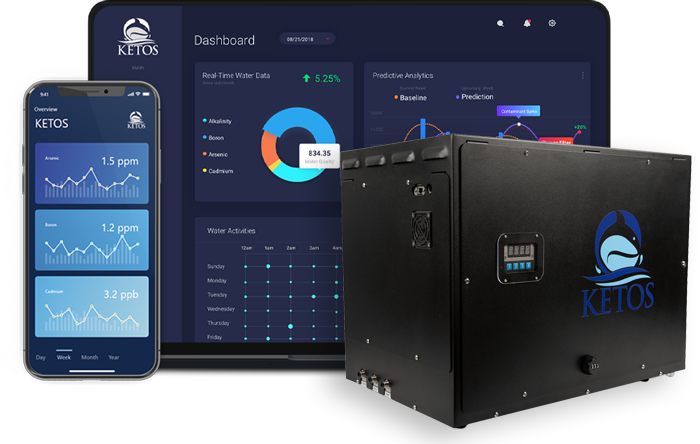
Inline conductivity measurement solves the continuity problem for one parameter. The harder problem for most facilities is doing the same for 20 to 30 parameters at once with consistent EPA-method compliance, automated calibration, and centralized data logging. KETOS SHIELD is a continuous water quality monitoring platform that measures conductivity natively alongside pH, free chlorine, total chlorine, lead, copper, and 25+ additional chemistry parameters in real time, with EPA-method-compliant logging and SCADA integration.
Best conductivity meter for lab and research use
Lab and research environments need a benchtop conductivity meter with multi-point calibration, automatic temperature compensation, ISO-compliant data export, and a cell type matched to the sample’s expected conductivity range. The Mettler Toledo SevenCompact S230 at around $1,300 covers 0.001 µS/cm to 1,000 mS/cm at ±0.5% accuracy, supports automatic three-point calibration with NIST-traceable standards, and accepts the InLab series of cells (including 4-electrode designs for ultra-pure water and platinum-black for high-conductivity samples).
Runner-up: the Thermo Scientific Orion Star A222 at around $1,200 for labs standardizing on Thermo Scientific consumables and the AQUASENSORS line.
Where to buy: Mettler Toledo (manufacturer direct), Thermo Fisher Scientific, VWR, Cole-Parmer.
For ultra-pure water (deionized, distilled, or USP Purified Water at less than 1 µS/cm), conductivity measurement requires special consideration. Standard meters with K=1.0 cells lose precision below 10 µS/cm. For sub-1 µS/cm work, use a K=0.1 cell or a 4-electrode design, and pay close attention to atmospheric CO2 absorption, which can raise apparent conductivity by 1 to 2 µS/cm within minutes of opening the sample.
When a conductivity meter is not the right answer
A conductivity reading gives you one number representing total ionic content. Three classes of buyer regularly need more than that.
For homeowners diagnosing water quality
If you are testing your home water because you suspect contamination from sources like lead in aging pipes, PFAS in groundwater, nitrate from septic systems, or agricultural runoff, a conductivity meter is the wrong tool. A high conductivity reading tells you something is dissolved in your water. It does not tell you what. Two homes with identical 400 µS/cm readings could have radically different contaminant profiles: one carrying calcium and bicarbonate from limestone aquifers, the other carrying lead and copper from corroding service lines.
A KELP water test kit ships pre-paid sample bottles to your home, a lab using EPA-certified methodology analyzes the sample, and you receive a quantitative report covering conductivity alongside pH, lead at sub-ppb detection limits, six PFAS compounds, copper, nitrate, arsenic, and total hardness. For under $200, you get a contaminant-identification report rather than a single ambiguous conductivity number. Order a KELP test kit →
For utilities, schools, and industrial facilities running multi-parameter monitoring
Utilities operating drinking water systems, school districts running lead and copper compliance programs, and industrial facilities managing process water need conductivity data integrated with the parameters that drive compliance and process control: pH, free chlorine, total chlorine, lead, copper, nitrate, and disinfection byproducts. A standalone inline conductivity meter generates accurate point-in-time readings but does not produce the multi-parameter, time-stamped, audit-ready record that the EPA Surface Water Treatment Rule, the 2024 Lead and Copper Rule Improvements, and most NPDES permits expect.
KETOS SHIELD generates continuous, EPA-method-compliant readings across conductivity, pH, free chlorine, total chlorine, lead, copper, and 25+ additional chemistry parameters at intervals appropriate to the system, ships data to a central dashboard, and provides the documentation trail compliance officers need during regulator audits. A 140-day SHIELD deployment at Goddard School in New Braunfels, Texas measured lead and 29 other water quality parameters continuously across nine sampling locations, generating 596,000 data points in support of the school’s lead and copper compliance program. Schedule a SHIELD demo →
For commercial hydroponic operations scaling beyond handheld meters
Commercial-scale hydroponic and controlled-environment-agriculture operations often graduate from handheld combo meters to continuous monitoring as nutrient management gets tighter. The continuous-monitoring problem starts when an operation needs:
- Conductivity plus pH, dissolved oxygen, and temperature reported continuously
- Centralized data across multiple grow rooms or zones
- Automated calibration and self-diagnostic alerts
- Integration with environmental control systems
- Audit-ready data for organic certification or buyer audits
A continuous monitoring platform replaces or supplements a network of handheld checks with one platform measuring conductivity, pH, dissolved oxygen, temperature, and other parameters relevant to nutrient solution management.
What to look for when buying a conductivity meter
Five specs separate a conductivity meter that holds calibration through a working week from one that drifts after the first sample.
Range, accuracy, and cell constant
Match the meter’s range and cell constant to the sample’s expected conductivity. K=0.1 cells handle 0.05 to 200 µS/cm (deionized and ultra-pure water). K=1.0 cells handle 10 µS/cm to 20 mS/cm (drinking water, surface water, hydroponics). K=10.0 cells handle 1 mS/cm to 200 mS/cm (seawater, brine, wastewater). A K=1.0 cell used in seawater saturates; a K=10.0 cell used in deionized water lacks the resolution to read accurately. Most modern meters auto-detect cell constant based on calibration solution.
Calibration solutions and frequency
Two-point calibration with NIST-traceable conductivity standards (typically 1413 µS/cm and 12.88 mS/cm, or 84 µS/cm for low-range work) is the minimum for daily commercial use. Single-point calibration with a 1413 µS/cm standard suffices for most home and field applications. Calibration solutions cost $10 to $30 per bottle and last 6 to 12 months once opened. The reference standard expires; once a bottle is open and exposed to atmospheric CO2, the calibration value drifts.
Automatic temperature compensation (ATC)
Conductivity changes about 2% per degree Celsius for most aqueous solutions. ATC corrects the reading to a 25°C reference. Without ATC, a 5°C swing produces a 10% error. Verify that the meter has ATC and that the temperature sensor is integrated into the conductivity probe rather than a separate component you have to position correctly. ATC reference temperatures other than 25°C are sometimes used in specific industries (20°C in some European utilities); check that your meter supports the reference your application requires.
Probe replacement and total cost of ownership
Conductivity electrodes are consumables. Pocket meters typically last 6 to 18 months and the unit is replaced. Handheld and benchtop probes are replaceable at $50 to $200 per probe. Inline industrial sensors last 2 to 5 years depending on process water aggressiveness, with replacement costs of $300 to $1,500. Calibration solutions add $40 to $80 per year. Over a five-year ownership horizon, probe replacement and calibration consumables often equal or exceed the original meter purchase price for daily-use applications.
Frequently asked questions about conductivity meters
What does a conductivity meter measure?
A conductivity meter measures the electrical conductivity of water, which represents the total dissolved-ion content. The reading is reported in microsiemens per centimeter (µS/cm) or millisiemens per centimeter (mS/cm). Higher readings mean more dissolved salts, minerals, or contaminants in the water. Conductivity is one of the fastest and most reliable indicators of changes in water composition.
What is a normal conductivity reading for drinking water?
The EPA does not set a primary or secondary maximum contaminant level for conductivity in drinking water, but treated US municipal water typically reads 50 to 500 µS/cm. Below 50 µS/cm is unusual for tap water and may indicate a softener or RO system. Above 1,500 µS/cm suggests high mineralization, contamination, or non-potable water. Pure water at 25°C has a conductivity of about 0.055 µS/cm.
How accurate are conductivity meters?
Accuracy depends on the meter type and conductivity range. Pocket testers typically deliver ±2 to ±5%. Handheld waterproof meters reach ±1 to ±2%. Benchtop meters operate at ±0.5%. Inline industrial meters operate at ±0.5 to ±2%. Real-world accuracy depends heavily on calibration freshness, the cell constant matching the sample range, and consistent temperature compensation. ASTM D1125 is the reference test method for water conductivity.
What is the difference between µS/cm and mS/cm?
Microsiemens per centimeter (µS/cm) and millisiemens per centimeter (mS/cm) are both units of electrical conductivity, related by a factor of 1,000. One mS/cm equals 1,000 µS/cm. Use µS/cm for low-conductivity samples like drinking water (50 to 500 µS/cm) or pure water (less than 1 µS/cm). Use mS/cm for high-conductivity samples like seawater (about 50 mS/cm), hydroponic nutrient solutions (1 to 4 mS/cm), or brine.
How do you calibrate a conductivity meter?
Most conductivity meters calibrate using a single-point standard at 1413 µS/cm. Place the probe in calibration solution at room temperature, wait for the reading to stabilize, and accept the value. Higher-end handheld and benchtop meters accept two-point or three-point calibration with additional standards (84 µS/cm for low-range and 12.88 mS/cm for high-range). Calibrate before each measurement session for compliance work, weekly for daily-use commercial meters, and monthly for occasional home use. Always calibrate after replacing the probe or buffer solutions.
What is cell constant?
Cell constant (K) is a physical characteristic of the conductivity probe that depends on the spacing and surface area of the electrodes. K=0.1 cells are designed for low-conductivity samples (deionized water, ultra-pure water). K=1.0 cells are the standard for drinking water, surface water, and most hydroponics. K=10.0 cells are designed for high-conductivity samples (seawater, brine, wastewater). The cell constant must match the sample range or readings will be inaccurate. Most modern meters auto-detect cell constant based on the calibration solution used.
Why does temperature affect conductivity readings?
Conductivity increases with temperature because warmer water has more mobile ions and lower viscosity. The temperature coefficient is typically 2% per degree Celsius for most aqueous solutions. A meter without automatic temperature compensation reads the raw conductivity at the actual sample temperature, which means a 5°C swing produces a 10% reading error. ATC corrects all readings to a standardized 25°C reference, allowing accurate comparison across samples taken at different temperatures.
When should I use continuous conductivity monitoring instead of a handheld meter?
A handheld meter measures conductivity at the moment you sample. Continuous monitoring tracks conductivity around the clock and flags excursions you would miss between sampling events. Use continuous monitoring for water treatment plants, drinking water distribution-system monitoring, food and beverage production where conductivity affects product quality, cooling tower management, hydroponic nutrient solution control, and any application where missing a conductivity excursion has consequences. KETOS SHIELD provides continuous conductivity monitoring alongside pH, free chlorine, lead, copper, and 25+ other water quality parameters in real time.
Choosing your conductivity meter: a 60-second decision flow
If you are running hydroponics or aquaculture, an Apera EC60 at around $80 covers daily nutrient-solution checks. If you also need pH and temperature, a Bluelab Combo Meter at $185 handles three parameters in one unit.
If you are checking your home water for general dissolved-ion load or verifying RO system performance, an HM Digital COM-100 or Apera EC400 at around $50 covers daily use. If you suspect contamination from lead, PFAS, nitrate, or other health-relevant contaminants, conductivity is the wrong measurement; multi-parameter lab analysis identifies what is actually in your water.
If you are running an industrial process line, water treatment plant, or cooling tower, an inline inductive sensor like the Hach 3700 sc paired with an SC4500 controller delivers continuous conductivity at the precision required for process control.
If you are a lab or research environment, a Mettler Toledo SevenCompact S230 at around $1,300 provides benchtop accuracy across the full range from ultra-pure water to high-conductivity samples.