


Updated November 2026
California now requires data centers to disclose their water use to the city or county that licenses them and to their water supplier. Governor Newsom signed the two water bills, AB 2619 and AB 2469, on September 21, 2026, and both take effect January 1, 2027. AB 2619 adds water reporting to business licensing. AB 2469 sets water conditions that must be met before a city or county approves a new or expanded data center.
What does AB 2619 require data centers to report?
AB 2619 (Papan, Chapter 437, Statutes of 2026) applies to “a person who owns or operates a data center” and sets three reporting points:
- Before applying for an initial business license or permit: give the water supplier a good faith estimate, under penalty of perjury, of expected water use, the anticipated source of water, and projected use for the maximum day, maximum month and average year.
- On the initial license application: report the same estimate to the city or county, also under penalty of perjury.
- At each license renewal: report the prior calendar year’s water use, including total water use and direct water use, and the data center’s cooling system type.
Direct water use means water withdrawn, delivered or otherwise used on site for data center operations, including cooling, sanitation and irrigation, identified by source: potable, nonpotable or recycled water.
AB 2619 also amends the Urban Water Management Planning Act, so an urban water supplier’s annual supply and demand assessment now includes the unconstrained demand of data centers.
Which data centers does the law cover?
The law defines a data center as a facility that houses computing infrastructure, such as servers, storage, networking equipment and the power and cooling systems that support them, mainly to process, store or distribute electronic data. It names three types:
- Type I (hyperscale): more than 10,000 servers or more than 25 megawatts.
- Type II: 2 to 25 megawatts.
- Type III: under 2 megawatts.
The reporting duties apply to all three types. There is no minimum size.
Concerned about contaminants in your water?
Get water testing from KETOS KELP using EPA-certified methodology, results you can trust, backed by real data.
Order a Water Test →What does AB 2469 require before a city or county approves a data center?
Under AB 2469 (Papan, Chapter 436, Statutes of 2026), a city or county may not approve a permit for a new data center, or for an expansion that increases maximum peak water use, until the applicant provides:
- A water supply assessment under Water Code Section 10910 and the sections that follow it.
- From January 1, 2028, a water scarcity plan: measures for each drought level defined by the U.S. Drought Monitor, from abnormally dry to exceptional, including staged withdrawal reductions, curtailment of nonessential use, recycling and reuse, thermal load reductions and, where necessary, temporary load shedding.
- Projected water use and water efficiency measures.
- Estimated workforce needs for the project.
The applicant also pays the full cost of any water conveyance, treatment, storage or distribution improvements that the water supplier determines are needed to serve the project. The law applies to charter cities as well.
When do the new rules start?
- January 1, 2027: both laws take effect.
- First AB 2619 reports: due with the first initial license application or renewal after that date, so each data center’s timing follows its own license cycle.
- January 1, 2028: the AB 2469 water scarcity plan becomes part of the approval package.
Who receives the reports?
The city or county that issues the business license receives the AB 2619 reports, and the water supplier receives the estimate made before the first application. AB 2469 information goes to the city or county reviewing the permit. Neither law sets up a statewide filing system.
How should a data center prepare?
- Meter water by source and by use: potable, nonpotable and recycled water, and cooling, sanitation and irrigation, so the renewal report draws on measured numbers.
- Record the cooling system type at each site.
- Build maximum-day and maximum-month estimates from hot-weather operating data for any new site or expansion.
- Draft the drought-stage water scarcity plan before 2028 for any project that will need a permit.
- Plan for recycled water chemistry. Recycled water can bring more dissolved solids and phosphate into a cooling loop, which limits how many cycles a tower can run before it must be bled off.
Where KETOS fits
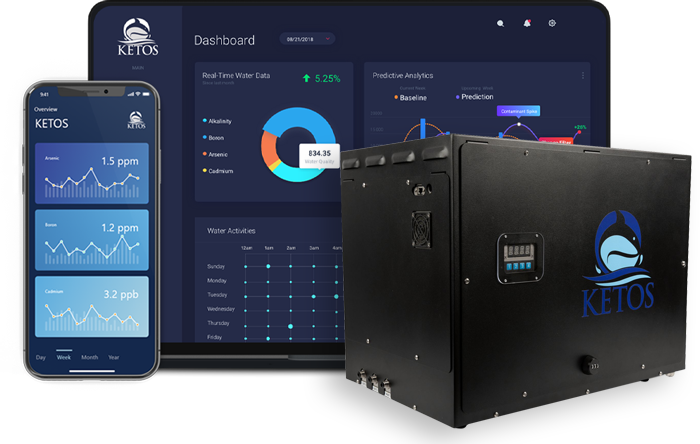
The new laws ask for gallons. Water chemistry decides how many cycles a cooling tower can run, and that sets how many gallons it needs. KETOS SHIELD measures cooling loop and makeup water on site: pH and conductivity about every minute, and inorganics and metals such as hardness, alkalinity, free chlorine, copper and zinc about hourly, within ±10% of certified lab results. It also reports the Langelier Saturation Index, which a multinational steel maker used to cut cooling tower treatment costs by 13%.
For lab analysis, KETOS KELP data center water testing packages cover the cooling loop, the discharge outfall and stormwater runoff, with digital reports in 5 to 7 business days. See water quality monitoring for data centers.
Common questions
Does California require data centers to report water use?
Yes. From January 1, 2027, AB 2619 requires data center owners and operators to report expected water use when they first apply for a business license, and the prior year’s total and direct water use, by source, at each renewal.
Do small data centers have to report?
Yes. The reporting duties cover all three data center types in the law, including Type III facilities under 2 megawatts.
What is a water scarcity plan under AB 2469?
It is a plan, required from January 1, 2028 for new or expanded data centers, that sets out what the facility will do at each U.S. Drought Monitor drought level: staged withdrawal reductions, curtailment of nonessential use, recycling and reuse, thermal load reductions and, where necessary, temporary load shedding.
Sources: AB 2619, chaptered text; AB 2469, chaptered text; Office of the Governor, September 21, 2026.