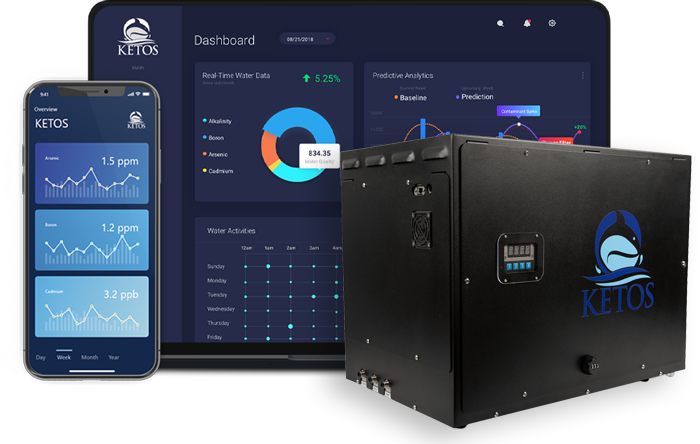


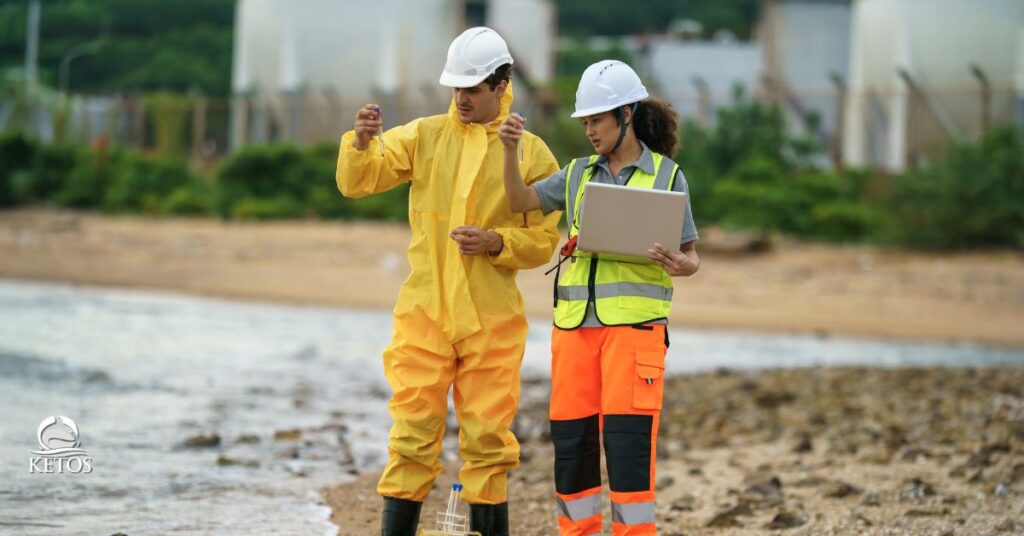
Real-time water quality monitoring is becoming a practical and strategic tool for water-intensive businesses, utilities, and municipalities that need to manage risk, protect their reputation, and meet strict regulations.
When done well, real-time water quality monitoring does more than collect data. It changes how organizations see and manage their water systems day to day.
What Is Real-Time Water Quality Monitoring and Why Does It Matter?
Real-time water quality monitoring involves continuously or at very short intervals measuring key water indicators, then sending those readings to a central system as they are measured. Instead of taking a sample, sending it to a laboratory, and waiting for results, field sensors provide a live picture of what is happening in the water right now. Parameters like pH, conductivity, dissolved oxygen, temperature, ammonia, nitrate and disinfectant residuals are often included in these systems.
This approach matters because it turns water quality from a backward-looking activity into a current operational signal. Traditional sampling methods tell you what your water looked like hours or days ago. Real-time water quality monitoring tells you what is happening in the present. That difference is important when permits, public health, and environmental impacts are on the line.
It also aligns with the direction of regulation and public expectations. Regulators are increasingly focused on ongoing control rather than occasional checks. Communities, investors, and customers want clear evidence that water systems are being managed responsibly. Organizations that can show continuous data and clear responses are better positioned than those with a handful of lab reports and spreadsheets.
Another reason real-time water quality monitoring is getting attention is the rise of ESG reporting. Many companies now report their water use, discharge, and associated risks to investors. Continuous, well-managed data makes these disclosures more credible and easier to defend.
How Does Real-Time Water Quality Monitoring Help With Regulatory Compliance?
Real-time water quality monitoring supports compliance in two critical ways. It improves the ability to keep processes within legal limits, and it creates records that are easier to defend during inspections or investigations.
On the process side, continuous monitoring lets staff see changes early. Imagine a plant that only takes one sample per day at its discharge point. If a problem occurs in the middle of the night and lasts for 2 hours, that event might never appear in the sample. The plant could technically “pass” its daily test while still harming the environment and violating permit conditions during that unseen period.
With real-time water quality monitoring, the same plant would see those changes as they occur. If ammonia or free chlorine begins to drift, alarms can notify operators while there is still time to respond. They can adjust chemical dosing, slow flows, divert water to additional treatment, or take other corrective steps before a full violation occurs. Instead of reacting to yesterday’s news, they respond to current conditions.
On the documentation side, streaming data into a central system builds a time-stamped record of how the plant has performed. If regulators question performance, the organization can show a detailed timeline of readings, alerts, and actions. When systems are properly designed, each piece of data is linked to a location, a parameter, and its configuration history. That trail can make a big difference during compliance reviews.
Real-time water quality monitoring can also simplify regular reporting. Many permits require monthly or quarterly performance reports. When the data is already captured, organized, and checked in real time, generating these reports becomes a matter of running standard queries and reviewing the results rather than recreating numbers by hand.
In some cases, organizations that can clearly show effective real-time water quality monitoring and fast response times may be viewed more favorably when something does go wrong. Regulators often look at intent, control, and corrective actions, not just the final number on a lab report.
What Parameters Are Usually Tracked in Real-Time Water Quality Monitoring?
In most systems, real-time water quality monitoring focuses on a group of core parameters that directly affect compliance, process control, and environmental impact. These parameters are chosen based on permit requirements, local conditions, and operational needs.
Common parameters include:
1. pH
pH affects corrosion, chemical reactions, biological treatment, and many permit limits. Real-time pH water quality monitoring helps keep systems within safe and legal ranges.
2. Ammonia and nitrate
Ammonia and nitrate show how well nitrogen is being removed in wastewater treatment, and both appear in many discharge permits and drinking water limits. A rising ammonia trend can point to an aeration problem or a change in incoming load before it shows up in a compliance sample.
3. Dissolved oxygen (DO)
DO is critical in biological treatment and for aquatic life in receiving waters. Monitoring DO in real time helps operators maintain healthy conditions in treatment basins and avoid harmful conditions downstream.
4. Conductivity or total dissolved solids (TDS)
These indicators reflect the overall level of dissolved ions. Real-time conductivity monitoring can detect changes in source water quality, spills, or illegal discharges.
5. Temperature
Temperature influences reaction rates, biological activity, and ecosystem health. Abnormal temperature trends can also point to mechanical or process problems.
6. Disinfectant residuals
In drinking water and some reuse systems, real-time tracking of chlorine or other disinfectants is essential for safety and compliance. Too little residual can mean pathogens are not controlled, while too much can cause byproduct issues and customer complaints.
In some settings, real-time water quality monitoring is extended to include nutrients such as ammonia and nitrate, metals, organic carbon, and other specific contaminants. This usually requires more advanced analyzers and careful maintenance, but it can be critical where permits are tight.
An interesting practice in many organizations is using basic parameters as early warning indicators. For example, a sudden jump in conductivity or drop in dissolved oxygen can alert staff that something has changed upstream, even before specific lab tests are available.
Real-time water quality monitoring enables these signals to be noticed and acted on rather than being buried in daily averages.
How Does Real-Time Water Quality Monitoring Actually Work in the Field?
Real-time water quality monitoring may sound complex, but it follows a clear structure. Most systems have four main parts that work together: sensors, local devices, communication, and central platforms.
1. Sensors in the field
Sensors or probes are installed at key locations, including raw water intakes, treatment tanks, pipelines, and discharge points. These devices measure one or more parameters and are designed to withstand local conditions.
For example, a probe in a wastewater aeration basin must handle solids and turbulence, while a sensor in a drinking water line must be suitable for potable water.
2. Local collection and control
The sensor signals go to local devices such as data loggers, controllers, or programmable logic controllers. These devices collect the readings at set intervals, perform basic checks, and may handle simple control actions. In some cases, if a value exceeds a limit, the local device can trigger an immediate response before sending data to a central system.
3. Communication to central systems
Local devices send data to a central location via different communication methods. These can include wired industrial networks, cellular connections, radio links, or satellite connections for very remote sites. The choice depends on distance, reliability needs, and cost.
4. Central platforms and applications
At the central level, software platforms receive, store, and organize the data. They link each reading to a specific site, asset, and parameter. These platforms often handle alarming rules, visual dashboards, trend analysis, and report generation. Real-time water quality monitoring data may also be integrated with control systems, lab information systems, or maintenance systems.
From a user’s point of view, the process looks simple. They log into a dashboard and see color-coded indicators, charts, and alerts for their facilities. Under the surface, a lot of work goes into keeping sensors calibrated, communication links stable, and data organized.
In more advanced setups, real-time water quality monitoring is tightly integrated with the plant’s control system. For example, if chlorine residual at the plant outlet starts to fall, operators see it on the dashboard as it happens and can adjust dosing before the residual drops out of range.
Some organizations also feed their real-time water quality monitoring data into longer-term analytics. Over months and years, this data can reveal patterns related to weather, production schedules, or raw water sources. These insights help improve design decisions, capital planning, and risk assessments.
What Technologies Are Used in Real-Time Water Quality Monitoring Systems?
Real-time water quality monitoring relies on a combination of sensor technology, communication tools, and software platforms. Each part has its own strengths and limitations.
1. Electrochemical sensors
These include pH, oxidation-reduction potential, and dissolved oxygen probes. They are common, widely understood, and relatively affordable. They provide continuous measurements but require regular calibration and cleaning. Over time, they can drift or fail if not maintained.
2. Optical sensors
Turbidity meters and some dissolved oxygen sensors use optical methods. They can be very sensitive and respond quickly. However, they can suffer from fouling, scaling, or film buildup, which can alter readings. Automatic cleaning or wipers are often used to keep them accurate in challenging environments.
3. Colorimetric and spectroscopic analyzers
For nutrients, metals, and organic carbon, more complex analyzers are often used. These devices may draw in a water sample, mix it with reagents, and measure color or light absorption. They can provide near real-time results for parameters that were once only available from a lab, but they are more expensive and require careful maintenance, reagent handling, and calibration.
4. Wireless and IoT-style equipment
To connect many monitoring points, especially in spread-out systems, wireless devices are useful. Low-power sensors, battery-powered nodes, and robust communication links enable real-time water quality monitoring where running cables would be costly or impossible. These systems must balance power use, data frequency, and reliability.
5. Software and analytics platforms
On the software side, platforms store data, apply validation rules, generate alerts, and display information clearly. Better platforms allow users to set their own alarm thresholds, build custom views, and connect water quality data to other information such as flow, equipment status, and maintenance history.
Modern platforms can also apply statistical analysis and basic machine learning to detect unusual patterns. For example, they might flag a sensor that suddenly behaves differently from similar sensors or from historical trends. This helps distinguish between real events and faulty instruments.
One important point is how these systems handle the math behind permits. Real-time water quality monitoring provides a stream of instantaneous values, but many regulations are written in terms of daily or monthly averages or total loads. Good systems calculate these metrics from the underlying data over time, so compliance status is clear at any moment, not just when a report is due.
How Should Organizations Design an Effective Real-Time Water Quality Monitoring Strategy?
Designing an effective strategy for real-time water quality monitoring starts with purpose, not technology. The first question should be “What decisions do we want to improve, and what risks do we want to reduce?” rather than “Which sensors should we buy?”
A practical approach includes several steps:
1. Clarify drivers and goals
Review permits, past incidents, and ESG commitments. Identify where failures would have the most serious consequences. This might include specific discharge points, critical treatment steps, or sensitive intake locations. Real-time water quality monitoring should focus first on these high-impact areas.
2. Decide what to measure and where
Select parameters that are relevant to your permits, processes, and local environment. Decide where sensors will be located to give a representative and useful view. Avoid placing sensors in hard-to-reach or hard-to-maintain locations unless there is a strong reason.
3. Set performance and data quality expectations
Define acceptable ranges, accuracy needs, and response times for each parameter. Decide how often sensors will be checked against lab results. Plan how long data must be kept, and how configuration changes will be documented.
4. Plan integration with existing systems
Map how real-time water quality monitoring data will interact with existing SCADA, maintenance software, lab systems, and reporting tools. Integration can range from simple shared tags and exports to complex real-time control loops and automated report generation.
5. Build governance and workflows
Assign clear roles: who owns the monitoring system, who responds to alarms, and who reviews performance. Develop written procedures for alarm response, incident logging, and periodic reviews. Make sure real-time water quality monitoring is part of regular operations meetings, not handled in isolation.
6. Start with pilots and scale thoughtfully
Many organizations benefit from starting with a pilot project at a high-priority site. This allows them to refine sensor choices, alarm settings, and workflows on a small scale. Lessons learned can then guide a wider rollout.
When done this way, real-time water quality monitoring becomes part of a broader management system. It supports better decisions, clearer accountability, and more confident communication with regulators and stakeholders.
Conclusion
Real-time water quality monitoring is no longer just a technical upgrade. It is a practical way to see what is happening in your water systems as it happens, instead of guessing from a few lab results and spreadsheets. With the right design, it supports better compliance, faster problem response, and more meaningful ESG reporting, all while giving your team clearer information for daily decision-making.
The organizations that benefit most are those that treat real-time water quality monitoring as part of their overall risk and operations strategy, not as a stand-alone project. They start with their highest-risk points, choose parameters that truly matter, and build clear workflows so that data drives action. Over time, this approach builds a record of control, competence, and transparency that is valuable with regulators, investors, and communities.
If you take one idea forward, let it be this: focus first on the single point in your system where a lack of visibility would hurt you the most. That is often the best place to begin or strengthen your real-time water quality monitoring program. To take the next step with confidence, contact KETOS to learn how we can help you design and deploy water-quality monitoring solutions that meet your operational needs and compliance goals.
FAQs
What is real-time water quality monitoring?
Real-time water quality monitoring is the continuous or high-frequency measurement of key water parameters, such as pH, conductivity, chlorine residual and ammonia, using instruments connected to a central system. It gives operators a live view of water conditions so they can respond quickly when something starts to go wrong.
How does real-time water quality monitoring help with compliance?
It helps by providing early warnings when parameters move toward permit limits, allowing staff to adjust processes before a violation occurs. It also creates detailed, time-stamped records that make it easier to answer regulator questions and prepare compliance reports.
Is real-time water quality monitoring only for large utilities and plants?
No, both large and small organizations can use real-time water quality monitoring. Smaller facilities often start with a few critical points, such as a main discharge or intake, and expand over time as they see benefits and gain experience.
What are the main costs involved in real-time water quality monitoring?
Costs typically include sensors and analyzers, communication hardware, software or platform subscriptions, and ongoing maintenance and calibration. The long-term value often comes from avoided fines, reduced manual sampling, optimized chemical use, and fewer unplanned incidents.
How do I choose where to install sensors for real-time water quality monitoring?
Start with locations with the highest regulatory, environmental, or business risks, such as final effluent, key treatment steps, or sensitive intake points. From there, you can add more sensors to fill in gaps and create a clearer picture of how water quality changes across your system.