


Quick recommendations
| Use case | Top pick | Price | Accuracy |
|---|---|---|---|
| Home well water and drinking water | Apera PH60S | ~$80 | ±0.01 pH |
| Hydroponics and aquaculture | Bluelab Combo Meter | ~$185 | ±0.1 pH |
| Industrial process and compliance | Hach SC4500 with pHD electrode | ~$2,500 | ±0.02 pH |
| Laboratory and research | Mettler Toledo SevenCompact S220 | ~$1,200 | ±0.005 pH |
Already know your needs go beyond a single pH reading? A KELP water test kit provides lab analysis of pH plus lead, PFAS, and 11 additional parameters in one report using EPA-certified methodology. Order a KELP test kit →
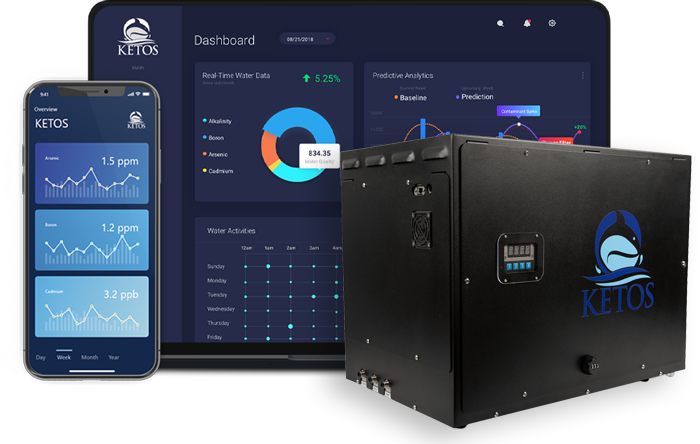
Need continuous pH monitoring with full water quality coverage? KETOS SHIELD measures pH alongside 30+ parameters in real time, with EPA-method-compliant logging and SCADA integration. Talk to SHIELD sales →
What a pH meter does (and what it doesn’t)
A pH meter is an electronic instrument that measures hydrogen-ion activity in aqueous solutions, reported on a scale from 0 (strongly acidic) through 7 (neutral) to 14 (strongly alkaline). pH meters use a glass measuring electrode and a reference electrode to generate a millivolt signal proportional to hydrogen-ion concentration, then convert that signal to a pH reading. The result tells you how acidic or alkaline a water sample is at the moment of measurement.
How a pH meter works
The glass measuring electrode contains a buffered internal solution. When the electrode is immersed in a sample, hydrogen ions exchange across the thin glass membrane and create a small voltage between the inside and outside of the bulb. The reference electrode produces a stable, known voltage. The meter measures the difference between the two and applies the Nernst equation, calibrated against pH 4.01, 7.00, and 10.01 buffers, to report a pH value.
When pH alone is not enough information
pH tells you one thing about water: how acidic or alkaline it is. It does not tell you what is dissolved in the water. Two water samples with identical pH 7.4 readings can differ by orders of magnitude in lead concentration, hardness, conductivity, dissolved oxygen, or PFAS content. For most safety, compliance, and process-control applications, pH is one input among many. The sections below cover both how to choose a pH meter and where pH measurement alone falls short.
pH meter types compared
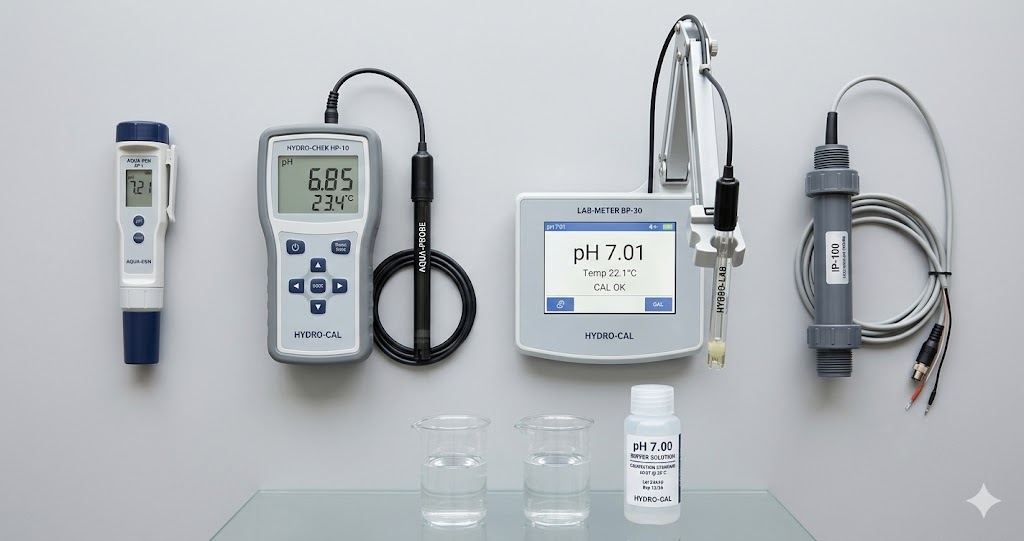
pH meters come in four common form factors, each built for a different working environment and accuracy budget. The table below summarizes typical accuracy, price, and electrode-replacement intervals based on current US pricing from Hanna Instruments, Apera Instruments, Hach, and Mettler Toledo.
| Type | Typical accuracy | Typical price (USD) | Best for | Calibration frequency | Electrode life |
|---|---|---|---|---|---|
| Pocket / pen-style | ±0.1 pH | $20–$120 | Home water testing, garden soil, aquariums, hobby brewing | Weekly to monthly, manual 2-point calibration | 6–18 months, full unit replacement common |
| Handheld portable | ±0.05 pH | $100–$500 | Field work, small commercial use, hydroponics, agriculture | Weekly, 2- or 3-point calibration | 12–24 months, replaceable electrode |
| Benchtop laboratory | ±0.005 to ±0.01 pH | $400–$2,000 | Lab analysis, research, manufacturing QC | Per-shift to weekly, automatic 3-point calibration | 12–36 months, replaceable electrode |
| Inline / process | ±0.02 pH | $1,500–$8,000+ | Continuous industrial monitoring, compliance reporting, drinking water treatment | Auto-calibration or quarterly manual | 6–24 months, process-dependent |
A pocket meter handles household spot-checks, but its ±0.1 pH error margin is too wide for compliance reporting. A benchtop meter delivers lab accuracy but operates on samples brought to the lab, so the data is point-in-time. Inline process meters solve the continuity problem at higher capital cost while still measuring only pH. For buyers who need both broader parameter coverage and continuous data, the right comparison shifts away from meter types and toward platforms like KELP test kits for multi-parameter lab analysis using EPA-certified methodology and SHIELD for 30+ parameter real-time monitoring.
Concerned about contaminants in your water?
Get water testing from KETOS KELP using EPA-certified methodology, results you can trust, backed by real data.
Order a Water Test →The best pH meters by use case
Best pH meter for home well water and drinking water
For homeowners testing well water, drinking water at the tap, or a backyard pool, the Apera PH60S at around $80 is the strongest entry-level pick. Apera ships it with a 2-point automatic calibration sequence, a sealed double-junction electrode that tolerates contaminants better than basic single-junction designs, and a ±0.01 pH accuracy spec that holds up against meters costing twice as much. Calibration buffers are included, the electrode is replaceable rather than disposable, and the unit reads in 30 seconds.
Runner-up: the Hanna HI98103 Checker at around $25 if budget is tight. The Checker is single-button simple but limited to ±0.2 pH accuracy, which means readings within a healthy drinking-water range (roughly 6.5 to 8.5) may not be precise enough to flag corrosion-causing low-pH water without a second confirmation reading.
Where to buy: Apera Instruments (manufacturer direct), Amazon, Hach.com.
A pen-style pH meter answers “what is the pH of this water” but does not answer “is this water safe to drink.” pH alone does not detect lead, copper, PFAS, arsenic, nitrate, hardness, or bacteria, which are the contaminants that drive most home-water-quality concerns. If you are testing well water for safety, a multi-parameter analysis is closer to the right answer. A KELP water test kit covers pH plus lead, PFAS, copper, nitrate, hardness, and seven additional parameters in one lab analysis using EPA-certified methodology. Order a KELP test kit →
Best pH meter for hydroponics and aquaculture
Hydroponic growers and aquaculture operators need pH meters that survive daily use in nutrient solutions or fish tanks, hold calibration through frequent sampling, and ideally measure conductivity in the same handheld. The Bluelab Combo Meter at around $185 is the standard answer in this segment. It combines pH (±0.1), conductivity in millisiemens per centimeter, and temperature into one unit, runs three years on a single 9V battery in typical use, and uses a replaceable double-junction probe.
Runner-up: the Apera PH60-Z at around $130 for growers who want higher pH precision (±0.01) and are willing to use a separate EC meter. Apera’s electrode handles nutrient solutions better than budget meters that drift after a few weeks of immersion.
Where to buy: Bluelab (manufacturer direct), Hydrobuilder, Amazon, Apera Instruments direct.
Hydroponics adds a wrinkle that homeowner pH testing does not have: pH is one of three or four parameters that have to be in range simultaneously for plants to thrive, alongside conductivity, dissolved oxygen, and water temperature. A handheld meter checks pH at the moment of sampling but says nothing about overnight pH drift, oxygen drops during dark cycles, or temperature spikes during heat events. Commercial-scale operations often graduate from handheld combo meters to continuous monitoring. KETOS SHIELD continuously monitors pH, conductivity, dissolved oxygen, temperature, and 25+ additional parameters with EPA-method-compliant logging. Talk to SHIELD sales →
Best pH meter for industrial process monitoring
Industrial process facilities (water treatment plants, food and beverage production lines, pharmaceutical manufacturing, semiconductor fabs) need inline pH meters that operate continuously, integrate with SCADA or DCS control systems, and meet EPA or FDA documentation requirements. The Hach SC4500 controller paired with a pHD differential electrode at around $2,500 (controller + electrode + cabling) is the working choice for most US drinking-water utilities and food-grade operations. The pHD electrode design uses two glass measuring electrodes and a third reference electrode in a single body, which extends sensor life to 12–24 months in challenging process water and reduces the calibration drift that single-junction electrodes suffer from.
Runner-up: the Endress+Hauser Liquiline CM44 with Memosens pH sensors at around $3,500 for facilities standardizing on the Memosens digital sensor protocol across multiple parameters. Memosens decouples the sensor from the analyzer with a digital connection, which simplifies sensor swap and laboratory pre-calibration.
Where to buy: Hach.com (manufacturer direct), Endress+Hauser US, Grainger industrial.
An inline pH meter solves the continuous-monitoring problem for one parameter. The harder problem for most facilities is doing the same for 20 or 30 parameters at once, with consistent EPA-method compliance, automated calibration, and centralized data logging that holds up to regulator audits. KETOS SHIELD is a continuous water quality monitoring platform that measures pH alongside 30+ parameters in real time, with EPA-method-compliant logging and SCADA integration. A 140-day SHIELD deployment at Goddard School in New Braunfels, Texas detected lead at 0.228 ppb across nine locations (well below the EPA action level of 15 ppb), generating 596,000 data points in support of the school’s lead and copper compliance program. Schedule a SHIELD demo →
Best pH meter for laboratory and research use
Laboratory and research environments need pH meters with three-point calibration, automatic temperature compensation, ISO-compliant data export, and electrodes specified for low ionic strength or non-aqueous samples. The Mettler Toledo SevenCompact S220 at around $1,200 is a lab-bench standard. It supports three-buffer calibration with auto-buffer recognition, logs 1,000 data points internally, exports to USB or LIMS via RS-232, and accepts a range of Mettler InLab electrode designs for sample-specific accuracy.
Runner-up: the Thermo Scientific Orion Star A211 at around $1,000 for labs standardizing on Thermo Scientific consumables and ROSS reference electrode technology, which holds calibration through wider temperature swings than gel-filled electrodes.
Where to buy: Mettler Toledo (manufacturer direct), Thermo Fisher Scientific, VWR, Cole-Parmer.
Most lab and research applications stay within benchtop pH measurement and do not graduate to continuous platforms. The exception is environmental monitoring or production QC where a research team needs to validate process water quality at scale. For those applications, a benchtop pH meter handles calibration validation while a continuous monitoring platform handles the production-line measurement.
When a pH meter is not the right answer
A pH meter measures one parameter at one point in time. Three classes of buyer need more than that, and the right next step depends on which class you fall into.
For homeowners testing well or drinking water
If you started this guide because you suspect your home water might not be safe, a pH meter is a partial tool. The EPA and CDC flag lead, copper, nitrate, arsenic, and PFAS as the most common health-relevant contaminants in private well water and aging municipal systems. None of those show up on a pH reading. A pH meter can hint at corrosion conditions, since water below pH 6.5 leaches lead and copper from plumbing, but it cannot quantify how much is actually in the water you drink.
A KELP water test kit ships pre-paid sample bottles to your home. You collect the sample, a lab using EPA-certified methodology analyzes it, and you receive a quantitative report on pH plus 12 other parameters including lead at sub-ppb detection limits, six PFAS compounds, copper, nitrate, arsenic, and total hardness. For under $200, you get the same lab analysis a utility runs on its own water. Order a KELP test kit →
For utilities and schools managing lead and copper compliance
The 2024 EPA Lead and Copper Rule Improvements (LCRI) lowered the lead action level from 15 ppb to 10 ppb and require service-line inventories, expanded tap sampling, and faster lead service line replacement timelines. A handheld or inline pH meter does not generate the continuous, audit-ready data record that an LCRI compliance program needs. Spot checks remain part of the workflow, but the documentation gap between sampling events is what regulators flag.
KETOS SHIELD generates continuous, time-stamped, EPA-method-compliant readings across pH, conductivity, free chlorine, total chlorine, and the parameters relevant to lead and copper exposure at intervals appropriate to the system. The Goddard School deployment referenced earlier is one example of how this works for an institution wanting to demonstrate proactive lead monitoring beyond its state program’s minimum. For utilities or school systems building out an LCRI program, continuous monitoring closes the documentation gap and gives compliance officers an audit trail. Schedule a SHIELD demo →
For industrial facilities needing continuous monitoring
For a single inline pH measurement at one point in a process line, a Hach SC4500 or Endress+Hauser CM44 does the job well. The SHIELD use case starts when a facility needs:
- Continuous monitoring across many parameters at once, not just pH
- Centralized data across multiple sample points or sites
- Automated calibration and self-diagnostic alerts
- Integration with SCADA or DCS for real-time process control
- Audit-ready, EPA-method-compliant data exports
A KETOS SHIELD deployment replaces or supplements a discrete network of single-parameter inline meters with one platform that measures pH alongside 30+ other parameters, ships data to a central dashboard, integrates with existing SCADA, and provides the documentation trail facility engineers and corporate environmental teams need. Schedule a SHIELD demo →
What to look for when buying a pH meter
Five specs separate a pH meter that holds up in production from one that drifts the moment you put it to work.
Accuracy and resolution
Pen-style pocket meters typically deliver ±0.1 pH accuracy at 0.1 pH resolution. Mid-tier handhelds reach ±0.05 pH at 0.01 resolution. Benchtop meters operate at ±0.005 to ±0.01 pH with three-decimal resolution. For drinking water compliance reporting, ±0.1 is generally too imprecise. ASTM D1293 is the reference test method for electrometric pH measurement of water.
Calibration and electrode care
Two-point calibration using pH 4.01 and 7.00 buffers is the minimum for casual use. Three-point calibration adds pH 10.01 and is required for accurate measurements in the alkaline range with accuracy claims tighter than ±0.05. Calibration buffer kits cost $15 to $30 and last 6 to 12 months. Store electrodes in 3M KCl or manufacturer-supplied storage solution. The glass bulb cannot dry out without permanent damage.
Automatic temperature compensation (ATC)
pH varies with temperature according to the Nernst equation. Automatic temperature compensation adjusts the reading to a 25°C reference, which matters because uncompensated readings drift roughly 0.003 pH per °C. Any meter used outside a temperature-controlled lab needs ATC. Verify that the temperature probe is built into the electrode or supplied as a separate sensor.
Electrode replacement and total cost of ownership
pH electrodes are consumables. Pocket-meter electrodes typically last 6 to 18 months, after which the full unit is usually replaced. Handheld and benchtop electrodes are replaceable at $40 to $200 per electrode. Add $15 to $30 per year for buffer solutions. Over a five-year ownership horizon, electrode replacement and calibration consumables often equal or exceed the original meter purchase price, which makes electrode lifespan one of the more important specs to compare.
Frequently asked questions about pH meters
How much does a pH meter cost?
pH meters range from about $20 for entry-level pocket testers to $8,000 or more for inline industrial systems with controllers and electrodes. Most home users spend $50 to $120 on a pen-style meter. Hydroponics operators typically spend $100 to $200. Lab benchtop meters run $400 to $2,000. Inline process meters with full installation start around $1,500.
How accurate are pH meters?
Accuracy depends on the meter type. Pocket testers typically deliver ±0.1 pH. Mid-tier handhelds reach ±0.05 pH. Lab benchtop meters operate at ±0.005 to ±0.01 pH, and inline industrial meters typically run ±0.02 pH. ASTM D1293 is the reference test method. Real-world accuracy depends heavily on calibration frequency and electrode condition, not just the rated spec.
How often should I calibrate my pH meter?
Calibrate before each measurement session for compliance work. Calibrate weekly for daily-use meters in hydroponics or commercial settings. Pocket meters used occasionally for home water testing should be calibrated monthly or before any reading you plan to act on. Always recalibrate after replacing the electrode or buffer solutions.
Do pH meters expire?
The meter electronics last for years. The pH electrode itself ages. Glass-bulb electrodes typically deliver 6 to 18 months of accurate readings in pocket meters, 12 to 24 months in handhelds, and up to 36 months in benchtop electrodes with proper storage. An electrode that drifts after fresh calibration is a sign it needs replacement.
What is the difference between a pH meter and pH test strips?
Test strips use a chemical color-change indicator and read in 0.5 pH increments at best. A pH meter uses an electrochemical sensor and reads to 0.01 pH or better with calibration. Strips are cheaper for one-off checks. Meters are required for any application where accuracy below ±0.5 pH matters, including drinking water and process monitoring.
Can I use the same pH meter for water, soil, and food?
A standard water pH electrode is not designed for soil or solid foods. Soil testing requires a spear-tip or insertion electrode. Food testing requires a flat-surface or puncture electrode rated for food contact. Using a water electrode in soil or food shortens its life and produces inaccurate readings. Buy the electrode rated for your application.
What is the best pH for drinking water?
The EPA’s secondary maximum contaminant level recommends a pH between 6.5 and 8.5 for drinking water. Water below pH 6.5 can corrode plumbing and leach lead and copper. Water above pH 8.5 tends to taste flat or alkaline. Treated municipal drinking water in the US usually targets 7.2 to 8.0 to balance corrosion control and taste.
When should I use continuous pH monitoring instead of a handheld meter?
A handheld meter measures pH at the moment you sample. Continuous monitoring tracks pH around the clock and flags excursions you would miss between samples. Use continuous monitoring for compliance reporting, process control where pH affects product quality, distribution-system monitoring, and any application where missing a 30-minute pH excursion has consequences. KETOS SHIELD provides continuous monitoring across pH and 30+ other water quality parameters.
Choosing your pH meter: a 60-second decision flow
If you are testing your home’s well water or municipal water at the tap, start with a complete water analysis rather than a single-parameter pH reading. A KELP water test kit covers pH plus the contaminants that actually drive health risk. Order a KELP test kit →
If you are running hydroponics or aquaculture at hobbyist or small-commercial scale, a Bluelab Combo Meter handles daily pH, EC, and temperature checks. As operations scale, continuous monitoring removes the gap between sampling events.
If you are a utility, school district, or industrial facility working under EPA, FDA, or state compliance requirements, a single inline pH meter solves part of the monitoring problem. The rest of the problem is continuous coverage across multiple parameters with audit-ready logging. KETOS SHIELD measures pH continuously alongside 30+ water quality parameters with EPA-method-compliant logging and SCADA integration. Schedule a SHIELD demo →
If you are working in a lab, a benchtop meter from Mettler Toledo or Thermo Scientific is the right tool for most workflows.