


Quick recommendations
| Use case | Top pick | Price | Range / accuracy |
|---|---|---|---|
| Drinking water utility (EPA Method 180.1) | Hach TU5200 EPA benchtop | ~$3,500 | 0–1,000 NTU, ±2% |
| Wastewater and discharge monitoring | Hach TU5300 sc inline | ~$3,800 | 0.001–4,000 NTU, ±2% |
| Industrial process and food / beverage | Endress+Hauser Turbimax CUS52D | ~$2,500 | 0–4,000 FNU, ±5% |
| Lab and research | Thermo Scientific Orion AQ4500 | ~$1,200 | 0–4,000 NTU, ±2% |
Testing home water for safety, not just clarity? A KELP water test kit measures turbidity alongside pH, lead, PFAS, copper, nitrate, and total hardness in one lab analysis using EPA-certified methodology. Order a KELP test kit →
What a turbidity meter does (and what NTU actually means)
A turbidity meter (turbidimeter or nephelometer) is a scientific instrument that measures the cloudiness of water by detecting how much light is scattered by suspended particles. The reading is reported in nephelometric turbidity units (NTU) or formazin nephelometric units (FNU), depending on the light source standard the meter follows. A turbidity reading represents the concentration of suspended particles in water, including silt, clay, organic matter, microbes, and dissolved color-causing compounds.
How a turbidity meter works
A turbidity meter shines a light beam through a water sample and measures the intensity of light scattered at a 90-degree angle by suspended particles. More particles scatter more light, producing a higher NTU reading. Most meters use one of two light source standards: white tungsten lamp (EPA Method 180.1, reports NTU) or 860 nm infrared LED (ISO 7027, reports FNU). The two standards produce slightly different readings on the same sample because particle scattering varies with wavelength. EPA Method 180.1 is required for US drinking water compliance reporting; ISO 7027 is the international standard and tolerates colored samples better.
What turbidity tells you, and what it doesn’t
A turbidity reading tells you how much suspended material is in the water. Higher turbidity often correlates with reduced disinfection effectiveness, since particles can shield microbes from chlorine or UV. The EPA’s primary drinking water standard requires utilities to maintain turbidity below 1 NTU for filtered water (95% of samples) with a maximum of 5 NTU.
What turbidity does not tell you: the identity of the suspended particles. A 3 NTU sample could be silt from a recent rain event, harmless calcium carbonate from a limestone aquifer, organic matter feeding bacterial growth, or fine particulate from corroding iron pipes. Turbidity is a useful early indicator of changes in water source or treatment performance, but the question of whether the suspended material poses a health risk requires separate testing for specific contaminants.
Turbidity meter types compared
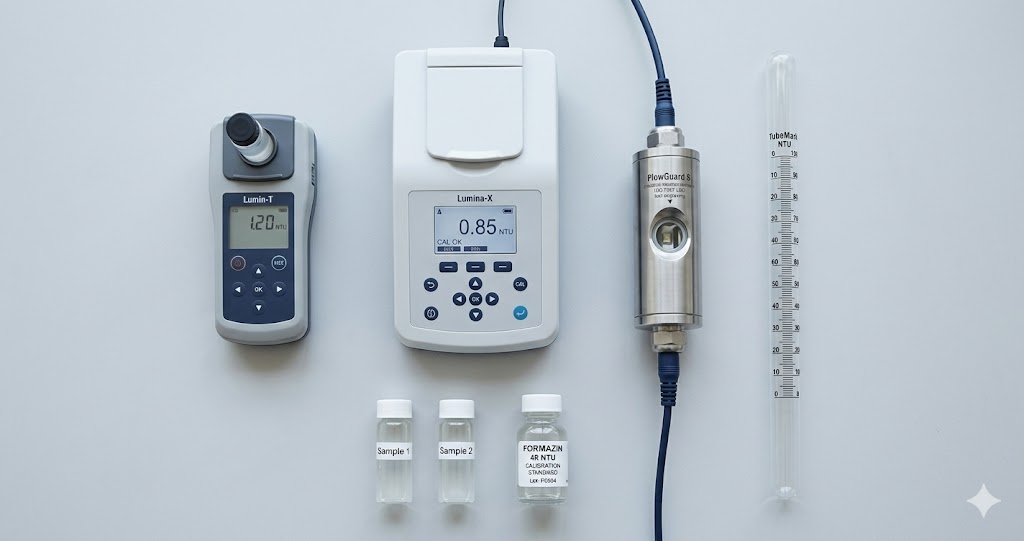
Turbidity meters span four common form factors. The table below summarizes typical accuracy, price, light source standard, and calibration cadence based on US pricing from Hach, Endress+Hauser, Thermo Scientific, and LaMotte.
| Type | Typical accuracy | Typical price (USD) | Best for | Light source standard | Calibration |
|---|---|---|---|---|---|
| Portable handheld | ±2% (0–1,000 NTU) | $1,500–$2,500 | Field surveys, spot-checks, well water sampling | Tungsten or LED | Formazin standards, monthly |
| Benchtop laboratory | ±2% (0–10,000 NTU) | $2,000–$5,000 | Lab QC, drinking water compliance, research | Tungsten (EPA Method 180.1) | Formazin standards, weekly |
| Inline / process | ±2 to ±5% (0–4,000 FNU) | $2,500–$6,000+ | Continuous monitoring, water treatment plants, food and beverage | LED (ISO 7027) | Auto or quarterly |
| Visual turbidity tube | ±0.5 NTU resolution | $30–$80 | Field estimation, education, emergency response | Visual comparison | Not applicable |
A portable handheld turbidity meter handles a field engineer spot-checking a sample at the source. A benchtop meter is the standard for drinking water utilities running EPA-method-compliant compliance samples. Inline meters solve the continuity problem at higher capital cost. Visual turbidity tubes are useful for rough estimates in the field but cannot generate the documentation that regulators expect.
Concerned about contaminants in your water?
Get water testing from KETOS KELP using EPA-certified methodology, results you can trust, backed by real data.
Order a Water Test →The best turbidity meters by use case
Best turbidity meter for drinking water utilities
Drinking water utilities testing finished water for EPA Method 180.1 compliance need a benchtop turbidity meter that meets EPA accuracy standards and produces traceable, reportable data. The Hach TU5200 EPA benchtop turbidimeter at around $3,500 is the standard for US municipal water systems. It uses a tungsten light source per EPA Method 180.1, ranges from 0 to 1,000 NTU at ±2% accuracy, and ships with formazin primary standards plus StablCal secondary standards for routine calibration verification. RFID-tagged calibration vials track verification history automatically.
Runner-up: the Hach 2100AN benchtop turbidimeter at around $3,800 for utilities that also need ratiometric measurement (more accurate at higher turbidity levels) or color-corrected measurement for source water with significant color.
Where to buy: Hach.com (manufacturer direct), Fisher Scientific, Cole-Parmer.
Best turbidity meter for wastewater and discharge monitoring
Wastewater treatment plants and industrial discharge facilities need continuous turbidity monitoring with NPDES permit-compliant logging. The Hach TU5300 sc inline turbidimeter at around $3,800 (sensor plus sc4500 controller required) measures from 0.001 to 4,000 NTU with ±2% accuracy and uses 360-degree x 90-degree detection geometry that improves accuracy on samples with bubbles or color. Auto-cleaning prevents biofilm fouling, which is the most common failure mode in wastewater applications.
Runner-up: the Endress+Hauser Turbimax CUS52D at around $2,500 for facilities standardizing on the Memosens digital sensor protocol across multiple parameters, including pH, conductivity, and dissolved oxygen.
Where to buy: Hach.com, Endress+Hauser US, Grainger industrial.
Best turbidity meter for industrial process and food and beverage
Food and beverage production lines, pharmaceutical manufacturing, and breweries need turbidity monitoring that handles process water quality verification, beer haze measurement, or filtration efficiency tracking. The Endress+Hauser Turbimax CUS52D at around $2,500 provides 0 to 4,000 FNU range with ISO 7027 compliance, sanitary fittings, and CIP (clean-in-place) compatibility for food-grade applications. Memosens digital connection eliminates electrical noise issues common in industrial environments.
Runner-up: the Hach SOLITAX sc inline sensor at around $3,200 for facilities needing combined turbidity and total suspended solids measurement in one sensor.
Where to buy: Endress+Hauser US, Hach.com.
Best turbidity meter for lab and research use
Lab and research environments need a benchtop turbidity meter with three-decimal NTU resolution, calibration via formazin primary standards, and data export for LIMS integration. The Thermo Scientific Orion AQUAfast AQ4500 at around $1,200 covers 0 to 4,000 NTU with ±2% accuracy, supports both EPA Method 180.1 (tungsten) and ISO 7027 (LED) modes by sensor swap, and exports to USB for downstream data handling.
Runner-up: the LaMotte 2020we at around $700 for budget-conscious labs that prioritize simplicity over LIMS integration.
Where to buy: Thermo Fisher Scientific, Cole-Parmer, LaMotte direct.
When a turbidity meter is not the right answer
A turbidity reading tells you how cloudy water is. Three classes of buyer regularly need more than that.
For homeowners testing well or drinking water
If you are a homeowner suspecting a problem with your well water or drinking water at the tap, a true turbidity meter is impractical for most household use. Real benchtop turbidimeters start at $1,500. A turbidity tube ($30 to $80) gives a visual estimate accurate to within 0.5 NTU but provides no documentation. More importantly, a turbidity reading tells you whether the water looks cloudy. It does not tell you whether the water contains lead, copper, nitrate, arsenic, PFAS, or microbial contamination, all of which can be present in clear water.
A KELP water test kit ships pre-paid sample bottles to your home, a lab using EPA-certified methodology analyzes the sample, and you receive a quantitative report covering turbidity alongside pH, lead at sub-ppb detection limits, six PFAS compounds, copper, nitrate, arsenic, and total hardness. For under $200, you get a contaminant-identification report rather than a single turbidity number. Order a KELP test kit →
For utilities and schools managing drinking water compliance
Drinking water utilities and school districts running compliance programs need continuous turbidity data integrated with the parameters that drive public health and regulatory documentation: free chlorine, total chlorine, pH, conductivity, lead, and copper. A standalone benchtop or inline turbidity meter generates accurate point-in-time readings but does not produce the multi-parameter, time-stamped, audit-ready record that the EPA Surface Water Treatment Rule and the 2024 Lead and Copper Rule Improvements expect.
Continuous water quality monitoring platforms like KETOS SHIELD generate EPA-method-compliant readings across pH, conductivity, free chlorine, total chlorine, lead, copper, and 25+ additional chemistry parameters that round out the compliance dataset alongside a dedicated turbidity meter. SHIELD does not measure turbidity directly; pair an inline turbidimeter with SHIELD to get the full Surface Water Treatment Rule and Lead and Copper Rule Improvements parameter set in one centralized record. A 140-day SHIELD deployment at Goddard School in New Braunfels, Texas measured lead and 29 other water quality parameters continuously across nine sampling locations, generating 596,000 data points in support of the school’s lead and copper compliance program. Schedule a SHIELD demo →
For industrial facilities running multi-parameter processes
For a single inline turbidity measurement at one point in a process line, a Hach TU5300 sc or Endress+Hauser Turbimax CUS52D does the job. Multi-parameter facilities often need more than just turbidity:
- Chemistry parameters (pH, chlorine, conductivity, lead, copper) reported alongside the turbidity number
- Centralized data across multiple sample points or sites
- Automated calibration and self-diagnostic alerts
- SCADA or DCS integration for real-time process control
- Audit-ready, EPA-method-compliant data exports
A KETOS SHIELD deployment supplements a dedicated turbidity meter with a continuous-monitoring platform measuring pH, conductivity, free chlorine, total chlorine, lead, copper, and 25+ additional chemistry parameters. Turbidity stays on the inline turbidimeter; the chemistry data consolidates onto SHIELD for one integrated compliance and process record.
What to look for when buying a turbidity meter
Five specs separate a turbidity meter that produces compliance-grade data from one that drifts after a few weeks.
NTU range and resolution
Drinking water applications typically operate at 0 to 1 NTU and require resolution to 0.01 NTU or better. Wastewater and surface water applications can range from 1 to 4,000 NTU. Industrial process applications vary widely. Match the meter’s range and resolution to the actual NTU values you expect; a 0 to 4,000 NTU meter used at 0.5 NTU readings will struggle with precision.
Light source standard (EPA Method 180.1 vs ISO 7027)
EPA Method 180.1 uses a tungsten lamp at 400 to 600 nm and is required for US drinking water compliance reporting. ISO 7027 uses an 860 nm infrared LED and is the international standard, with better tolerance for colored samples. Most modern meters offer both modes via interchangeable sensor heads. If your application includes US drinking water compliance, the meter must support EPA Method 180.1.
Calibration and formazin standards
Turbidity calibration uses formazin primary standards (the reference suspension defined by EPA and ISO) or stabilized formazin substitutes like StablCal or AMCO Clear that maintain calibration value longer. Primary formazin standards expire 24 hours after preparation and are typically used only for initial certification. Secondary standards last 6 to 24 months but require periodic verification against primary formazin. Calibration frequency depends on application: drinking water utilities calibrate weekly, lab QC daily, industrial process per EPA-Method or vendor recommendation.
Sample handling and bubble removal
Air bubbles in the sample produce false high readings. Quality benchtop meters include sample degassing (vacuum or sonication), and quality inline meters use ultrasonic cleaning or air injection to prevent fouling. For low-turbidity samples (drinking water at less than 1 NTU), bubble interference can exceed the actual turbidity signal. Verify how the meter handles bubbles before committing to a model for low-NTU work.
Frequently asked questions about turbidity meters
What does a turbidity meter measure?
A turbidity meter measures the cloudiness of water by detecting how much light is scattered by suspended particles. The reading is reported in nephelometric turbidity units (NTU) per EPA Method 180.1 or formazin nephelometric units (FNU) per ISO 7027. Higher readings mean more suspended material in the water, including silt, clay, organic matter, and microbes.
What is a normal turbidity reading for drinking water?
The EPA’s primary drinking water standard requires utilities to maintain finished water below 1 NTU in 95% of samples and never above 5 NTU. Treated municipal water typically reads 0.05 to 0.3 NTU. Above 5 NTU the water often appears visibly cloudy. Above 100 NTU, turbidity becomes obvious without measurement.
How accurate are turbidity meters?
Accuracy depends on the meter type and NTU range. Benchtop laboratory meters operate at ±2% across 0 to 10,000 NTU. Portable handheld meters reach ±2% across 0 to 1,000 NTU. Inline industrial meters operate at ±2 to ±5% depending on the application. Real-world accuracy depends heavily on calibration freshness, formazin standard age, and sample handling (bubbles, color, temperature).
What is the difference between NTU and FNU?
NTU (nephelometric turbidity units) is the unit used when measurement follows EPA Method 180.1, which uses a tungsten lamp. FNU (formazin nephelometric units) is the unit used when measurement follows ISO 7027, which uses an 860 nm infrared LED. The two standards produce slightly different readings on the same sample because particle scattering varies with wavelength. NTU is required for US drinking water compliance; FNU is the international standard.
How do you calibrate a turbidity meter?
Most benchtop turbidity meters calibrate using formazin primary standards or stabilized substitutes (StablCal, AMCO Clear) at three or four NTU points (typically 20 NTU, 200 NTU, 800 NTU, and a low-range standard for sub-1 NTU work). Place each standard in the meter, allow the reading to stabilize, and accept the value. Fresh formazin primary standards must be used within 24 hours. Stabilized standards are valid for 6 to 24 months depending on the manufacturer.
Do home water filters reduce turbidity?
Most household carbon filters do not reduce turbidity meaningfully. Sediment filters (5-micron or finer) reduce turbidity from sediment, rust, or silt. Reverse osmosis systems remove most suspended particles. UV systems do not reduce turbidity, and high turbidity can prevent UV from working effectively. If your tap water is consistently above 1 NTU, the right filter depends on the source of the turbidity, which a multi-parameter water test can identify.
What is EPA Method 180.1?
EPA Method 180.1 is the US Environmental Protection Agency’s reference method for measuring turbidity in drinking water. It specifies a tungsten lamp light source at 400 to 600 nm color temperature, 90-degree detection geometry, formazin calibration standards, and reporting in NTU. Drinking water utilities are required to use Method 180.1-compliant meters for compliance reporting under the Surface Water Treatment Rule.
When should I use continuous turbidity monitoring instead of grab samples?
A grab sample measures turbidity at the moment you collect the sample. Continuous monitoring tracks turbidity around the clock and flags excursions you would miss between sampling events. Use continuous monitoring for drinking water treatment plants (required by EPA SWTR), distribution-system monitoring, NPDES wastewater discharge compliance, food and beverage production where turbidity affects product quality, and any application where missing a turbidity excursion has consequences. Inline turbidimeters handle the turbidity reading itself; multi-parameter platforms like KETOS SHIELD handle the chemistry parameters (pH, free chlorine, lead, copper, conductivity) that pair with turbidity for full compliance and process documentation.
Choosing your turbidity meter: a 60-second decision flow
If you are a drinking water utility running EPA Method 180.1 compliance, a Hach TU5200 benchtop at around $3,500 is the standard. If you also need continuous distribution-system monitoring, integrate inline turbidity into a multi-parameter platform.
If you are running wastewater treatment or NPDES discharge monitoring, a Hach TU5300 sc inline at around $3,800 with a sc4500 controller covers continuous monitoring at the precision required for permit compliance.
If you are operating a food and beverage production line, pharmaceutical facility, or brewery, an Endress+Hauser Turbimax CUS52D at around $2,500 with sanitary fittings handles process water quality verification.
If you are a lab or research environment, a Thermo Scientific Orion AQ4500 at around $1,200 provides benchtop accuracy with both EPA Method 180.1 and ISO 7027 modes.
If you are a homeowner concerned about your well or tap water, a turbidity tube provides a rough visual estimate, but a multi-parameter lab analysis identifies what is actually in your water.