



Updated November 2026
Cooling tower blowdown sent to a river, lake or storm drain needs an NPDES permit, either an individual permit or coverage under a state general permit. Blowdown sent to the sanitary sewer falls under the local utility’s pretreatment program, which sets local limits and decides whether the facility needs an industrial wastewater discharge permit. Either way, the permit lists what to test and how often.
What is cooling tower blowdown?
As water evaporates in a cooling tower, the minerals it carries stay behind and concentrate. Blowdown is the water bled off to keep that concentration in range. North Carolina’s general permit defines it as “the minimum discharge of recirculating water for the purpose of discharging materials contained in the water.” Blowdown carries those concentrated minerals plus the treatment chemicals added to the loop, such as biocides and scale and corrosion inhibitors.
Do I need an NPDES permit or a sewer permit for blowdown?
It depends on where the water goes:
| Where blowdown goes | What you need | Who issues it |
|---|---|---|
| River, lake or storm drain | NPDES permit: individual, or coverage under a state general permit | The state environmental agency (EPA where a state has no delegated program) |
| Sanitary sewer | Approval under the utility’s pretreatment program (40 CFR 403), often an industrial wastewater discharge permit | The wastewater utility |
A storm drain is not a shortcut. Fairfax County, Virginia, treats an unpermitted cooling tower discharge to the storm system as an illicit discharge, and notes that potable makeup water often already carries more copper and zinc than Virginia’s cooling water general permit allows.
Concerned about contaminants in your water?
Get water testing from KETOS KELP using EPA-certified methodology, results you can trust, backed by real data.
Order a Water Test →Which states have general permits that cover blowdown?
Examples, each with its own limits and sampling schedule:
- Arkansas, ARG250000 (non-contact cooling water, cooling tower blowdown and boiler blowdown; renewal effective December 1, 2022): flow up to 0.5 million gallons per day, limits for COD, TSS, oil and grease, pH 6.0 to 9.0 and temperature, sampled twice a month.
- North Carolina, NCG500000 (December 1, 2025 to November 30, 2030): flow, temperature, total residual chlorine, pH and COD, sampled twice a year.
- Virginia, VAG25 (noncontact cooling water discharges of 50,000 gallons per day or less): total residual chlorine 0.011 mg/L, copper 9.0 µg/L, zinc 120 µg/L and pH 6.0 to 9.0 in fresh water, sampled quarterly.
- Ohio: Ohio EPA proposed a first statewide general permit for data centers, OHD000001, covering cooling tower blowdown. In July 2026 it decided not to finalize the permit and said it will review data center discharge permits individually.
Does blowdown to the sewer make a data center a Significant Industrial User?
Ask your utility early, because the utility makes that call. Under 40 CFR 403.3(v), a Significant Industrial User includes any industrial user that discharges an average of 25,000 gallons per day or more of process wastewater to the treatment plant, “excluding sanitary, noncontact cooling and boiler blowdown wastewater.” Cooling tower blowdown is not on that exclusion list, and the utility, as the control authority, decides how it counts. A utility can also designate a smaller user as significant if it finds the discharge could affect the treatment plant. Loudoun Water, for example, uses an industrial waste survey and may sample to decide whether a facility needs a wastewater discharge permit.
What is tested in cooling tower blowdown, and why?
| Parameter | Why it is tested | Example limit |
|---|---|---|
| Conductivity and dissolved solids | They rise with every cycle of concentration | Ohio’s proposed data center permit: 1,500 mg/L dissolved solids, monthly (never finalized) |
| pH | Scale and corrosion control; protects streams and sewers | 6.0 to 9.0 (Virginia, Arkansas); 5.0 to 10.0 to the Loudoun Water sewer |
| Chlorine or bromine residual | Biocide residual is toxic to aquatic life | 0.011 mg/L total residual chlorine (Virginia) |
| Copper and zinc | Corrosion of tower metals, zinc-based inhibitors and potable makeup water | To a stream: copper 9.0 µg/L, zinc 120 µg/L (Virginia). To the sewer: copper 5.1 mg/L, zinc 11 mg/L (Loudoun Water) |
| Phosphate | Scale and corrosion inhibitor, and a nutrient in receiving water | Loudoun Water approval needed above 8 mg/L total phosphorus |
| Molybdenum | Corrosion inhibitor | 0.70 mg/L (Loudoun Water) |
| Chromium | A former inhibitor; hexavalent chromium treatment chemicals are banned in comfort cooling towers (40 CFR 749.68) | 15 mg/L total chromium (Loudoun Water) |
| Temperature | Warm discharge harms streams and sewer biology | 40 °C at the Loudoun Water treatment plant |
| TSS, oil and grease, COD | General effluent quality | TSS 35 mg/L monthly average (Arkansas) |
Limits to a stream are much tighter than limits to a sewer, because the sewer water is treated again at the plant.
How often does blowdown have to be sampled?
The permit sets the schedule. Examples:
- Quarterly grab samples: Virginia VAG25.
- Twice a year: North Carolina NCG500000.
- Twice a month: Arkansas ARG250000.
- Daily pH and weekly dissolved solids: proposed in Ohio’s data center permit before it was withdrawn.
Tower chemistry changes with every cycle, load swing and chemical feed, so many sites track it continuously and use the permit samples to confirm.
Where KETOS fits
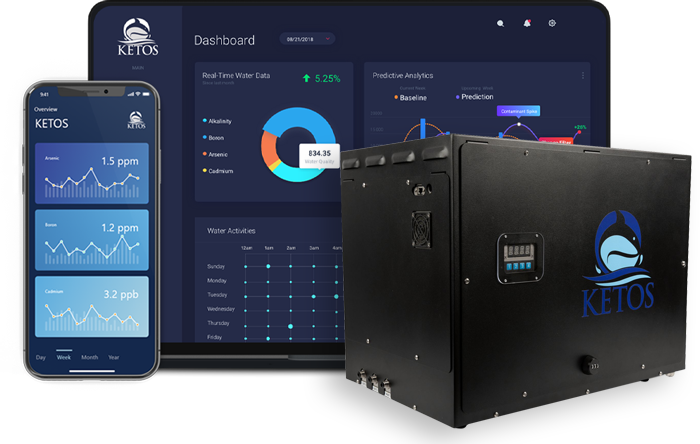
KETOS SHIELD monitors blowdown and makeup water on site: pH and conductivity about every minute, and copper, zinc, molybdenum, hexavalent chromium, free chlorine, orthophosphate, hardness and alkalinity about hourly, within ±10% of certified lab results. Operators get the data and alerts on a dashboard or in SCADA, and see a drift toward a limit before the next permit sample. SHIELD works alongside the certified lab your permit names.
For lab analysis, the KETOS KELP outfall package tests discharge samples with documented chain of custody and a digital report in 5 to 7 business days. See water quality monitoring for data centers and how AI data centers manage discharge.
Common questions
Can I discharge cooling tower blowdown to a storm drain?
Only with NPDES permit coverage. A storm drain leads to surface water, so an unpermitted blowdown discharge there is an illicit discharge.
Does the steam electric rule (40 CFR 423) apply to data centers?
No. 40 CFR 423 covers steam electric power plants. Its cooling tower blowdown limits are a well-known benchmark: free available chlorine 0.2 mg/L average and 0.5 mg/L maximum, total chromium 0.2 mg/L and total zinc 1.0 mg/L.
What happened to Ohio’s data center general permit?
Ohio EPA proposed general permit OHD000001 for data center discharges, including cooling tower blowdown, and decided in July 2026 not to finalize it. Ohio data centers that discharge directly to surface water now apply for individual permits.
Sources: 40 CFR 403; 40 CFR 749; 40 CFR 423.13; Arkansas ARG250000 fact sheet; North Carolina NCG500000; 9VAC25-196-70; Loudoun Water pretreatment program; Fairfax County cooling towers; Circle of Blue, July 2026.