


By Ganesh Hegde, Director of Data Science and AI Strategy, KETOS, Inc.
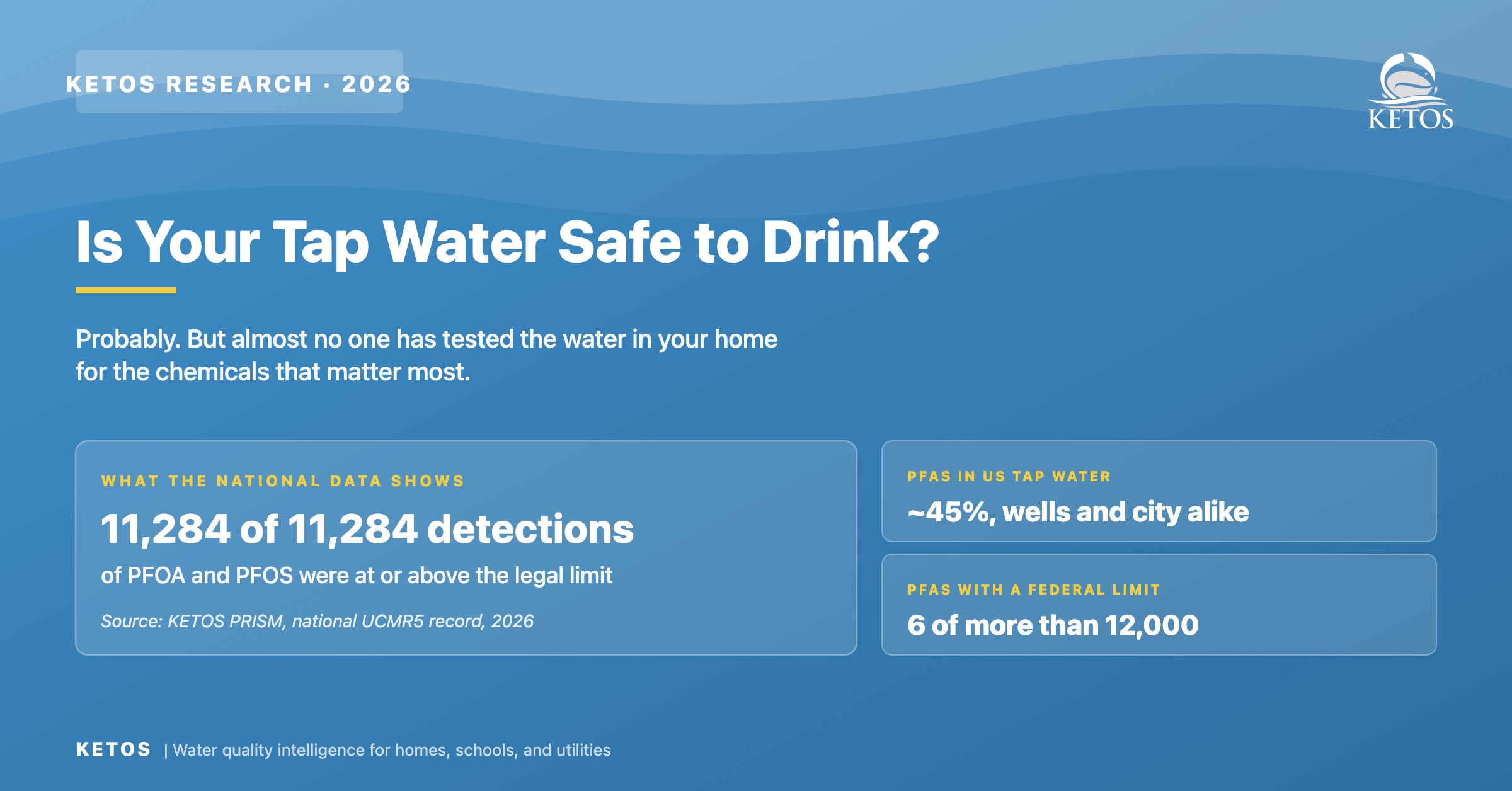
Think about the last glass of water you drank from your tap. You probably did it on autopilot: turned the handle, filled the glass, drank. That is ordinary trust. You assume the water is clean, and that someone is making sure it stays that way. It raises a question most people never actually ask: is your tap water safe to drink?
The system is real, and it sets limits for the contaminants we have understood for decades. It also misses constantly: the federal record holds more than two million drinking-water violations since 2020. A system already straining on the threats it was built for was never going to catch the one in this article, which it does not even test for.
The story narrows when you look hard at one specific threat. We spend our days inside the data on that threat, and it tells a more uncomfortable story than the trust most people carry around.
When PFAS shows up, it shows up high
You have probably heard of PFAS, the “forever chemicals” in nonstick pans, fast-food wrappers, stain-resistant carpet, and firefighting foam. Everyone repeats that they are everywhere, and the word has gone numb from overuse. The number that matters is what turns up the moment anyone measures them in drinking water.
We hold the complete national record of federal PFAS testing in drinking water. For PFOA and PFOS, the two PFAS that carry a hard legal safety limit, we checked every detection in the country, all 11,284 of them. Every one sat at or above the limit. Most contaminants spend their time drifting through a low, unremarkable range; these two skipped it and went straight past the line.
That is worth sitting with, because it dismantles the way people reassure themselves. The instinct is to assume that a little is probably fine. With PFOA and PFOS, every amount that turns up is already too much; they arrive over the line or stay invisible. Your water comes back one of two ways: clean below what the test can see, or already past the limit.
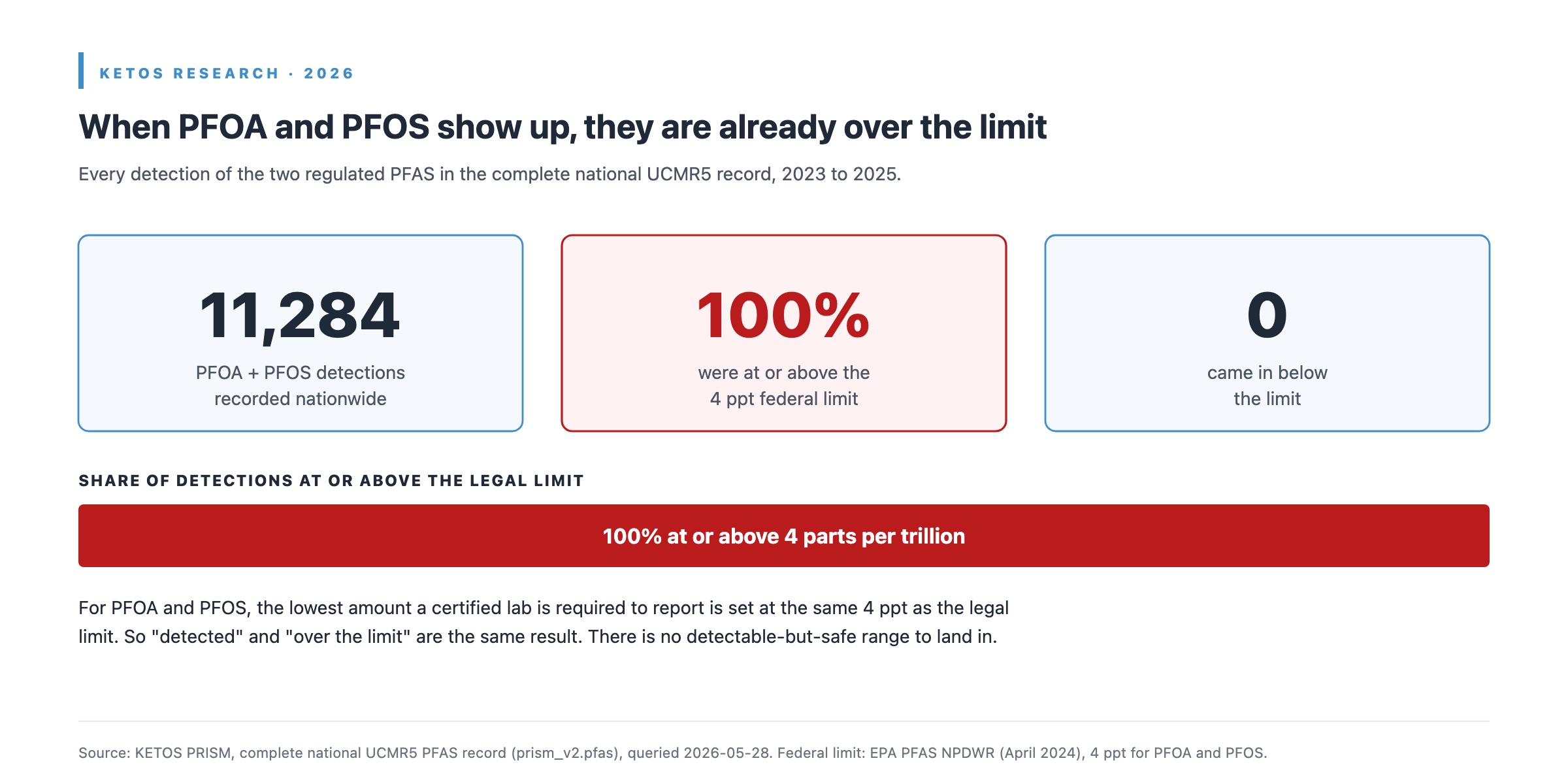
Every PFOA and PFOS detection in the national record was at or above the legal limit. Source: KETOS PRISM, UCMR5, 2026.
Why the all-or-nothing pattern? Part of it is mechanical: the lowest amount a certified lab is required to report for these two chemicals sits right at the legal limit. So the moment your water shows any PFOA or PFOS at all, it is already over it. The data hands you a clean yes or no, and a yes means too much.
This problem lives closer to home than you think
The reflex after a fact like that is to file it under someone else’s problem, an industrial town or an old city, somewhere upriver of your own tap.
The largest independent study to date points the other way. The U.S. Geological Survey collected water straight from kitchen faucets across the country and found PFAS in about 45 percent of samples. Because the lab covered only 32 of the more than 12,000 known PFAS, treat 45 percent as the floor. Then the researchers ran the comparison that undoes the stories people tell themselves, private wells against public city supplies, and found about the same PFAS in both.
If you are on city water, the treatment plant in that study delivered PFAS anyway. If you draw from a private well, the water carried it too, even though nobody adds anything to a well. Both shortcuts people use to call their own water safe collapsed in the one large dataset that checked.
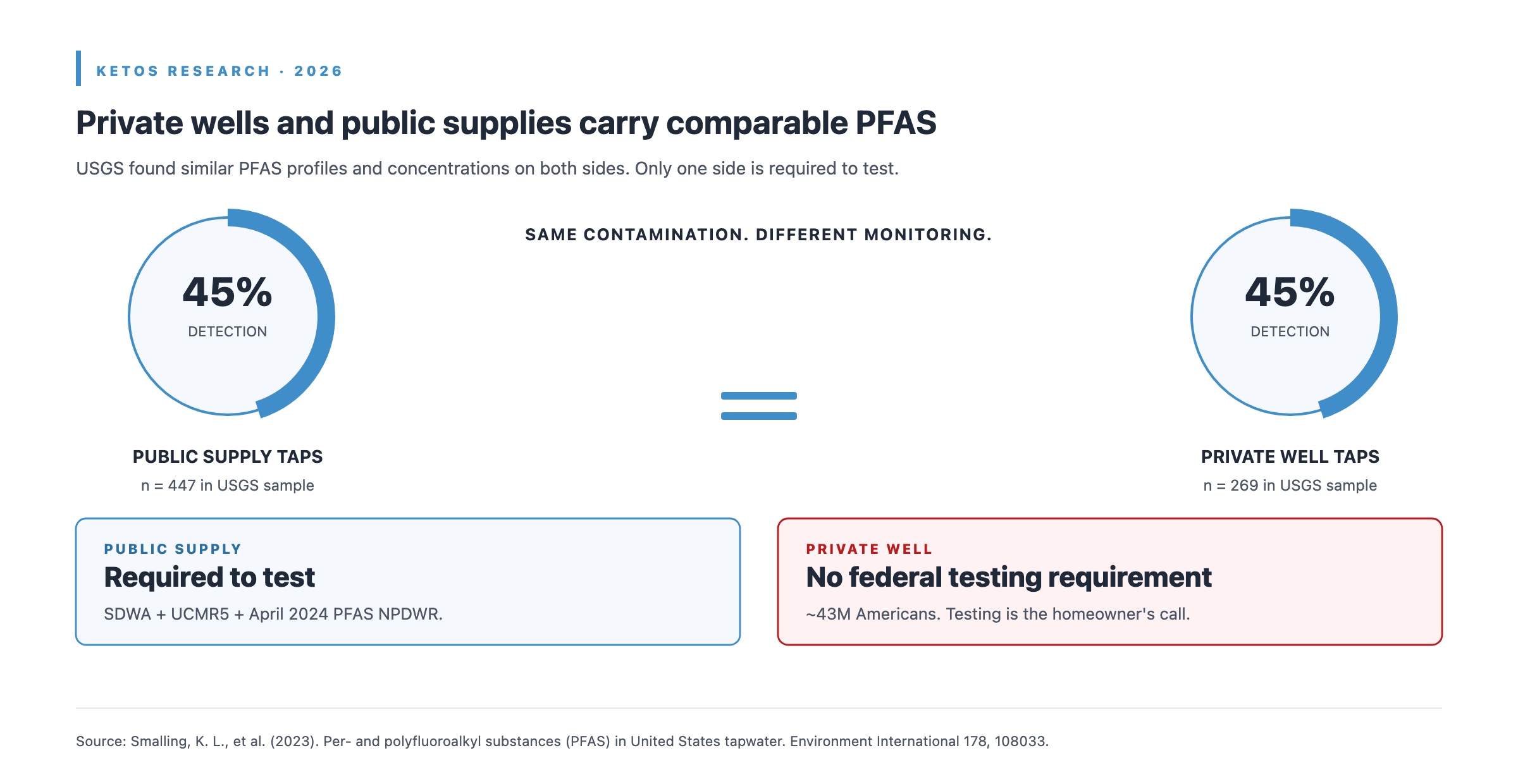
Private wells and public supplies carried comparable PFAS. Only one side is required to test. Source: USGS Smalling et al. (2023).
Concerned about contaminants in your water?
Get water testing from KETOS KELP using EPA-certified methodology, results you can trust, backed by real data.
Order a Water Test →PFAS rarely comes alone, and it runs high
When PFAS appears, it usually brings company. In the national record, more than two-thirds of the systems with any detection carried two or more PFAS in the same water, and the health research shows these exposures stack. The amounts run far past the line, too: the highest PFOS result on record reached about 122 times the legal limit, and the highest PFOA about 59 times.
Your body holds onto these. They earn the name forever chemicals by persisting, in the environment and in you, building up over years. The National Academies of Sciences links them to kidney cancer, a weakened immune response, lower birth weight in infants, and higher cholesterol.
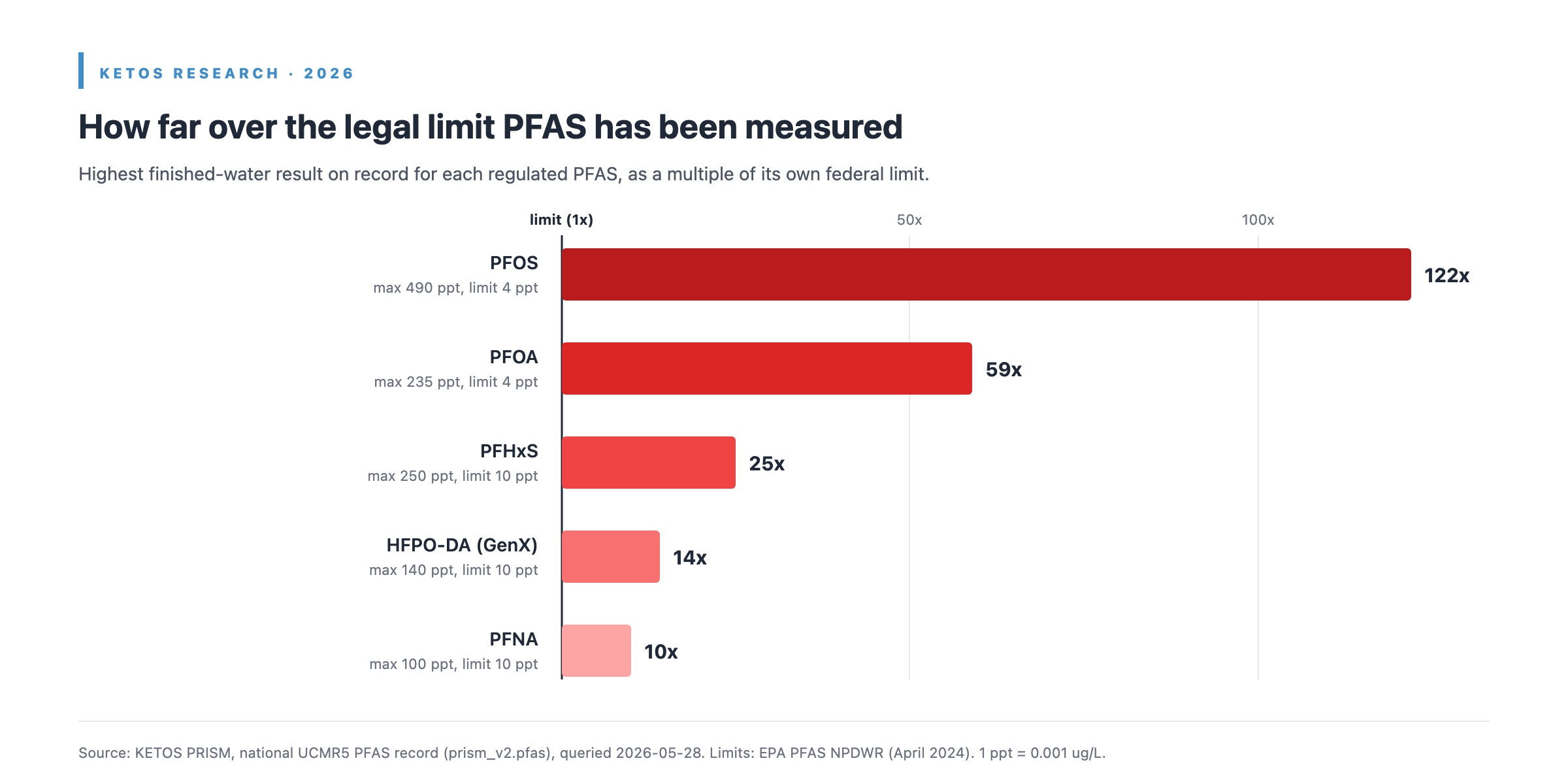
When regulated PFAS show up, the worst cases run far past the limit. Source: KETOS PRISM, UCMR5, 2026.
Why your own tap is still an open question
Everything above is the national picture. Your own kitchen is still an open question, for one plain reason: almost certainly, your water has never been tested for these chemicals.
The federal program regulates six PFAS out of more than twelve thousand, samples larger public systems about once every five years, and skips private wells entirely. PFAS slips past every sense you have, tasteless and odorless and clear as the water itself. The one place it might surface, if your system was even sampled, is a water-quality report that sits unread in most inboxes. So the calm you feel about your tap rests on a blank space where a test should be. You have been assuming, and the assumption has gone unchecked.
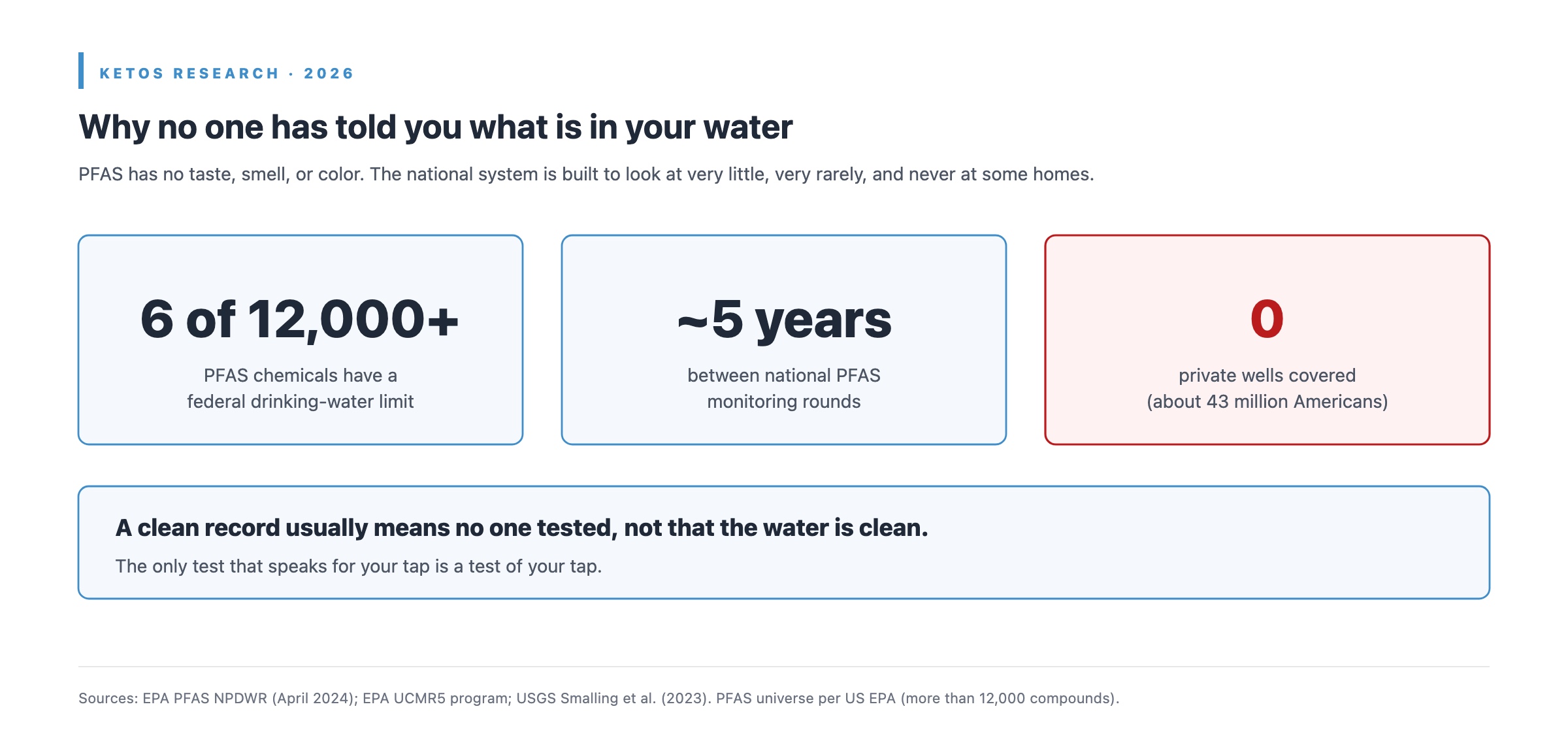
A clean record usually means no one tested, not that the water is clean. Sources: EPA PFAS NPDWR; UCMR5; USGS.
How to find out if your tap water is actually safe
All of that points to one move you can actually make, and it puts you in charge. The regulations have lagged; the measurement has caught up, and that is the part KETOS builds. The official system samples rarely, by hand, on a five-year clock. KETOS builds measurement the opposite way, in two forms. SHIELD is an autonomous system that monitors water chemistry continuously, the antidote to a five-year snapshot, for the utilities, schools, and facilities that supply everyone else. KELP is the lab-services arm, a complete, lab-grade test of a sample from your own tap or well.
Your assumption was only ever missing one thing: information about your particular water. The official system offers an average, a five-year snapshot, or for most households silence. A direct measurement of your own tap turns that into a fact.
You can settle this for your own household today. KELP tests your water using EPA-approved methodology, measures PFAS and the other contaminants that matter, and returns a documented result you can act on and that an inspector, lender, or buyer will recognize. For a quick read on your area first, check the PFAS grade for your zip code, but a map is a forecast and a test is the answer.
What makes that worth doing is that PFAS is one of the few contaminants you can decisively remove at home, once a test tells you it is there and how much. The remedy already exists; the piece you usually lack is information about your own water. The problem is solvable, and a measurement is what unlocks the solution.
And if the health reasons leave you unmoved, there is a financial one most people never connect. When water contamination becomes known in an area, home values fall, by roughly 1.4 to 2.8 percent on an affected public system and 6.4 to 7.4 percent on a contaminated private well. The price moves on disclosure, when the problem becomes known, rather than when it begins. A homeowner holding a recent test result gets to frame the news. Hear it first from a buyer’s inspector, and you are negotiating from behind. We laid out that whole body of evidence in a companion piece on how water quality affects real estate prices. The same test that protects your family protects the largest asset you own.
So, is your tap water safe to drink?
Probably. That is a true answer, and it is also a strange thing to bet your family’s health and the value of your home on, when “probably” is just another way of saying you have never actually looked. The chemicals the data keeps finding stay silent and invisible, and the one report that might name them rarely reaches you. What turns “probably safe” into “safe” is a measurement.
Leave the system to the regulators. Your tap is yours to settle, with one question: is my water actually clean, or have I only been assuming it? A single test answers it.
Find out what is in your water with KELP.
Frequently asked questions
Is tap water safe to drink?
For most large public water systems and the contaminants regulated for decades, US tap water is generally safe to drink. But the national data shows real gaps. PFAS “forever chemicals” turn up in about 45 percent of US tap water, and when the two regulated ones are detected they are almost always above the federal safety limit. Roughly 43 million Americans on private wells are not covered by federal monitoring at all, and most taps have never been tested for these chemicals. The only way to confirm a specific tap is safe is to test that water directly.
How do I know if my tap water is safe?
You cannot know from a regional map or a utility-wide average, because they do not measure your specific water. Read your water system’s annual Consumer Confidence Report for any recent violations, then test your own tap or well with a certified lab method for the contaminants that matter, including PFAS, lead, and nitrate. A direct test is the only thing that turns an assumption into a fact.
How do I test my tap water at home?
Collect a sample from your own tap or well and have it analyzed by a lab using certified methods, such as EPA Methods 533 and 537.1 for PFAS. KELP provides this testing using EPA-approved methodology and returns a documented result that inspectors, lenders, and buyers recognize. At-home strip kits can flag a few basics but do not measure PFAS or give a defensible lab result.
How common is PFAS in tap water?
PFAS is common. A USGS study found PFAS in about 45 percent of US tap water samples, at similar rates in private wells and public supplies, while testing for only 32 of more than 12,000 PFAS. In the national regulatory record, every detection of PFOA and PFOS, the two PFAS with a federal limit, came in at or above that limit, so when these chemicals are present they are rarely present in small amounts.
What is PFAS in water?
PFAS, per- and polyfluoroalkyl substances, are a family of more than 12,000 manufactured “forever chemicals” used in nonstick coatings, food packaging, and firefighting foam. They do not break down in the environment or the body, and exposure is linked to kidney cancer, weakened immune response, lower infant birth weight, and raised cholesterol. They reach drinking water from industrial sites, landfills, and firefighting-foam use.
Is there PFAS in my tap water?
There is a meaningful chance. A USGS study found PFAS in about 45 percent of US tap water samples, in private wells and public supplies alike. National monitoring covers only larger public systems, about once every five years, and only a handful of PFAS, so the absence of a reported detection does not mean your water is free of PFAS. A direct PFAS test of your tap or well is the only way to know.
How do I remove PFAS from water?
Reverse osmosis removes more than 99 percent of PFOA, PFOS, and most other PFAS when the unit is built for it. Granular activated carbon and ion exchange resins also remove PFAS, with different tradeoffs in cost and maintenance. Test your water first so you can size the treatment to what is actually present.
Do water filters remove PFAS?
Some do, many do not. Look for filters certified to NSF/ANSI Standard 53 for PFAS reduction or Standard 58 for reverse osmosis; an ordinary carbon pitcher filter is not reliable for PFAS. Reverse osmosis and properly specified activated carbon or ion exchange are the dependable options.
Does reverse osmosis remove PFAS?
Yes. A reverse osmosis system specified for it removes more than 99 percent of PFOA, PFOS, and most other PFAS in a single pass, which makes under-sink reverse osmosis one of the most effective home options.
Does boiling water remove PFAS?
No. Boiling does not remove PFAS and slightly concentrates it as water evaporates. Use reverse osmosis, activated carbon, or ion exchange instead.
Are private wells safe to drink?
Private wells are not safer by default, and they are not covered by federal monitoring. USGS found roughly the same PFAS in private wells as in public supplies, and about 43 million Americans on wells have no required testing at all. If you are on a well, testing is entirely your responsibility, and it should cover PFAS, lead, nitrate, and bacteria.
Sources cited
- KETOS PRISM, complete national UCMR5 PFAS record (prism_v2.pfas), queried 2026-05-28: 11,284 PFOA/PFOS detections, all at or above the 4 ppt limit.
- KETOS PRISM, US drinking-water violations (prism_v2.sdwa), queried 2026-05-28: 2,129,211 SDWA violations since 2020.
- EPA PFAS National Primary Drinking Water Regulation (April 2024)
- USGS, Smalling et al. (2023), PFAS in United States tapwater, Environment International
- National Academies of Sciences (2022), Guidance on PFAS Exposure, Testing, and Clinical Follow-Up
- KETOS companion article: water quality and real estate prices