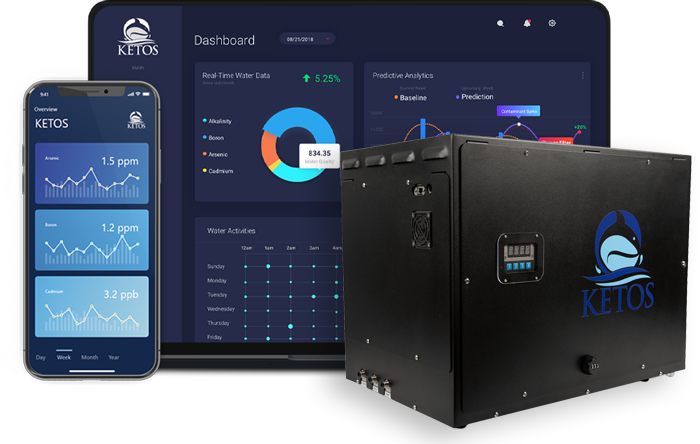




Lead in water testing services split into three methodologies that are not interchangeable: continuous monitoring (real-time, automated, suited to utilities and large institutions), certified lab analysis (point-in-time, EPA-method-aligned, suited to compliance windows and one-time testing), and field test kits (indicator-only, homeowner DIY, not accepted for regulatory compliance). This guide compares the three on detection limit, cadence, regulatory acceptability, and total cost across a multi-year compliance window, then maps each institutional buyer profile (utility under the EPA Lead and Copper Rule Revisions, school district under LCRR or 3T, hospital, multi-tenant building, industrial facility) to the right testing service combination. KETOS is a lead in water testing company that delivers both continuous monitoring through SHIELD and lab analysis using EPA-certified methodology through KELP, so the LCRR data record can come from a single vendor relationship rather than two separate ones. Use this guide to qualify any lead in water testing services vendor, KETOS included, before signing.
Why the lead testing model matters more than the price
Lead has no safe exposure level for children, per the U.S. Centers for Disease Control and Prevention. The EPA’s current action level for lead in public drinking water is 15 ppb, and under the Lead and Copper Rule Improvements (LCRI) finalized in October 2024 that level drops to 10 ppb. Roughly 9 to 10 million U.S. homes are still served by lead service lines, and a parallel 10-year replacement timeline is now a federal requirement. For a utility, school district, or building owner, choosing the wrong testing methodology means either failing a regulator’s data request, missing a contamination event between scheduled samples, or buying expensive monitoring you do not need.
For institutional buyers, lead testing is a compliance program, not a product purchase. The decision rarely comes down to “which lab is cheapest.” It comes down to: what cadence of data do regulators expect, what detection limit does our risk profile demand, and how do we generate auditable records that survive a state primacy agency’s review.
For homeowners and renters, the question is simpler but still load-bearing: should I trust a colorimetric strip from a hardware store, or do I need a lab to put a number on a federal form. The honest answer is that a lab analysis is the only testing modality whose results a school nurse, a pediatrician, a real estate buyer, or a remediation contractor will actually rely on. KETOS covers this audience through KELP’s home water test kit, a lab service that uses EPA-certified methodology and returns digital results in 5 to 7 days with no subscription.
The three lead-in-water testing methodologies
Before evaluating any specific service, frame the decision by methodology. The three categories below are not interchangeable. They differ on detection limit, cadence, data format, regulatory acceptability, and total cost over a multi-year compliance window.
1. Continuous monitoring
Sensors installed in the distribution system or at point-of-entry locations measure lead and related water-chemistry parameters on an ongoing schedule (typically multiple times per day) and stream the data to a central platform. Detection limits at the sub-ppb range are achievable with ICP-MS-class chemistry. The output is time-series data with thresholds and alerts.
When this methodology is the right call: public water utilities under LCRR distribution-system monitoring; school districts in older buildings with elevated risk profiles; hospitals and dialysis centers; large multi-tenant buildings with internal plumbing of unknown vintage; industrial facilities where lead can enter from raw materials, plating, or solder.
What it requires: a sensor platform with EPA-method-aligned detection, a data layer that produces compliance-grade exports (chain-of-custody substitutes are not yet universally accepted, so most LCRR-regulated utilities still pair continuous monitoring with periodic certified-lab samples), and field-tested operation in real distribution-system water (chlorine, scale, biofilm, and pH variation degrade many lab-grade chemistries when run continuously).
The KETOS approach to this methodology is SHIELD, which delivers continuous, lab-accurate, EPA-compliant lead measurements alongside more than 30 other chemistry parameters relevant to lead-in-water programs (copper, pH, free and total chlorine, conductivity, alkalinity, and others). Pairing lead with those co-parameters matters more than it sounds: lead solubility in distribution-system water is governed by pH, alkalinity, and corrosion inhibitor dose. A continuous monitoring platform that captures lead in isolation cannot tell you why the value moved. SHIELD captures the chemistry context that makes the lead reading actionable.
For context on how continuous monitoring fits the regulatory picture, see our explainer on the Lead and Copper Rule and how technology supports compliance and our piece on data and technology to replace lead service lines faster.
2. Certified lab analysis
A water sample is collected on a defined protocol (first-draw stagnant samples for residential lead, sequential samples for plumbing characterization, distribution-system tap samples for LCRR), shipped to an accredited environmental laboratory and analyzed by EPA Method 200.8 or 200.9 (ICP-MS or graphite furnace atomic absorption). Results return as a single-time-point reading with chain-of-custody documentation, typically within 5 to 14 days.
When this methodology is the right call: compliance-driven testing windows where a regulator requires a certified-lab data point with chain of custody (LCRR sampling, EPA 3T testing in schools and child care facilities, real-estate transactions, post-remediation verification, single-family homeowner concern); programs that need a baseline before deciding whether continuous monitoring is justified; multi-parameter analysis where lead is one of several contaminants on the test list (heavy metals, PFAS, disinfection byproducts).
What it requires: EPA-approved methods (Method 200.8 ICP-MS or 200.9 graphite furnace atomic absorption for lead), validated chain of custody, lab accreditation that meets EPA’s data-quality requirements (state primacy-agency or equivalent), and a turnaround the program can absorb. Accredited environmental labs in this space include national providers such as Eurofins and Pace, alongside vertically integrated water-quality companies that run their own labs.
The KETOS approach to this methodology is KELP, which uses EPA-certified methodology (including EPA Method 200.8 for lead) and returns lab results in 5 to 7 days covering lead alongside heavy metals, PFAS, and 35+ other contaminants in a single multi-parameter package. The multi-parameter angle matters for institutional buyers: LCRR data fields require lead and copper paired (the rule is the Lead and Copper Rule), and many state primacy programs require additional disinfectant residual and corrosion-control parameters in the same dataset. A single-vendor multi-parameter test fits the LCRR data model without requiring multiple lab relationships.
3. Field test kits
A consumer-grade kit with colorimetric strips, a small chemistry module, or a smartphone-readable optical reagent. Reads in minutes. Detection limit typically sits at or above the EPA action level (15 ppb), with poor accuracy below that.
When this methodology is the right call: a homeowner who wants a screening read before deciding whether to commission a lab test; a renter checking baseline conditions; a journalist or community organizer establishing whether lead is plausibly present at a sample of taps. Field kits are not accepted for LCRR compliance, 3T compliance, real-estate transactions, or any program that requires chain-of-custody data.
We do not recommend specific consumer field-kit brands in this guide because their detection limits and false-positive rates vary widely and the category is dominated by single-parameter strips that miss the chemistry context (pH, alkalinity, copper) that explains a lead result. For homeowners we recommend skipping straight to a certified lab kit; the cost difference is modest and the result is actionable.
Concerned about contaminants in your water?
Get water testing from KETOS KELP using EPA-certified methodology, results you can trust, backed by real data.
Order a Water Test →Continuous monitoring in detail: when SHIELD is the right call
Continuous lead monitoring is the right choice when the cost of a missed contamination event between samples exceeds the cost of the platform. That calculation breaks in favor of continuous monitoring more often than people assume.
For a public water utility, the LCRR action-level exceedance triggers a sequence of regulatory and public-notification obligations. Catching a developing exceedance days or weeks earlier than the next scheduled sample is the difference between a controlled response and a public-notification scramble. SHIELD delivers continuous lead readings at the sub-ppb sensitivity required for the new 10 ppb LCRI action level, alongside the chemistry parameters that explain why a lead reading is moving (pH, alkalinity, free chlorine, corrosion inhibitor markers).
For a school district, multi-location continuous monitoring is increasingly viable because the per-fixture cost is amortized across the campus. Schools operating under the EPA’s 3T (Training, Testing, and Telling) program for lead in drinking water have historically run sample windows on a one-time or every-three-years cadence. Continuous monitoring at a small number of high-risk fixtures (older drinking fountains, classroom sinks served by long lateral pipes) catches the events that 3T windows miss. Multi-location SHIELD deployments in school district pilot programs have demonstrated continuous lead detection well below the EPA action level, paired with the broader water-chemistry context (pH, copper, free chlorine) that the LCRR data model requires.
For a hospital, dialysis center, or large multi-tenant building, the value of continuous monitoring is not just regulatory but operational. A spike in lead at the point of entry can indicate corrosion changes upstream that require a same-day plumbing response. SHIELD’s threshold alerts and time-series data convert a periodic compliance task into an operational signal.
The chemistry parameters SHIELD covers alongside lead include pH, conductivity, total dissolved solids (derived from conductivity), copper, free chlorine, total chlorine, nitrate, ammonia, sulfate, fluoride, phosphate, iron, manganese, calcium, dissolved oxygen, ORP, and additional inorganic parameters. SHIELD does not measure turbidity (turbidity uses light-scattering chemistry that complements rather than replaces a dedicated nephelometric turbidimeter), so any turbidity-relevant compliance program pairs SHIELD with a separate inline turbidimeter. For more on the chemistry parameter side, see our buyer’s guides on pH meters, conductivity meters, and TDS meters, each of which carries the underlying parameter logic that LCRR programs rely on.
Certified lab analysis in detail: when KELP is the right call
Certified-lab testing is the right choice when a compliance window, a real-estate transaction, a post-remediation verification, or a homeowner question requires a single defensible data point with chain of custody.
For schools running 3T testing on a routine schedule, an accredited lab service with a multi-parameter package fits the program shape: one collection event, one shipment, one report covering lead, copper, and the supporting chemistry. KELP’s home water test kit ships to the address, returns digital results in 5 to 7 days, and does not require a subscription. School facilities directors who need to demonstrate due diligence to a state primacy agency or to a parent-teacher organization receive a result with EPA-method documentation.
For utilities running LCRR sampling, lab analysis remains the default for the routine sampling pool because the rule’s data model was written around it. Continuous monitoring complements rather than replaces this lab work. The right institutional pattern is: KELP-class certified lab analysis for the LCRR sample pool, SHIELD-class continuous monitoring for the high-risk distribution-system points and the chemistry context that explains lead movement.
For multi-tenant building owners (apartment complexes, commercial leases, university dorms), KELP-style multi-sample lab testing is the practical entry point. A grid of 10 to 30 samples across a building characterizes the plumbing risk profile and identifies which fixtures merit deeper investigation. If the result identifies a chronic-elevated subset of fixtures, continuous monitoring through SHIELD becomes the next step; if not, periodic re-testing is sufficient.
For single-family homeowners and renters, KELP is the right starting point. A 5 to 7 day result with an EPA-method-backed lab number is what a pediatrician, a real estate transaction, or a remediation contractor will accept. Hardware-store strips are not.
The KETOS approach: continuous monitoring plus certified lab analysis under one vendor
The structurally distinctive thing KETOS offers in lead-in-water testing is that the same vendor delivers both methodologies. SHIELD covers the continuous-monitoring leg of an institutional compliance program; KELP covers the certified-lab leg. Compliance officers do not have to coordinate between a separate inline-monitoring vendor and a separate certified-lab vendor to assemble the LCRR or 3T data record. The data flows out of the same multi-parameter chemistry stack and into a single reporting layer.
That coverage matters most when a deployment crosses both methodology boundaries. A school district running 3T compliance lab samples at the start of a school year and continuous monitoring at the highest-risk fixtures across the academic year produces a unified dataset. A utility running LCRR sample-site analysis and continuous distribution-system monitoring produces a record that survives a state primacy review without per-source reconciliation. A building owner running KELP baseline characterization and SHIELD targeted monitoring on the elevated subset converts a one-time test into an ongoing program.
The full lead-related KETOS content stack you can link compliance teammates to includes the lead parameter page (regulatory thresholds and SHIELD’s lead-specific capability), the Lead and Copper Rule explainer (regulatory framing), the lead service line replacement piece (LCRI 10-year timeline context), and the broader lead-in-water situation in America.
Decision matrix: which testing service for which buyer
| Who you are | Primary methodology | Secondary methodology | What “good” looks like |
|---|---|---|---|
| Public water utility under LCRR | Continuous monitoring at high-risk distribution-system points | Certified lab analysis for the LCRR routine sampling pool | Sub-ppb continuous detection paired with EPA Method 200.8 lab samples; unified data export for state primacy review |
| School district under LCRR or 3T | Certified lab analysis on the 3T sampling protocol | Continuous monitoring at the highest-risk fixtures (older drinking fountains, classroom sinks) | Multi-parameter lab package covering lead, copper, and supporting chemistry; continuous monitoring at the small number of fixtures with elevated history |
| Hospital, dialysis center, or healthcare campus | Continuous monitoring at point of entry plus high-risk fixtures | Periodic certified lab analysis for documentation | Threshold alerts on lead and the chemistry parameters that explain it, with documented chain-of-custody samples for incident investigation |
| Multi-tenant building or campus operator | Certified lab analysis on a sample grid (typically 10 to 30 fixtures) | Continuous monitoring on the elevated subset, if any | Baseline characterization of the plumbing risk profile, then targeted monitoring on the fixtures that warrant it |
| Single-family homeowner or renter | Certified lab kit (KELP or equivalent accredited service) | None | EPA-method-backed lead reading with documentation a pediatrician, real estate buyer, or remediation contractor will accept |
| Industrial facility (plating, manufacturing, chemical processing) | Continuous monitoring on process water and discharge | Certified lab analysis for permit reporting | Time-series data on lead and the parameters that drive its mobility, paired with the documented samples your discharge permit requires |
How to evaluate lead in water testing services before signing
The same five questions surface the difference between a serious lead in water testing services vendor and a marketing-led one. Apply them to any provider, including KETOS, to qualify a lead in water testing company before you commit budget:
- Which EPA methods does the lab run, and what are the documented detection limits? For lead in drinking water, the answer should include EPA Method 200.8 (ICP-MS) or 200.9 (graphite furnace atomic absorption), with quantitation reported below the LCRI 10 ppb action level. A vendor that cannot answer with a method number and a documented detection limit does not run a defensible lab.
- What is the detection limit, and is it below the LCRI 10 ppb action level? Sub-ppb detection is achievable with ICP-MS chemistry. A method or sensor that quantifies only at or above the action level cannot support corrosion-control optimization or early-warning workflows.
- What is the multi-parameter coverage, and does it include the chemistry that drives lead solubility? Lead in distribution-system water is governed by pH, alkalinity, corrosion inhibitor dose, free chlorine, and copper interactions. A lead-only result without those co-parameters cannot diagnose why a value moved.
- What is the data export format, and is it compatible with state primacy reporting? An LCRR submission is a structured data file, not a PDF. A lab or platform that cannot deliver compatible exports adds friction to every compliance cycle.
- What is the realistic turnaround, and what happens at peak load? Spring testing windows for schools and lead-pipe-replacement-driven utility cycles can saturate national labs. Confirm peak-period turnaround commitments in writing.
Frequently asked questions
What is the EPA action level for lead in drinking water?
The current EPA Lead and Copper Rule action level for lead in public drinking water is 15 ppb at the 90th-percentile sample. Under the Lead and Copper Rule Improvements (LCRI) finalized in October 2024, the action level drops to 10 ppb. Children have no safe lead-exposure level, per the U.S. CDC, regardless of the regulatory action threshold.
What testing methodology does the EPA accept for LCRR compliance?
The EPA Lead and Copper Rule and its 2021 Revisions (LCRR) accept results from accredited environmental laboratories running EPA-approved methods, primarily Method 200.8 (ICP-MS) and Method 200.9 (graphite furnace atomic absorption) for lead, with documented chain of custody. Continuous-monitoring data is increasingly used to supplement the routine sampling pool but does not yet universally replace certified-lab samples for the regulatory record.
What is 3T testing?
3T stands for Training, Testing, and Telling, the EPA’s voluntary framework for lead in drinking water at schools and child care facilities. It defines a sampling protocol (first-draw, sequential, and follow-up samples), an analytical standard (accredited environmental labs running EPA Method 200.8 or 200.9), and a public-communication expectation (transparent reporting of results to parents, staff, and the community). Most state-administered school lead programs anchor on the 3T methodology.
How does pH affect lead readings?
Lead solubility in distribution-system water is highly pH-sensitive. Below pH 7.5, lead is more mobile and tends to enter the water column from solder, brass fixtures, and lead service lines. Optimized corrosion control typically holds pH in the 7.5 to 8.5 range with an orthophosphate-based inhibitor. A lead reading without the accompanying pH (and alkalinity) cannot be diagnosed as a chemistry problem versus a physical-disturbance problem (a recent service-line repair, a fire-flow event, a plumbing change).
Can a continuous monitoring platform replace lab samples for LCRR?
Not yet universally. The LCRR data model was written around chain-of-custody lab samples, and most state primacy programs still require certified-lab data points for the routine sampling pool. Continuous monitoring is increasingly accepted as supplemental data for distribution-system surveillance, early-warning, and compliance support. The right institutional pattern is to run both: continuous monitoring at high-risk points and certified-lab samples for the routine pool.
How often should a school test for lead in water?
Federal-level guidance (EPA 3T and LCRR-applicable provisions) sets a minimum schedule, typically every three years for schools that fall under the LCRR. Best practice in older buildings is an annual test for lead in water on the highest-risk fixtures, with continuous monitoring at the small subset where elevated readings have appeared historically. State and local programs may impose more frequent schedules.
How accurate is a single lead in water test compared to ongoing monitoring?
A single lead in water test from an accredited environmental lab using EPA Method 200.8 is highly accurate at the sample point and time of collection, with quantitation typically below 1 ppb. The limitation is not analytical accuracy but temporal coverage: lead in distribution-system water moves with pH, alkalinity, free chlorine, water-age, and physical disturbances (recent service-line repairs, fire-flow events, plumbing changes). A point-in-time test characterizes the conditions at that exact moment. Continuous monitoring through SHIELD captures the time-series behavior that a single test cannot, which is why the institutional pattern pairs both methodologies.
What is chain of custody, and why does it matter for lead testing?
Chain of custody is the documented record of who collected a water sample, when, where, how it was preserved and shipped, and who handled it through analysis. For LCRR and other compliance reporting, regulators require an unbroken chain of custody so the lab result can be defended in an audit. A field test kit cannot satisfy chain of custody. Only a sample collected on a documented protocol, shipped to an accredited environmental lab in tracked custody, and reported with a chain-of-custody form qualifies for the regulatory record. KETOS KELP samples ship with chain-of-custody documentation and are analyzed under EPA-certified methodology including EPA Method 200.8 (ICP-MS) for lead.
How are lead and copper testing connected?
The EPA rule that governs both is named the Lead and Copper Rule for a reason: lead and copper enter drinking water through the same plumbing pathways (lead service lines, brass fixtures, copper pipe with lead-tin solder), respond to the same corrosion-control chemistry (pH, alkalinity, orthophosphate dose), and are reported as a paired data point in LCRR submissions. A lead test that does not include copper misses half the picture. KETOS covers both as part of SHIELD’s copper monitoring and the multi-parameter KELP lab package.