



The EPA’s 2024 PFAS Drinking Water Rule: What It Actually Requires
In April 2024, the EPA published the first-ever legally enforceable national drinking water standard for PFAS. For the first time, public water systems have a federal obligation to monitor for specific PFAS compounds and take action if levels exceed the limit.
If you are on a public water system, this rule directly affects you. If you are on a private well, it does not. This article explains exactly what the rule requires, when compliance kicks in, what it leaves out, and what questions you should be asking your water provider right now.
The Six Regulated Compounds and Their Limits
The rule covers six PFAS compounds under two different regulatory approaches:
Individual MCLs (maximum contaminant levels):
PFOA has a limit of 4 parts per trillion (ppt). PFOS has a limit of 4 ppt. These are the two most studied PFAS compounds and the ones most commonly found in drinking water. Four parts per trillion is among the lowest MCLs ever set for any drinking water contaminant, reflecting the potency of these chemicals at trace levels.
Hazard Index approach:
PFHxS, PFNA, HFPO-DA (GenX), and PFBS are regulated collectively. Each compound receives a hazard quotient based on its concentration relative to a health-based reference value. If the sum of all four hazard quotients exceeds 1.0, the water system is out of compliance. The EPA’s technical fact sheet explains the hazard index calculation in detail.
Concerned about contaminants in your water?
Get lab-certified water testing from KETOS KELP — results you can trust, backed by real data.
Order a Water Test →The Compliance Timeline
The rule does not take full effect overnight. There are three key milestones:
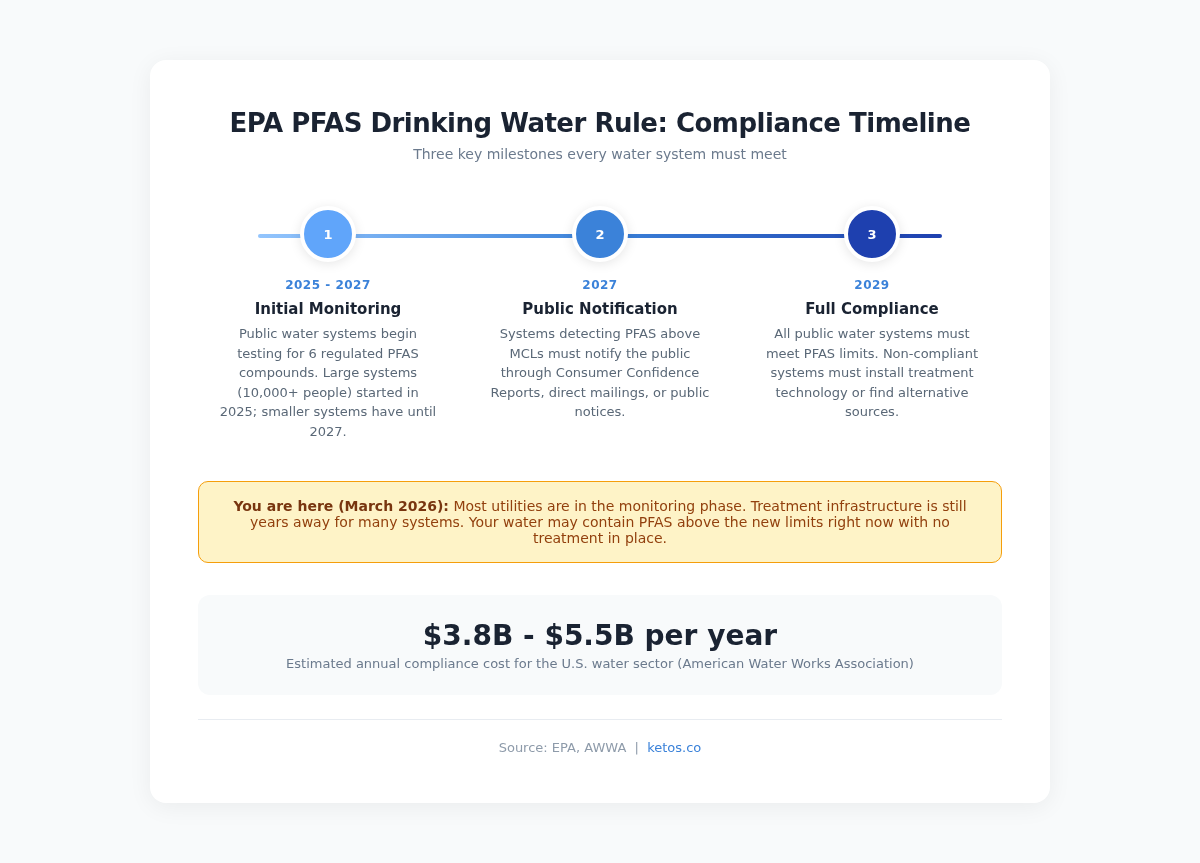
2025-2027: Initial monitoring.
Public water systems must begin testing for the six regulated PFAS compounds. Large systems (serving more than 10,000 people) were required to begin monitoring within 12 months. Smaller systems have until 2027.
2027: Public notification.
Systems that detect PFAS above the MCLs must notify the public. This may come through Consumer Confidence Reports (CCRs), direct mailings, or public notices.
2029: Full compliance.
All public water systems must be in full compliance, meaning PFAS levels at or below the MCLs. Systems that cannot meet the standard must install treatment technology or find alternative water sources.
The American Water Works Association (AWWA) estimated that compliance will cost the water sector between $3.8 billion and $5.5 billion annually once fully implemented. Many utilities will need to install granular activated carbon systems, ion exchange units, or reverse osmosis at the treatment plant level.
What UCMR 5 Is Revealing
Before the 2024 rule, the EPA had already begun collecting PFAS data through the Fifth Unregulated Contaminant Monitoring Rule (UCMR 5). This program required public water systems serving more than 3,300 people to test for 29 PFAS compounds between 2023 and 2025.
UCMR 5 is the largest systematic PFAS screening of public drinking water ever conducted in the United States. The data is publicly available and searchable by water system through the EPA’s UCMR occurrence data portal.
Early UCMR 5 results have confirmed what smaller studies suggested: PFAS are widespread, with detections in thousands of water systems across every region. The data is still being compiled, but preliminary findings have already prompted some states to accelerate their own regulatory timelines.
States That Have Gone Further
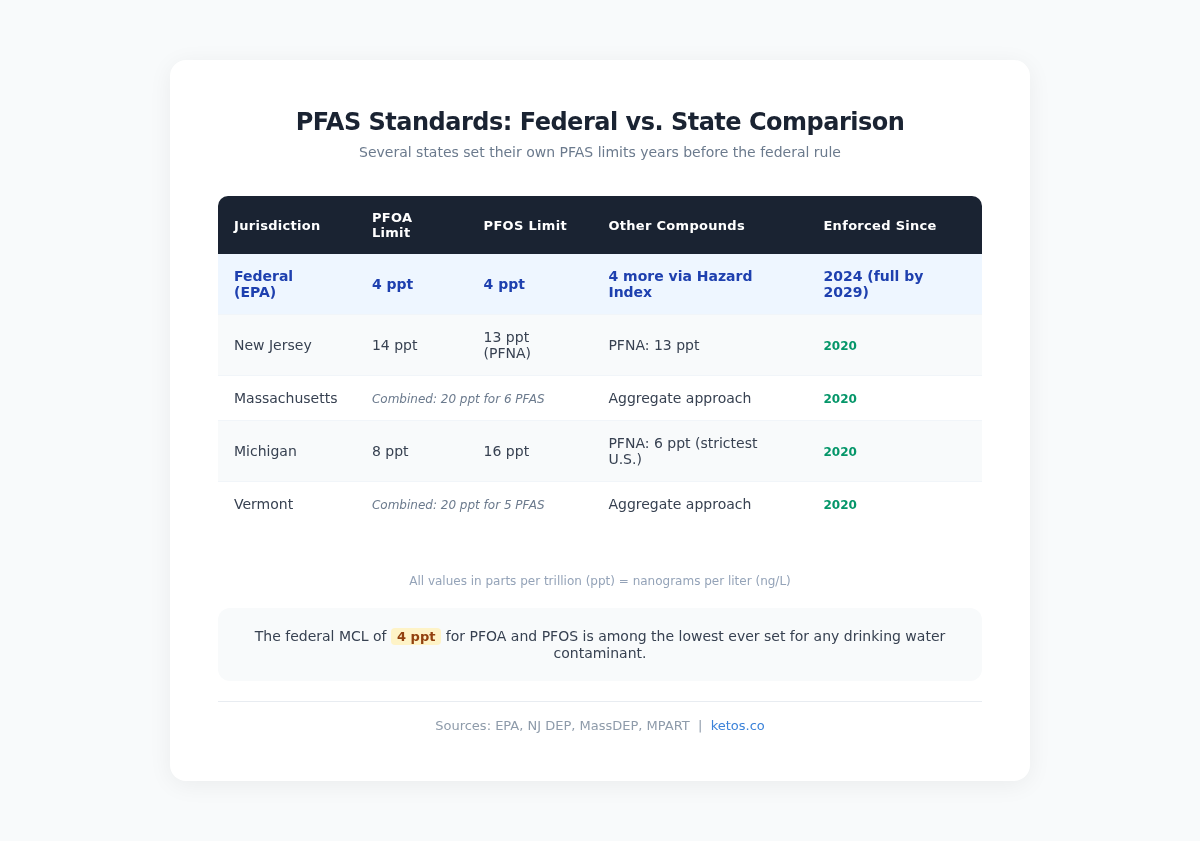
Several states have not waited for federal deadlines. They have set their own PFAS limits, and in some cases those limits are stricter than the EPA’s:
New Jersey
New Jersey was among the first states to regulate PFAS, setting MCLs of 13 ppt for PFNA and 14 ppt for PFOA in 2020 through the NJ Department of Environmental Protection. New Jersey’s PFOA limit of 14 ppt is less strict than the federal 4 ppt, but it was enforced years earlier.
Massachusetts
Massachusetts set a combined MCL of 20 ppt for six PFAS compounds in 2020 through the MassDEP. This aggregate approach differs from the federal compound-by-compound method.
Michigan
Michigan set individual standards for seven PFAS compounds in 2020, some as low as 6 ppt for PFNA, through the Michigan PFAS Action Response Team (MPART). Michigan has also been among the most aggressive in investigating and remediating contamination sites.
Vermont
Vermont adopted a combined PFAS standard of 20 ppt for five compounds in 2020, making it one of the strictest state-level standards at the time.
If you live in a state with its own PFAS rules, your utility may already be testing and treating. Check your state’s environmental agency website for the most current information.
What the Federal Rule Does Not Cover
The 2024 rule is significant, but it has boundaries you should understand:
Private wells are entirely excluded.
The Safe Drinking Water Act applies only to public water systems. If your home is served by a private well, no federal or state agency is required to test your water for PFAS. This affects roughly 23 million U.S. households.
Only six PFAS compounds are regulated.
There are thousands of PFAS variants in circulation. Your water may contain dozens of unregulated compounds that are not covered by this rule and that your utility has no obligation to test for.
The rule does not address PFAS in food, air, or consumer products.
Drinking water is one exposure pathway, but not the only one.
Small system waivers.
Very small water systems may qualify for extended compliance timelines or exemptions if they can demonstrate financial hardship.
How to Find Out What Your Utility Is Doing
You have the right to know what is in your water. Here are the specific steps:
Request your Consumer Confidence Report (CCR).
Every public water system is required to publish an annual CCR. Starting in 2027, these must include PFAS monitoring results. Some utilities already include PFAS data voluntarily. Your utility’s CCR is usually available on their website or by calling their customer service number.
Search UCMR 5 data.
If your system serves more than 3,300 people, it was required to participate in UCMR 5. Search the EPA’s occurrence data portal for your system’s results.
Contact your utility directly.
Ask three specific questions: (1) Have you tested for PFAS? (2) What were the results? (3) What treatment changes are planned for compliance by 2029?
Check your state agency.
Some states publish PFAS results from public water systems in searchable databases. Start with your state’s department of environmental protection or health website.
If your utility has not tested, or if their data covers only a few compounds, independent testing of your tap water fills the gap. For guidance on testing options and how to collect a valid sample, see our guide on how to test your water for PFAS.
The Gap Between Now and 2029
The compliance deadline is 2029, but you are drinking water today. Many utilities are still in the monitoring phase. Treatment infrastructure takes years to design, fund, and build. If your water contains PFAS above the new limits right now, there may be no treatment in place to remove them until years from now.
That gap is why individual testing matters. A PFAS water test tells you what is in your water today, not what your utility hopes to achieve by 2029.
For the science behind why PFAS are harmful, see what are forever chemicals. To check whether known contamination sources exist near you, see PFAS contamination by zip code.
References
- U.S. Environmental Protection Agency. “Biden-Harris Administration Finalizes First-Ever National Drinking Water Standard to Protect 100M People from PFAS.” April 2024. https://www.epa.gov/newsreleases/biden-harris-administration-finalizes-first-ever-national-drinking-water-standard
- U.S. Environmental Protection Agency. “PFAS National Primary Drinking Water Regulation: Monitoring Fact Sheet.” April 2024. https://www.epa.gov/system/files/documents/2024-04/pfas-npdwr-fact-sheet-monitoring.pdf
- U.S. Environmental Protection Agency. “Fifth Unregulated Contaminant Monitoring Rule (UCMR 5).” https://www.epa.gov/dwucmr/fifth-unregulated-contaminant-monitoring-rule
- U.S. Environmental Protection Agency. “UCMR Occurrence Data.” https://www.epa.gov/dwucmr/occurrence-data-unregulated-contaminant-monitoring-rule
- American Water Works Association. “PFAS Resources.” https://www.awwa.org/Resources-Tools/Resource-Topics/PFAS
- New Jersey Department of Environmental Protection. “PFAS in New Jersey.” https://www.nj.gov/dep/pfas/
- Massachusetts Department of Environmental Protection. “Per- and Polyfluoroalkyl Substances (PFAS).” https://www.mass.gov/info-details/per-and-polyfluoroalkyl-substances-pfas
- Michigan PFAS Action Response Team (MPART). https://www.michigan.gov/pfasresponse
- Centers for Disease Control and Prevention. “Private Wells.” https://www.cdc.gov/healthywater/drinking/private/wells/index.html
Test your water for PFAS: KETOS KELP provides EPA-certified lab analysis of 30+ PFAS compounds with fast digital results. View testing packages.