


What Are Forever Chemicals, and Why Should You Care About Your Water?
Forever chemicals are synthetic compounds called PFAS (per- and polyfluoroalkyl substances) that do not break down in the environment or in your body. A 2023 nationwide study by the U.S. Geological Survey detected PFAS in approximately 45% of U.S. tap water samples tested across public and private supplies. These compounds accumulate in your blood, liver, and kidneys over years and decades.
If you have never tested your water for PFAS, you have no way of knowing whether you are drinking them right now. This article explains what PFAS are, how they enter drinking water, what the health evidence says, and what steps you can take.
What Does PFAS Stand For?
PFAS stands for per- and polyfluoroalkyl substances. Most people call them “forever chemicals” because they persist in the environment for thousands of years without degrading.
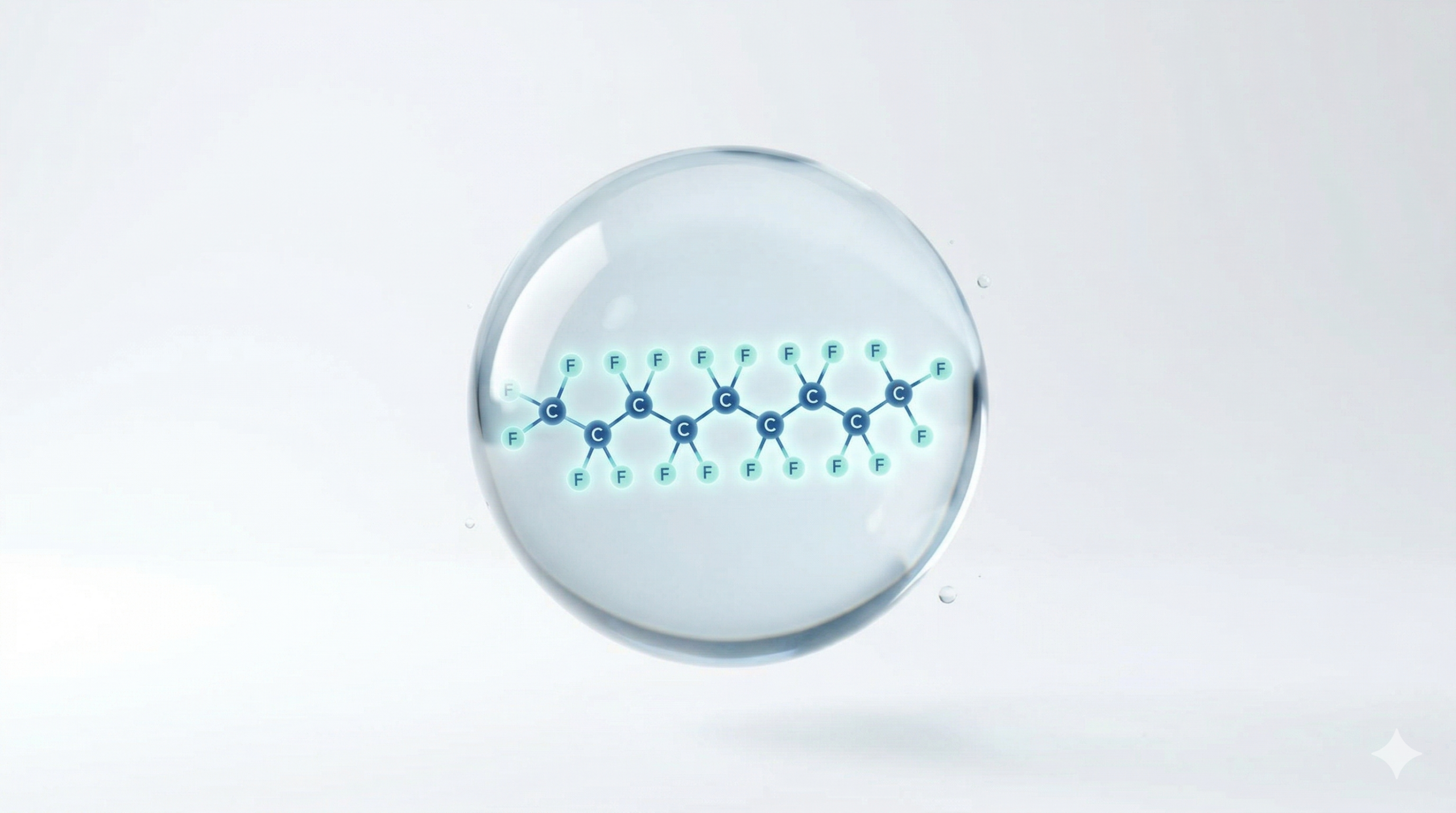
The chemistry behind PFAS is straightforward. These molecules contain a carbon-fluorine bond, one of the strongest bonds in organic chemistry. That bond makes PFAS extremely resistant to heat, water, oil, and grease. It also makes them nearly impossible for nature to break down.
According to the EPA’s CompTox Chemicals Dashboard, there are more than 15,000 known PFAS compounds. The most studied are PFOA (perfluorooctanoic acid) and PFOS (perfluorooctane sulfonic acid), but newer short-chain PFAS compounds like GenX (HFPO-DA) are also raising concerns among researchers and regulators.
Concerned about contaminants in your water?
Get water testing from KETOS KELP using EPA-certified methodology, results you can trust, backed by real data.
Order a Water Test →Where Do Forever Chemicals Come From?
PFAS have been manufactured since the 1940s and are found in a wide range of products and processes:
Consumer products: Nonstick cookware (Teflon), stain-resistant fabrics and carpets, water-repellent clothing, food packaging (microwave popcorn bags, fast food wrappers), and some cosmetics. The FDA has documented PFAS in food contact materials and has been phasing out certain uses.
Industrial sources: Firefighting foam (aqueous film-forming foam, or AFFF) used at military bases and airports, chrome plating, electronics manufacturing, and oil refining. The Department of Defense has identified over 700 military installations with known or suspected PFAS contamination from AFFF use.
Infrastructure: Wastewater treatment plants that cannot fully remove PFAS, biosolids (treated sewage sludge) applied to agricultural land, and landfill leachate from discarded consumer products.
The scope of contamination is enormous. Manufacturing facilities, military bases, airports, and wastewater plants can all introduce PFAS into local groundwater and surface water. From there, it enters municipal water systems and private wells.
How Do PFAS Get Into Drinking Water?
PFAS enter water supplies through several pathways. Industrial facilities discharge PFAS into rivers and lakes. Firefighting foam used during training exercises soaks into the ground and reaches aquifers. Landfills leach PFAS into groundwater as consumer products containing these chemicals decompose.
Municipal water treatment plants are designed to remove sediment, chlorine byproducts, and common chemical contaminants. Most are not equipped to remove PFAS at parts-per-trillion concentrations. That means even treated city water can contain forever chemicals.
Private well owners face additional risk. According to the CDC, approximately 23 million U.S. households (about 45 million people) rely on private wells, which draw directly from groundwater with no treatment step in between. If PFAS have reached your aquifer, they are in your drinking water.
What Are the Health Risks of PFAS?
Research on PFAS health effects has accelerated in recent years. The Agency for Toxic Substances and Disease Registry (ATSDR), part of the CDC, links PFAS exposure to several serious conditions:
Cancer: A study from the USC Keck School of Medicine found links between PFAS-contaminated drinking water and a range of rare cancers, including kidney and testicular cancer. The International Agency for Research on Cancer (IARC) classified PFOA as a Group 1 carcinogen (carcinogenic to humans) in November 2023.
Thyroid disease: PFAS can interfere with thyroid hormone production, leading to hypothyroidism and related metabolic problems.
Immune suppression: Exposure has been linked to reduced vaccine effectiveness in children, meaning their immune systems respond less effectively to routine immunizations.
Liver damage: PFAS accumulation in the liver can elevate cholesterol levels and impair liver function over time.
Reproductive effects: Some studies have found associations between PFAS exposure and fertility issues, pregnancy complications, and developmental delays in children.
Children are especially vulnerable because their bodies are smaller and still developing. According to the CDC/ATSDR, common PFAS compounds like PFOA have a biological half-life of 4 to 8 years in the human body, meaning it takes years for your system to eliminate even half of what it has absorbed.
Beyond personal health, PFAS contamination has measurable economic effects on home values, particularly for households on private wells. See how water quality affects real estate prices for the research on what buyers and sellers should know.
What Is the EPA Doing About PFAS?
In April 2024, the EPA finalized the first-ever national drinking water standard for PFAS. The rule sets maximum contaminant levels (MCLs) for six PFAS compounds:
PFOA and PFOS each have individual limits of 4 parts per trillion (ppt). That is an extremely low threshold, reflecting how toxic these compounds are even at trace concentrations. Four additional PFAS compounds (PFHxS, PFNA, HFPO-DA/GenX, and PFBS) are regulated under a hazard index approach.
Public water systems have until 2029 to comply. However, there are important gaps:
The rule covers only six compounds out of more than 15,000 known PFAS. Private wells are not covered by the regulation at all. And compliance is years away, meaning your utility may not be testing for or treating PFAS yet.
How to Know If PFAS Are in Your Water
You cannot see, smell, or taste PFAS. The only way to know is to test.
If you are on a public water system, your utility may publish PFAS testing results. Check your annual Consumer Confidence Report (CCR) or contact your water provider directly. You can also search the EWG’s PFAS Contamination Map for known contamination sites near you. Keep in mind that many utilities have not yet tested for the full range of PFAS compounds.
If you are on a private well, no one is testing your water for you. There is no federal requirement and no oversight. Testing is entirely your responsibility.
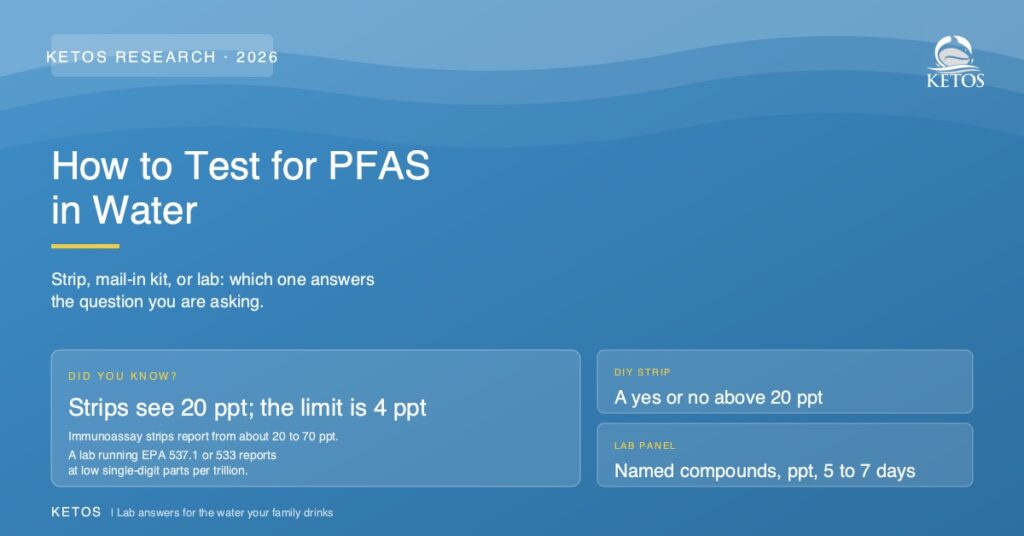
A PFAS water test from KETOS KELP uses EPA-certified methods (Methods 1633, 537.1, and 533) to detect PFAS at parts-per-trillion sensitivity. You collect a sample at home, ship it with a prepaid label, and receive a digital report in 5 to 7 business days with plain-language results and next steps.
What Can You Do If PFAS Are Found?
If testing reveals PFAS in your water, you have options. The most effective removal methods, according to the EPA’s guidance on PFAS treatment, are:
Reverse osmosis (RO) systems: Point-of-use RO systems installed under the kitchen sink are highly effective at removing PFAS from drinking water. They force water through a membrane that blocks PFAS molecules.
Granular activated carbon (GAC) filters: Whole-house carbon filtration can reduce PFAS levels, though effectiveness varies by compound and filter quality. Standard pitcher filters are not sufficient for PFAS removal.
Ion exchange systems: These specialized systems are particularly effective for short-chain PFAS compounds that GAC filters may miss.
The right approach depends on which PFAS compounds are present and at what concentrations. That is why testing comes first. Without knowing your specific contamination profile, choosing the right filter is guesswork.
The Bottom Line
Forever chemicals are real, widespread, and accumulating in millions of Americans right now. They do not break down in the environment, they do not wash out of your body on their own, and based on the USGS data, they are present in nearly half of all tap water tested nationwide. The only way to know what is in your water is to test it.
Test your water for PFAS with KETOS KELP using EPA-certified methods with results in 5 to 7 business days and no subscription required.
Related Resources
Test your water for PFAS: KETOS KELP provides EPA-certified lab analysis of 30+ PFAS compounds with fast digital results. View testing packages.