


Choosing the Right PFAS Test for Your Water
You have decided to test your water for PFAS. The next question is how. There are several testing approaches available, and they differ significantly in accuracy, cost, and the number of compounds they screen for.
This guide compares your options, walks through proper sample collection technique, and explains how to interpret the numbers on your results report.
EPA-Certified Test Methods: The Standard That Matters
The EPA has approved three analytical methods for PFAS detection in drinking water. Any test you use should specify which method it employs:
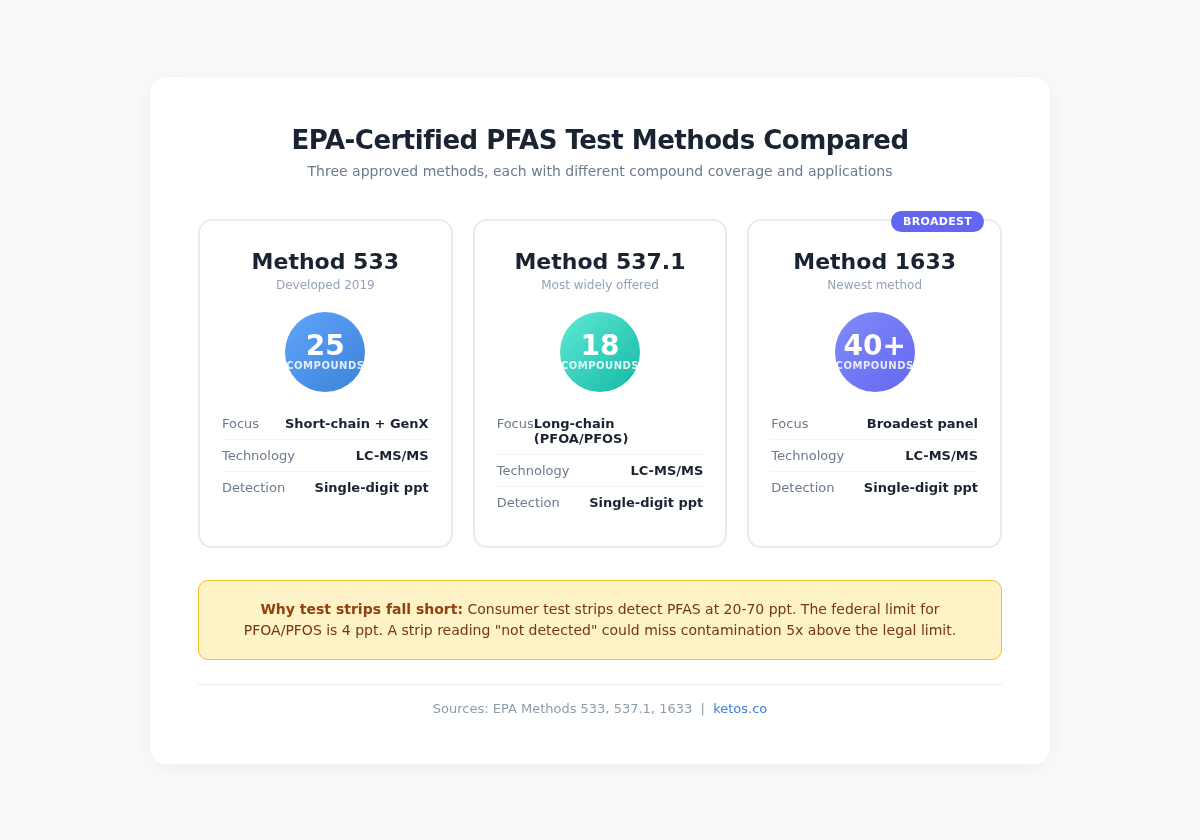
Method 533 targets 25 PFAS compounds, including short-chain compounds like GenX that older methods miss. Developed in 2019, it uses solid phase extraction followed by liquid chromatography-tandem mass spectrometry (LC-MS/MS).
Method 537.1 covers 18 PFAS compounds, focusing on the most commonly detected long-chain compounds including PFOA and PFOS. This method has the longest track record and is the most widely offered by commercial labs.
Method 1633 is the newest and broadest, capable of screening 40 or more PFAS compounds in a single analysis. Originally developed for wastewater, it is increasingly being adopted for drinking water testing as well.
The detection limits for all three methods reach into single-digit parts per trillion, which is necessary given that the federal MCL for PFOA and PFOS is 4 ppt.
Concerned about contaminants in your water?
Get lab-certified water testing from KETOS KELP — results you can trust, backed by real data.
Order a Water Test →Comparing Your Testing Options
Test Strips and Rapid Screening Kits
Consumer PFAS test strips have entered the market in recent years, typically priced between $30 and $100. These use immunoassay technology to detect PFAS.
The fundamental limitation is sensitivity. Most strips have detection limits in the range of 20 to 70 ppt. The federal standard for PFOA and PFOS is 4 ppt. A strip that reads “not detected” at 20 ppt could be missing contamination that is five times the legal limit. For this reason, the Interstate Technology and Regulatory Council (ITRC) does not recommend rapid screening kits as a substitute for laboratory analysis when regulatory compliance or health decisions are involved.
Independent Lab Testing
You can ship a sample directly to a certified environmental laboratory. The EPA maintains a searchable database of laboratories certified for drinking water analysis, and many labs now offer PFAS panels.
Costs typically range from $250 to $600 depending on the method and number of compounds. Turnaround varies from 5 to 21 business days. The advantage is that you choose the specific method and compound list. The disadvantage is that you are responsible for sourcing PFAS-free collection bottles (standard containers can introduce contamination), following the lab’s chain-of-custody procedures, and arranging shipping with appropriate temperature controls.
Mail-In Test Kits
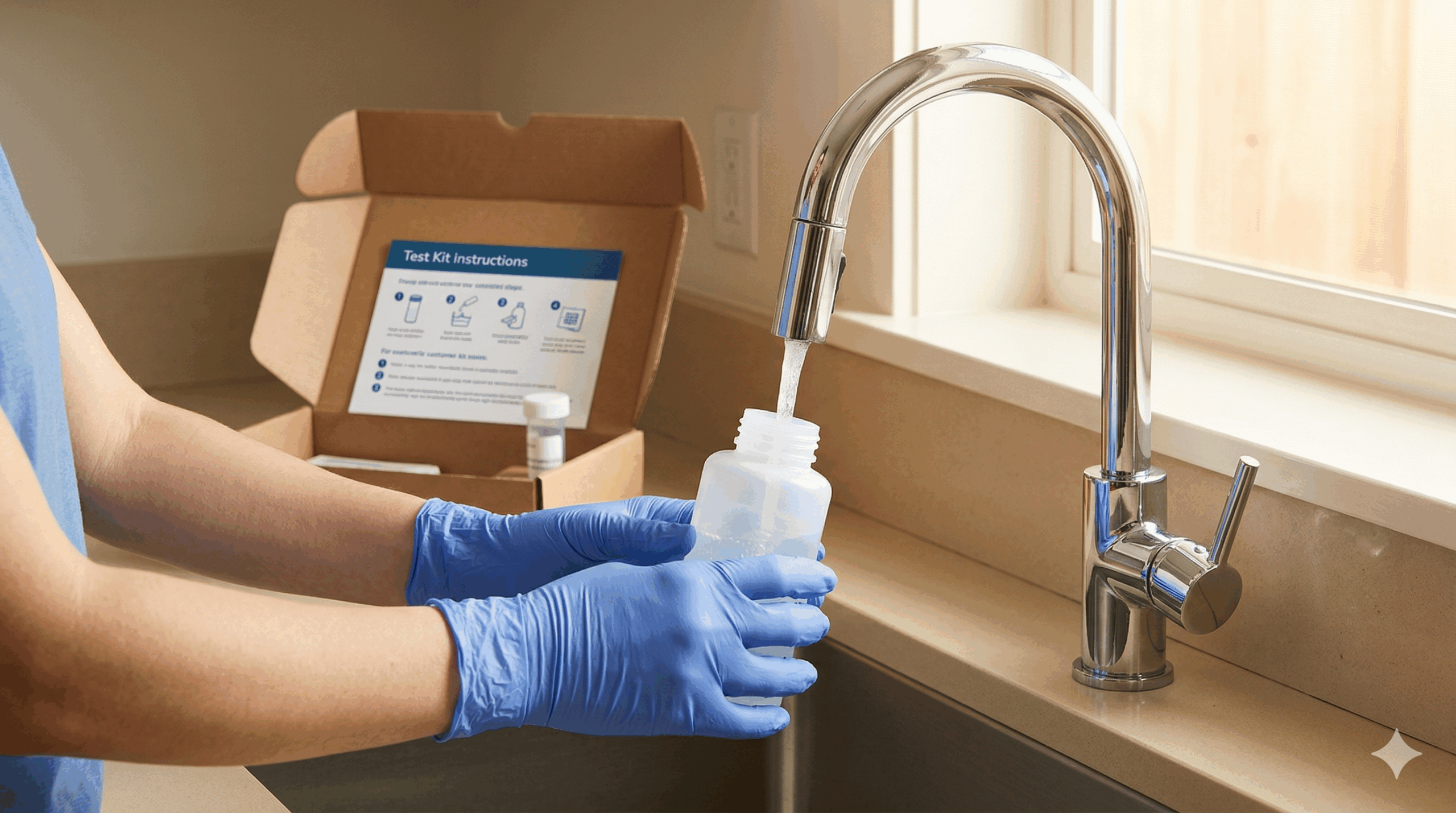
Mail-in kits bundle lab-grade analysis with consumer convenience. The provider ships you certified PFAS-free collection bottles, clear instructions, and a prepaid return label. You collect the sample, ship it back, and receive a digital report.
KETOS KELP’s PFAS test kits use EPA-certified Methods 533, 537.1, and 1633 depending on the package. The Basic PFAS Screen ($280) tests for PFNA, PFOA, and PFOS, plus lead, arsenic, copper, and key inorganic markers. The Home Safety Screen ($549) expands to 18 PFAS compounds plus a full metals and chemistry panel. The Ultimate Water Safety Suite ($699) includes the broadest PFAS panel available plus an expanded metals panel and corrosivity indicators.
How to Collect a Valid PFAS Sample
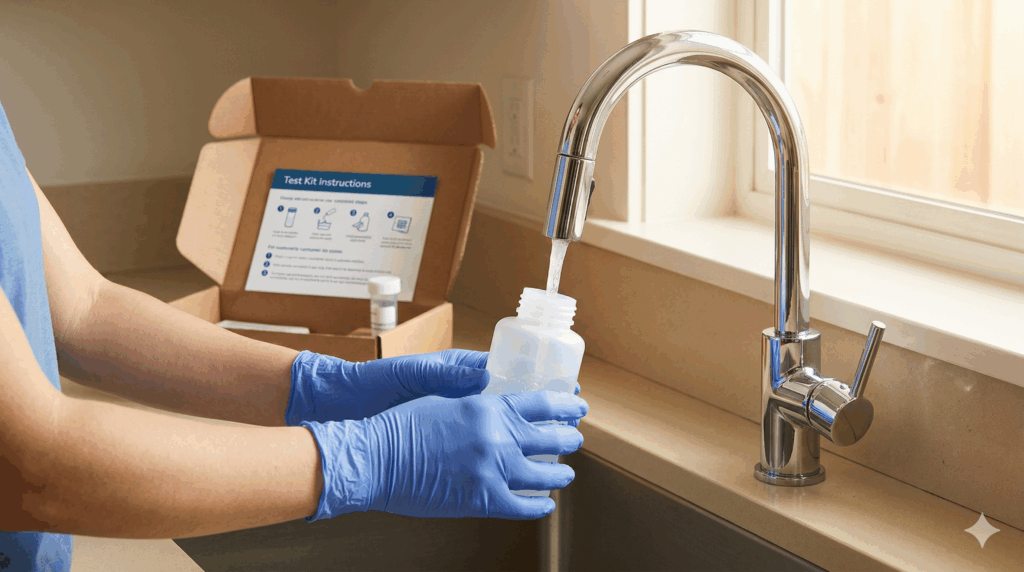
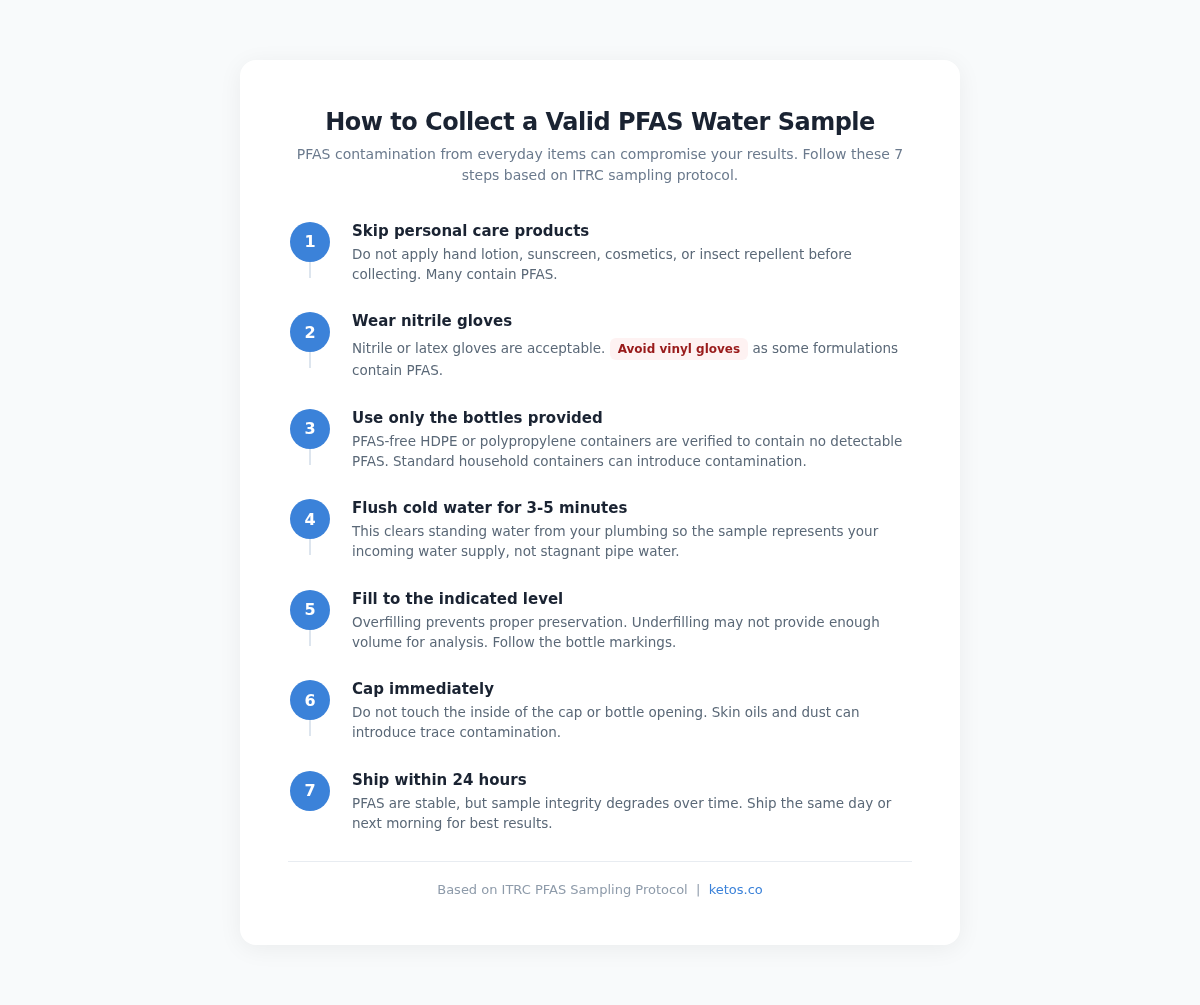
Sample collection for PFAS requires more care than standard water testing. PFAS contamination from everyday items can compromise your results if precautions are not followed. These guidelines align with the ITRC’s PFAS Sampling Protocol:
Avoid PFAS-containing products on test day. Do not apply hand lotion, sunscreen, cosmetics, or insect repellent before collecting your sample. Many personal care products contain PFAS compounds. Wash your hands with plain soap and water only.
Wear nitrile gloves if provided. Some test kits include nitrile gloves. Latex gloves are also acceptable. Do not use vinyl gloves, as some vinyl formulations contain PFAS.
Use only the bottles provided. PFAS-free sample containers are made from specific materials (typically HDPE or polypropylene) that have been verified to contain no detectable PFAS. Standard household containers, including reused water bottles, can introduce trace PFAS.
Run cold water for 3 to 5 minutes. This flushes standing water from your plumbing and ensures the sample represents your incoming water supply, not water that has been sitting in pipes.
Fill bottles to the level indicated. Overfilling can prevent proper preservation. Underfilling may not provide enough volume for analysis. Follow the markings on the bottle.
Cap immediately and avoid touching the inside of the cap or bottle opening. Skin oils and environmental dust can introduce trace contamination.
Ship within 24 hours. PFAS are chemically stable, but sample integrity degrades over time. Use the prepaid label and ship the same day or the following morning for best results.
Reading Your PFAS Results Report
Your lab report will list individual PFAS compounds and their measured concentrations. Here is how to interpret the key elements:
Individual Compound Results
Each PFAS compound will show a result in parts per trillion (ppt) or nanograms per liter (ng/L). These are equivalent units. Common results include:
ND (Not Detected): The compound was below the method’s detection limit. This is the best outcome. The detection limit will be noted on the report, typically between 1 and 4 ppt depending on the compound and method.
A numerical value (e.g., “PFOA: 2.3 ppt”): The compound was detected at that concentration. Compare this against the relevant standard.
Federal Benchmarks
For PFOA: the federal MCL is 4 ppt. Results below 4 ppt meet the standard. Results above 4 ppt exceed it.
For PFOS: the federal MCL is 4 ppt. Same interpretation as PFOA.
For PFHxS, PFNA, GenX, and PFBS: these are evaluated using the hazard index. Your report may calculate this for you. If the hazard index exceeds 1.0, the combined concentration of these four compounds exceeds the federal standard.
State Benchmarks
If your state has its own PFAS limits (New Jersey, Massachusetts, Michigan, Vermont, and others), your report may also compare results against those standards. State limits can be stricter or more lenient than federal limits depending on the compound.
What the Numbers Mean in Practice
A result of 2 ppt PFOA is below the federal limit but is not zero. It means PFAS are present in your water at a detectable level. Whether to take action at sub-MCL concentrations is a personal decision. Some families, particularly those with young children or pregnant members, choose to filter even when results are below the federal standard.
The NSF International certification program (NSF/ANSI 53 and 58) tests and certifies water filters specifically for PFAS reduction. If you decide to filter, look for a system certified under NSF P473 or NSF/ANSI 58 (reverse osmosis).
After You Get Results
If all compounds are ND: Retest in 12 months. Contamination levels change over time, and new sources can emerge.
If PFAS are detected below the MCL: Consider your household’s risk tolerance. Families with infants or pregnant members may want to install a point-of-use reverse osmosis system as a precaution.
If PFAS exceed the MCL: Install an NSF-certified reverse osmosis system for drinking and cooking water. Retest in 30 to 60 days after installation to verify the system is performing. Contact your water utility if you are on municipal water.
For an overview of how PFAS affect your health and why they persist, see what are forever chemicals. For details on what your utility is required to do, see PFAS drinking water regulations.
References
- U.S. Environmental Protection Agency. “Method 533: Determination of Per- and Polyfluoroalkyl Substances in Drinking Water by Isotope Dilution Anion Exchange SPE and LC/MS/MS.” https://www.epa.gov/dwanalyticalmethods/method-533-determination-and-polyfluoroalkyl-substances-drinking-water-isotope
- U.S. Environmental Protection Agency. “Method 537.1: Determination of Selected Per- and Polyfluorinated Alkyl Substances in Drinking Water.” https://www.epa.gov/dwanalyticalmethods/method-5371-determination-selected-and-polyfluorinated-alkyl-substances
- U.S. Environmental Protection Agency. “CWA Analytical Methods for PFAS.” https://www.epa.gov/cwa-methods/cwa-analytical-methods-and-polyfluorinated-alkyl-substances-pfas
- Interstate Technology and Regulatory Council (ITRC). “PFAS Sampling and Analysis.” https://pfas-1.itrcweb.org/sampling-and-analysis/
- U.S. Environmental Protection Agency. “Laboratory Support for Drinking Water Methods.” https://www.epa.gov/dwanalyticalmethods/laboratory-support-drinking-water-methods
- NSF International. “PFAS Drinking Water Treatment.” https://www.nsf.org/consumer-resources/articles/pfas-702-702-1-702-2
Test your water for PFAS: KETOS KELP provides EPA-certified lab analysis of 30+ PFAS compounds with fast digital results. View testing packages.