


What to test your well water for, and how often
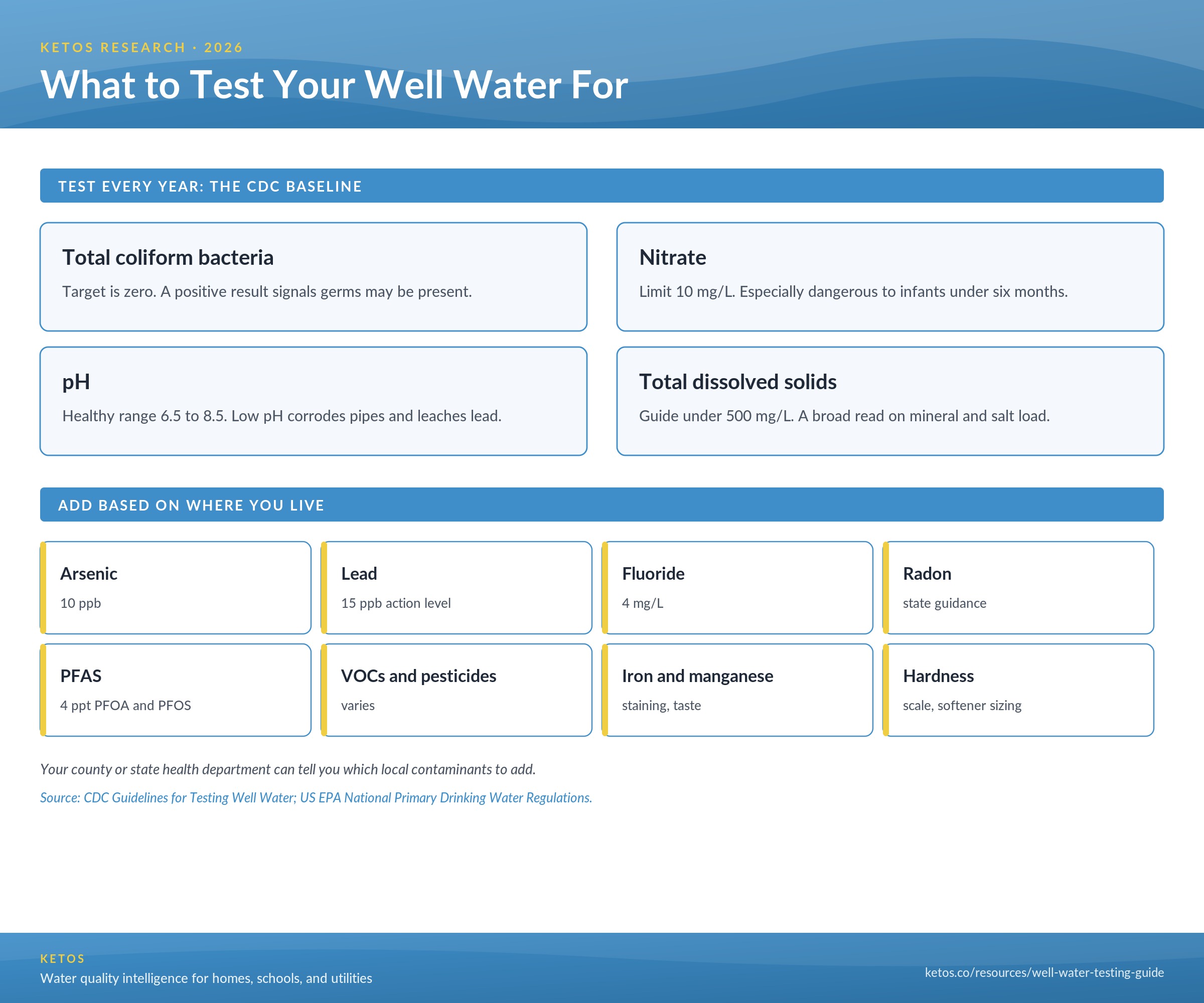
| Test | Why it matters | How often |
|---|---|---|
| Total coliform bacteria | Signals that disease-causing germs may be present | At least once a year |
| Nitrate | Dangerous to infants; flags fertilizer or septic intrusion | At least once a year |
| pH | Low pH corrodes plumbing and leaches lead and copper | At least once a year |
| Total dissolved solids (TDS) | A broad indicator of mineral and contaminant load | At least once a year |
| Arsenic, lead, fluoride, radon, VOCs, PFAS | Local geology and land use determine which apply | At setup, then as advised by your health department |
Want one report that covers the full list? A KELP water test kit analyzes your well water for lead, PFAS, nitrate, arsenic, copper, pH, hardness, and additional parameters in a single lab report using EPA-approved methods, with prepaid sample bottles shipped to your door. Order a KELP well water test kit →
Private wells are not regulated, so testing falls to you
If your home draws water from a private well, no agency tests it for you. Drinking water from private wells is not regulated by the federal government under the Safe Drinking Water Act, and it is not covered by most state laws either. The owner of the well is responsible for making sure the water is safe to drink. That responsibility is the foundation of well water testing, and the reason this guide exists.
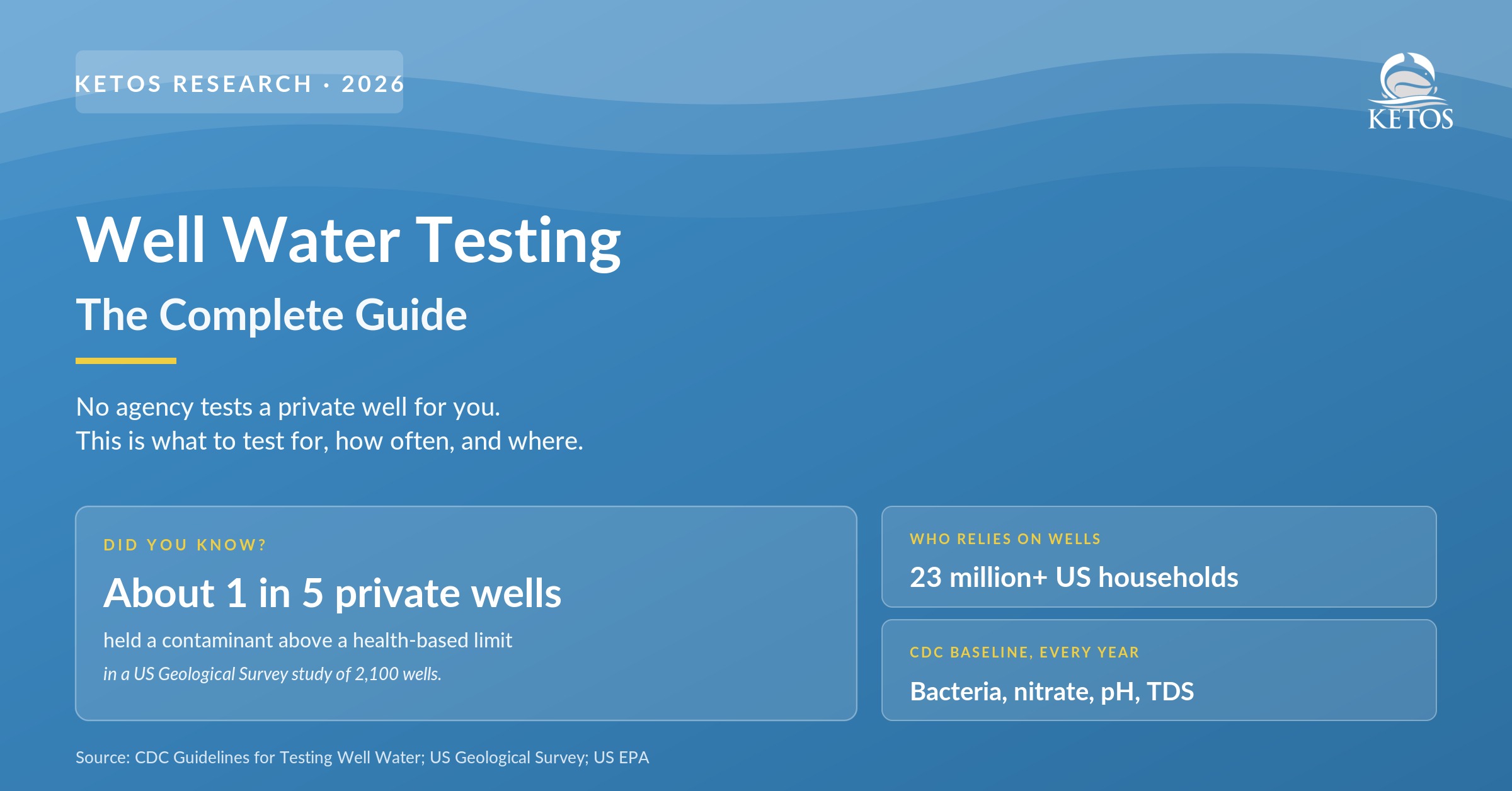
This is not a small group of households. The EPA estimates that more than 23 million households, around 15 percent of the US population or more than 43 million people, rely on private wells for their drinking water. And the water is not automatically safe because it comes from underground. A US Geological Survey study of roughly 2,100 private wells found that about one in five contained at least one contaminant at a level above a human-health benchmark.
Public water utilities test their supply constantly and report the results. As a private well owner, you are the utility. Testing on a regular schedule is how you find a problem before it reaches a glass of water.
What to test your well water for
The CDC recommends testing every private well at least once a year for four baseline indicators: total coliform bacteria, nitrate, pH, and total dissolved solids. These four are the starting point for every well, everywhere, regardless of location.
The annual baseline: four tests every well needs
Three of the four baseline tests are not contaminants you worry about directly. They are indicators. They tell you whether something harmful is likely present, even when you cannot see, taste, or smell it.
Total coliform bacteria. Coliform bacteria are common in soil and surface water and are mostly harmless on their own. Their presence in well water matters because it signals a pathway, a crack, a poor seal, or surface runoff, through which disease-causing germs can also enter. A safe result is zero. Any detection means the well needs attention. A positive E. coli result specifically points to fecal contamination and is an immediate health concern.
Nitrate. Nitrate enters groundwater from fertilizer, manure, and septic systems. The EPA maximum contaminant level for nitrate in drinking water is 10 milligrams per liter (measured as nitrogen). Nitrate is especially dangerous to infants under six months, in whom it can cause a potentially fatal condition known as blue baby syndrome. Any household with an infant, or a pregnant person, should treat nitrate testing as non-negotiable.
pH. pH measures how acidic or alkaline the water is. The EPA recommends a range of 6.5 to 8.5 for drinking water. Below 6.5, water becomes corrosive and can dissolve lead and copper out of household plumbing, which means a low-pH well can create a lead problem even when the groundwater itself contains no lead.
Total dissolved solids (TDS). TDS is the combined concentration of all dissolved minerals, salts, and metals in the water. It does not identify what is dissolved, but a high or rising TDS reading is a signal to investigate further. The EPA secondary standard for TDS is 500 milligrams per liter.
Beyond the baseline: tests driven by where you live
The four baseline tests catch the most common problems, but they do not catch everything. Which additional contaminants you test for depends on your local geology, nearby land use, and the age of your home. Your county or state health department can tell you what is common in your area. The contaminants below are the ones that most often justify an expanded panel.
| Contaminant | Where it comes from | EPA limit or benchmark | When to test |
|---|---|---|---|
| Arsenic | Naturally occurring in bedrock in many regions | 10 ppb (0.010 mg/L) | At setup, then every few years in known arsenic areas |
| Lead | Corroded plumbing, solder, fixtures; rarely the aquifer | 15 ppb action level (10 ppb under the 2024 LCRI) | Homes built before 1986, or if pH is low |
| Fluoride | Naturally occurring in some groundwater | 4 mg/L (2 mg/L secondary) | At setup, especially in the West and Southwest |
| Radon | Radioactive decay of uranium in rock | No federal MCL; state guidance varies | In known radon regions, especially with granite bedrock |
| VOCs and pesticides | Fuel storage, industry, agricultural runoff | Varies by compound | Near farms, fuel tanks, or industrial sites |
| PFAS | Industrial sites, firefighting foam, landfills | 4 ppt for PFOA and PFOS (2024 federal limits) | Near known PFAS sources or contamination plumes |
| Iron and manganese | Naturally occurring minerals | 0.3 mg/L iron, 0.05 mg/L manganese (secondary) | If water stains fixtures or tastes metallic |
| Hardness | Dissolved calcium and magnesium | No health limit; affects scaling and soap use | If you see scale buildup or sizing a softener |
Testing for this full list one contaminant at a time, through separate single-purpose kits, is slow and expensive. A single comprehensive panel that reports many parameters from one sample is usually the more practical route, a point covered in the methods comparison below.
Concerned about contaminants in your water?
Get water testing from KETOS KELP using EPA-certified methodology, results you can trust, backed by real data.
Order a Water Test →How often to test your well water
The CDC recommends annual testing for the four baseline indicators for every private well. Beyond that yearly schedule, several events should trigger an immediate test, regardless of when you last checked.
Test right away if there has been flooding, a land disturbance, or new waste disposal activity near your well, since any of these can introduce contamination through the wellhead or the aquifer. Test if you notice a change in how your water looks, tastes, or smells, because a sudden change often means something new has entered the water. Test after any repair or replacement of well components, since opening the system can introduce bacteria. And test before bringing home a newborn, or during a pregnancy, with particular attention to nitrate and bacteria.
Households in agricultural areas, near industrial activity, or with a history of contamination should test more than once a year and should include the relevant contaminants from the expanded list each time.
How to test your well water: three methods compared
There are three practical ways to test private well water. They differ in accuracy, cost, and how much they actually tell you. The right choice depends on whether you are doing a quick screen, a thorough safety assessment, or ongoing monitoring of a shared or managed well.
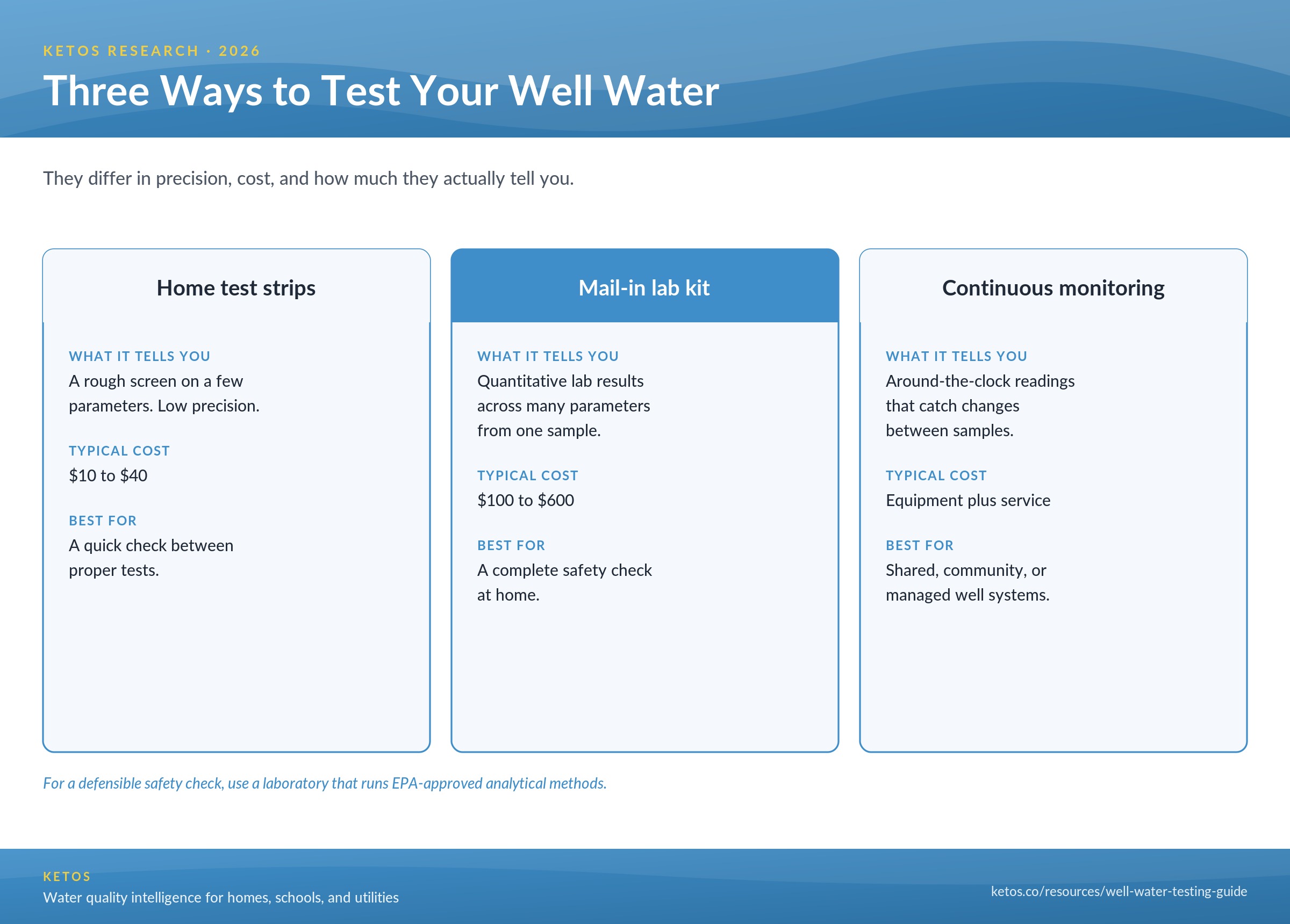
| Method | What it tells you | Typical cost | Best for |
|---|---|---|---|
| Home test strips and kits | A rough yes or no on a few parameters; low precision | $10–$40 | A quick screen between proper tests |
| Mail-in lab test kit | Quantitative lab results across many parameters from one sample | $100–$600 | A complete, defensible safety assessment at home |
| Continuous monitoring | Around-the-clock readings that catch changes between samples | Equipment plus service | Shared, community, or managed well systems |
Home test strips: fast, cheap, and limited
Test strips and basic home kits use a color-change reaction to give a rough reading on a handful of parameters such as pH, hardness, nitrate, and sometimes bacteria. They cost very little and return a result in minutes. The trade-off is precision. A strip can tell you that nitrate is roughly high or low, but it cannot resolve whether you are just under or just over the 10 mg/L limit, and most strips cannot detect lead, arsenic, or PFAS at the low levels that matter for health. Treat strips as a screening tool, not as the basis for a decision about whether your water is safe to drink.
Mail-in lab test kits: the practical standard for homeowners
For an actual safety assessment, a sample analyzed in a laboratory using EPA-approved methods is the standard. A mail-in kit ships you prepaid sample bottles, you collect the water following the instructions, and the lab returns a quantitative report measured against EPA limits. This is the method that gives you a number you can act on, lead in parts per billion, nitrate in milligrams per liter, rather than a color on a chart.
The decision within this category usually comes down to how many parameters one kit covers. A single comprehensive panel is more economical and far less hassle than mailing separate kits for bacteria, then metals, then PFAS. A KELP water test kit covers lead at sub-ppb detection limits, PFAS, nitrate, arsenic, copper, pH, hardness, and more in one report using EPA-approved methods, for a fraction of what the same parameters cost when tested separately. Order a KELP well water test kit →
Continuous monitoring: for shared and managed wells
A lab test, no matter how thorough, is a snapshot. It tells you what was in the water on the day you sampled. For a single household that is usually enough when repeated on schedule. But a well that serves many people, a community well, a homeowners association system, a mobile home park, a small water system, or an agricultural operation, carries more risk between samples, and the people responsible for it often need a documented record rather than a once-a-year snapshot. For those systems, continuous monitoring tracks water quality around the clock and flags problems as they happen.
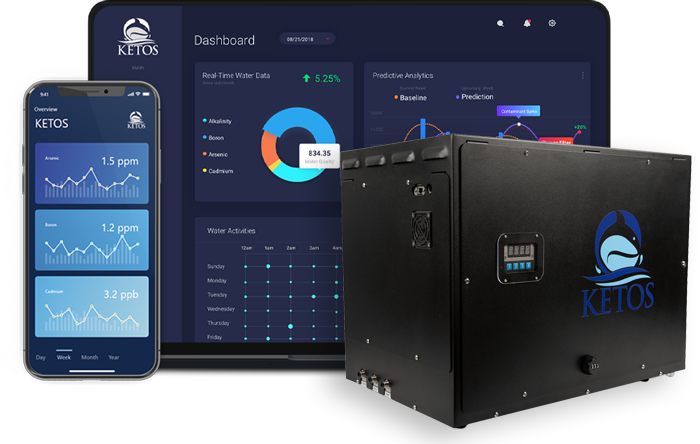
KETOS SHIELD continuously monitors a shared or managed well across more than 30 water quality parameters in real time, with EPA-method-compliant logging that produces the audit-ready record a small water system or community well operator needs. Talk to SHIELD sales →
Where to get your well water tested
What makes results reliable is that the analysis uses EPA-approved methods. There are three common routes, and the constant across all of them is the use of EPA-approved analytical methods.
A mail-in test kit. For most homeowners this is the most convenient route, since the bottles, instructions, prepaid shipping, and lab analysis come as one package and you never have to locate a lab yourself. The detail that matters is that the kit analyzes your sample using EPA-approved methods.
Your county or state health department. Many county health departments test well water for a low fee, and some offer free bacteria or nitrate testing, especially for households with infants or after a flood. Your health department is also the authority on which local contaminants you should add to the baseline.
A laboratory in your area. Your state’s drinking water program maintains contact information for laboratories that can analyze a private well sample. You collect the sample and deliver or mail it to the lab.
People often search for free well water testing near them. Free or subsidized testing does exist, but it is usually limited to one or two parameters such as bacteria or nitrate, and it is offered through public health programs rather than as a complete panel. For a full safety assessment covering metals, PFAS, and the rest, expect to pay for a comprehensive test.
How much does well water testing cost?
Cost depends entirely on how many parameters you test. A single-parameter test for bacteria or nitrate through a county health department may be free or cost around $20 to $50. A basic multi-parameter panel from a laboratory typically runs $100 to $300. A comprehensive panel that includes metals such as lead and arsenic, plus PFAS, generally runs $200 to $600 or more when each contaminant group is priced separately.
The reason comprehensive panels vary so widely is that PFAS and metals analysis are expensive to run individually. This is why a bundled kit that includes them in one price is usually the better value for a homeowner who wants a complete picture rather than a single number.
Frequently asked questions about well water testing
How do I test my well water?
Collect a sample following the instructions from a mail-in kit or a laboratory, then send it for analysis. At minimum, test once a year for total coliform bacteria, nitrate, pH, and total dissolved solids, as recommended by the CDC. Home test strips can give you a quick screen, but a laboratory analysis using EPA-approved methods is what tells you whether your water is actually safe to drink.
Where can I get my well water tested?
Through a mail-in test kit, through your county or state health department, or through a laboratory in your area. What matters in every case is that the analysis uses EPA-approved methods.
Can I get my well water tested for free?
Sometimes. Many county health departments offer free or low-cost testing for one or two parameters, often bacteria or nitrate, and frequently prioritize households with infants or wells affected by flooding. A complete panel covering metals, PFAS, and other contaminants is almost always a paid test.
How often should well water be tested?
At least once a year for the four baseline indicators. Test immediately, outside that schedule, after flooding or nearby land disturbance, when the water changes in taste, color, or smell, after any repair to the well, and before a newborn arrives or during a pregnancy.
How much does it cost to test well water?
A single-parameter test can be free to around $50 through a health department. A basic lab panel runs $100 to $300. A comprehensive panel including lead, arsenic, and PFAS generally runs $200 to $600 or more when priced parameter by parameter, which is why a bundled kit is often the better value.
What should I test my well water for?
Every well should be tested annually for total coliform bacteria, nitrate, pH, and total dissolved solids. Depending on your location and home, add arsenic, lead, fluoride, radon, VOCs and pesticides, PFAS, iron and manganese, or hardness. Your local health department can tell you which of these are common in your area.
Is well water safe to drink without testing?
There is no way to know without testing. Well water can look, taste, and smell completely normal while containing nitrate, arsenic, lead, or bacteria at levels above health limits. A US Geological Survey study found that about one in five private wells contained a contaminant above a human-health benchmark. Because private wells are not regulated, testing is the only way to confirm the water is safe.
Do home well water test kits actually work?
Home test strips work as a rough screen for a few parameters, but they lack the precision to confirm safety and generally cannot detect lead, arsenic, or PFAS at the low levels that matter. For a result you can rely on, use a kit that sends your sample to a laboratory for quantitative analysis using EPA-approved methods.
Choosing how to test: a quick decision flow
If you own a single-household private well and want to know whether your water is safe, get a comprehensive laboratory analysis once a year, and test immediately after any flood, repair, or change in taste, color, or smell. A mail-in kit such as KELP, which analyzes your sample using EPA-approved methods, covers the full contaminant list in one report.
If you only need a fast screen between proper tests, a home strip kit will tell you roughly where pH, hardness, and nitrate stand, with the understanding that it cannot confirm safety on its own.
If you are responsible for a shared, community, or managed well that serves many people, a once-a-year snapshot is not enough. Continuous monitoring gives you an audit-ready record and catches problems between samples. KETOS SHIELD monitors more than 30 parameters in real time with EPA-method-compliant logging.
Related guides
For a broader view of testing any water source, not just wells, see our complete guide to water quality testing. To go deeper on individual parameters, see our guides to pH meters and TDS meters for water testing.
Sources and references
- CDC, Guidelines for Testing Well Water (annual testing for total coliform, nitrate, pH, and TDS; test after flooding or changes in taste, color, or smell).
- US EPA, Private Drinking Water Wells (private wells are not federally regulated; owners are responsible; more than 23 million households and roughly 15 percent of the US population rely on private wells; USGS study finding roughly one in five wells exceeded a health benchmark).
- US EPA, National Primary Drinking Water Regulations (maximum contaminant levels for nitrate, arsenic, fluoride, and others; lead action level).
- US EPA, PFAS National Primary Drinking Water Regulation (2024 limits of 4 parts per trillion for PFOA and PFOS).
- US EPA, State drinking water laboratory programs (state program contacts for locating a laboratory in your state).