



Most coverage of data center water use focuses on the building itself: a data center opens near a town and begins drawing millions of gallons a day to cool its servers. Those figures are accurate, but they describe only part of the water a data center depends on. The larger share is consumed elsewhere, at the power plants that supply its electricity.
Power plants generate most U.S. electricity by boiling water into steam to turn a turbine, and cooling that steam consumes water. Because a large data center draws a great deal of power, the water used to generate that power is greater than the water the data center uses on site.
The larger footprint is upstream
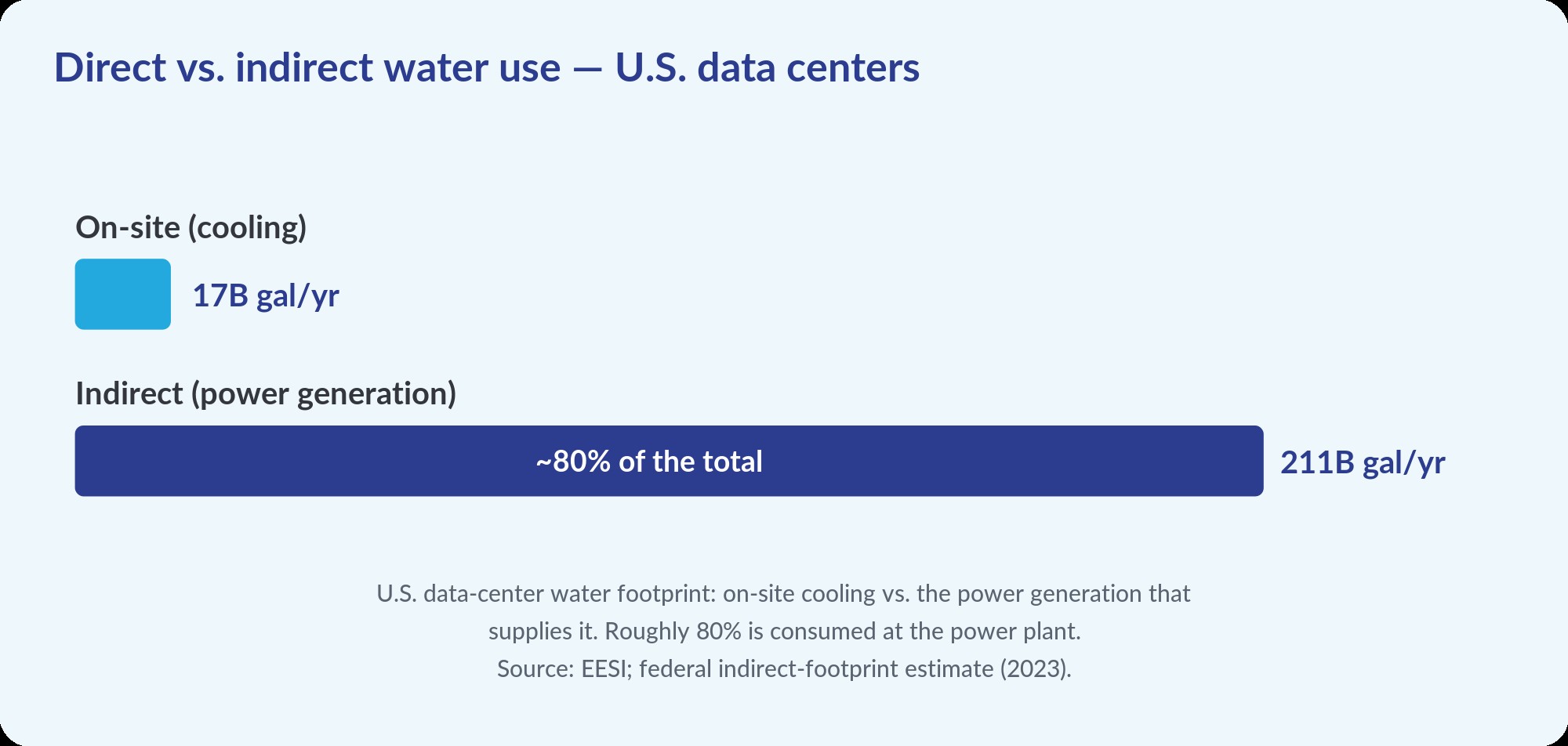
U.S. data centers consume roughly 17 billion gallons of water on site each year. The power plants generating their electricity consume an estimated 211 billion gallons over the same period. About four-fifths of the combined total sits upstream, in power generation rather than in the data center’s own cooling. Corporate reporting on data center water use generally measures the on-site figure, which is the smaller of the two.
The same split appears at the scale of a single AI query. Researchers estimate that one short response from a large model involves about 17 milliliters of water, of which roughly two milliliters cover on-site cooling and the remainder comes from electricity generation.
What closed-loop cooling changes
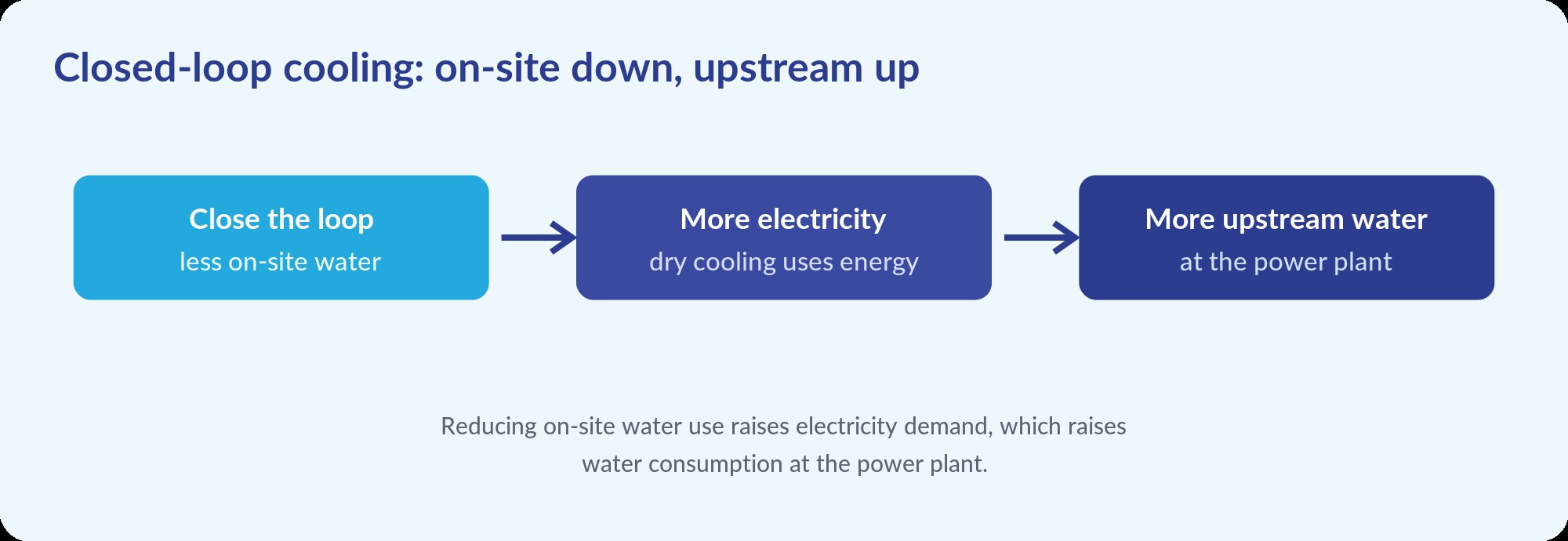
Many operators now use closed-loop or dry cooling, which recirculates a sealed water charge or rejects heat to the air. These designs sharply reduce on-site water use. They also raise electricity use, because rejecting heat without evaporation takes more energy; evaporative cooling lowers peak cooling power by 25 to 35 percent compared with dry cooling.
The additional electricity is generated at power plants that consume water to produce it. So closed-loop cooling lowers the water measured at the data center while raising the water consumed upstream. The total footprint moves rather than falls.
Need real-time water quality monitoring?
KETOS SHIELD continuously monitors 30+ parameters, replacing manual testing with automated, lab-accurate data.
Schedule a Demo →The plants being built for AI run on gas
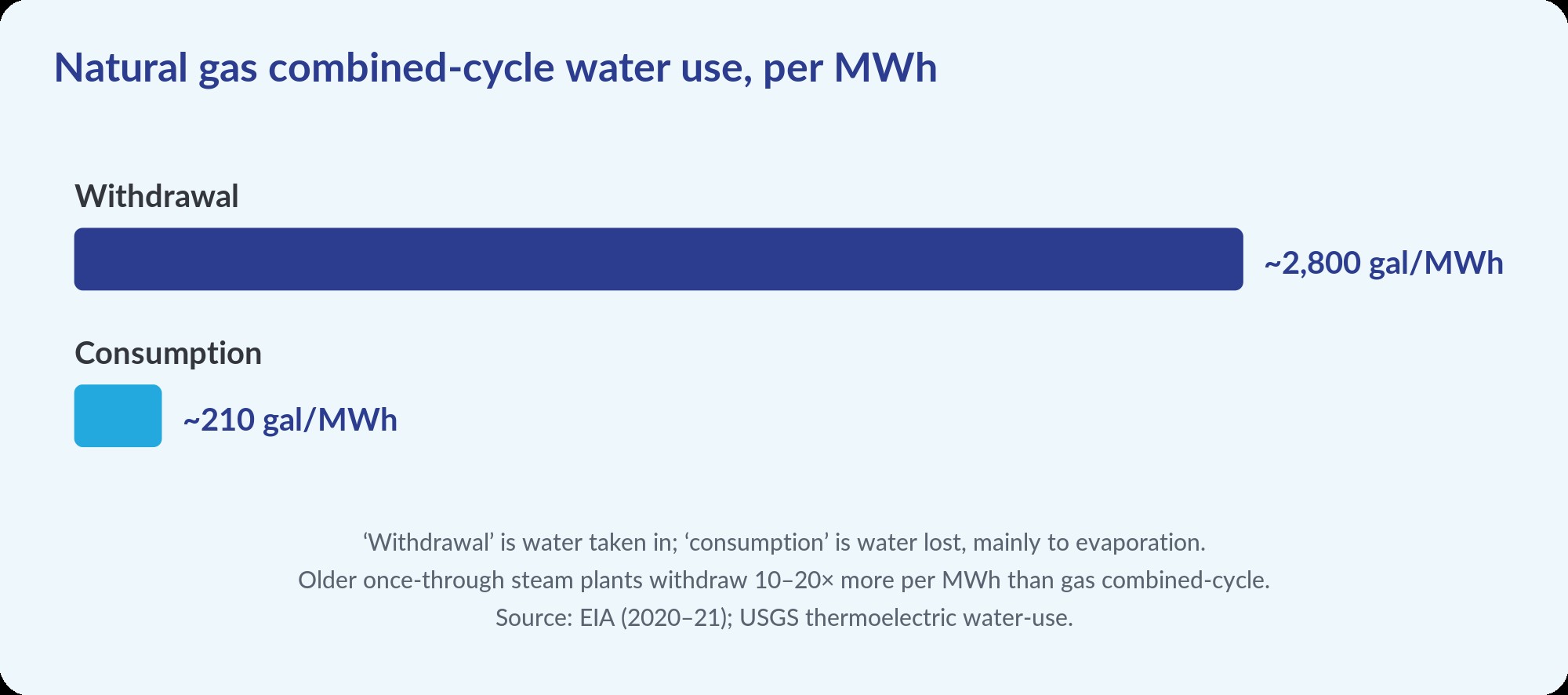
Most of the new generation being built to meet AI demand is natural gas. Combined-cycle gas is the most water-efficient thermal generation at scale, and it still withdraws about 2,800 gallons of water per megawatt-hour and consumes roughly 210. At the scale of a hyperscale campus, those per-megawatt-hour figures add up to large volumes. Thermoelectric power is already the largest single category of water withdrawal in the United States, at about 103 billion gallons per day.
What the plant discharges
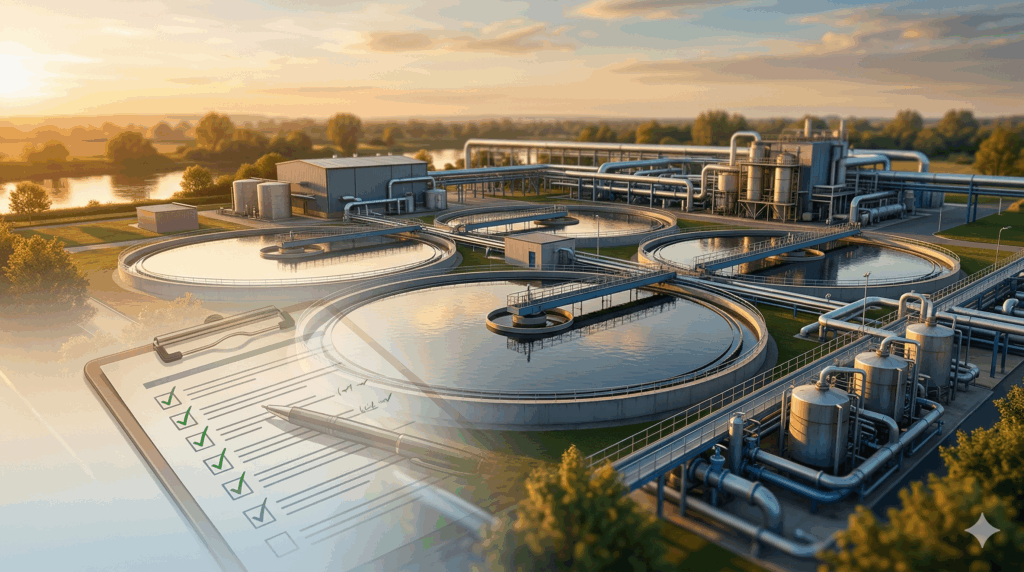
Water use is one side of a power plant’s water profile; discharge is the other. Cooling water returns to the river or bay warmer than it left, usually chlorinated to control biofouling, and blowdown and process streams can carry suspended solids, oil and grease, and metals. Plants that discharge operate under an NPDES permit, which sets enforceable limits on temperature, pH, total suspended solids, residual chlorine, oil and grease, and metals such as copper, zinc, and iron. These are the routine byproducts of using water to move heat.
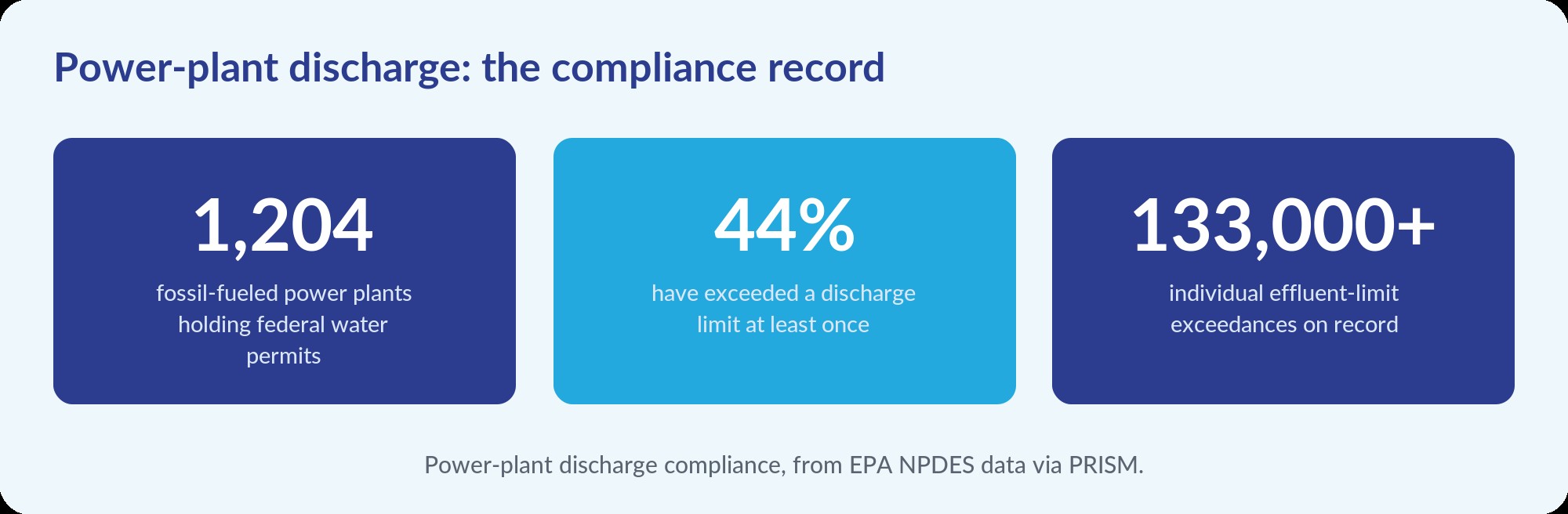
The compliance record for these permits is public. Reading the EPA’s discharge and enforcement data through KETOS PRISM shows how often those limits are exceeded.
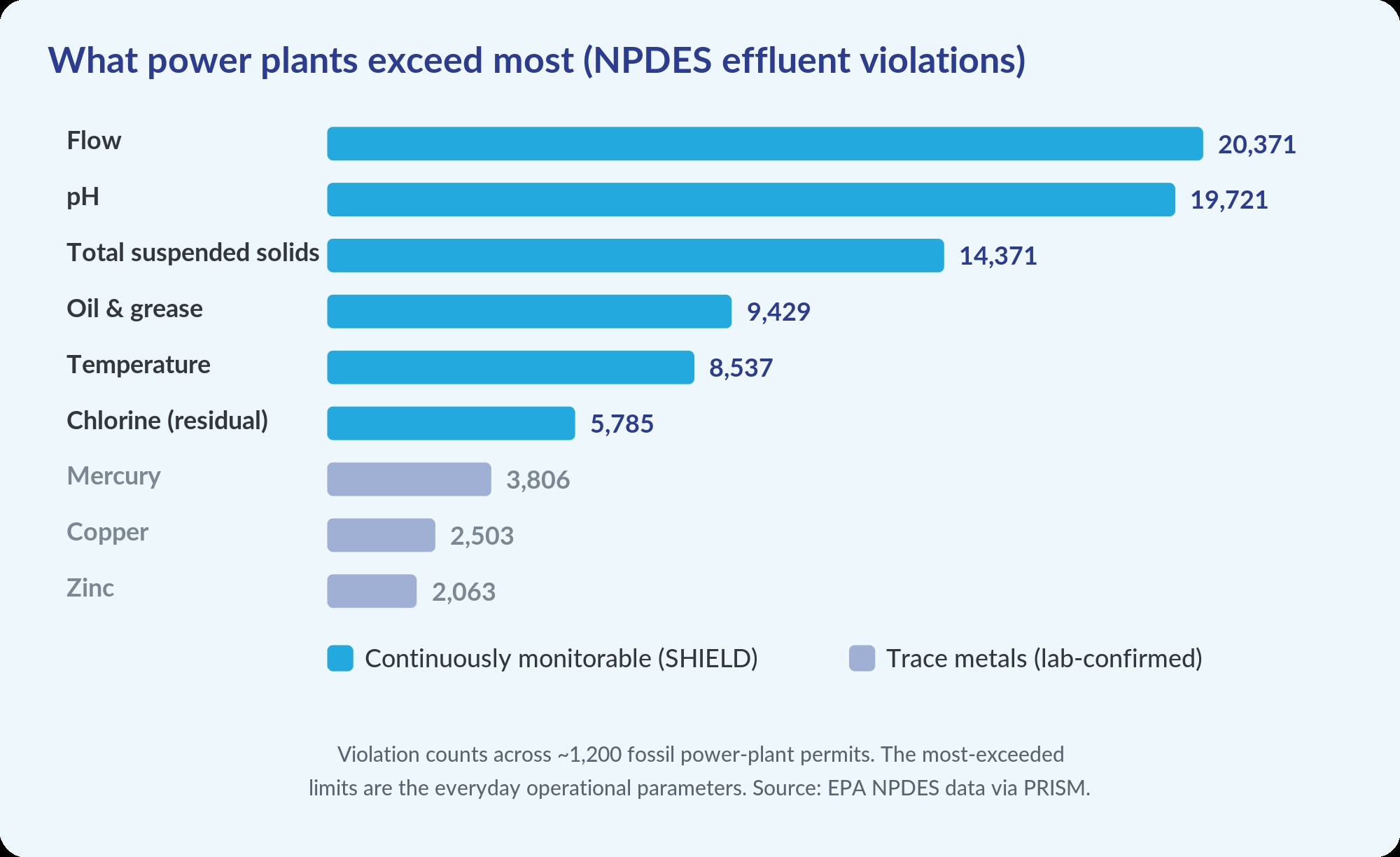
The most frequently exceeded limits are the common operational parameters. Flow, pH, suspended solids, oil and grease, temperature, and chlorine all rank above the trace metals. These are also the parameters that change through the day, which makes them the ones a periodic grab sample is most likely to miss.
Enforcement follows. Power plants account for hundreds of Clean Water Act and RCRA cases, tens of millions of dollars in cash penalties, and considerably larger sums in court-ordered upgrades. In one thermal-discharge case, the required cooling-tower retrofit ran into the hundreds of millions of dollars. For most operators, the mandated capital work costs far more than the penalty itself.
Across roughly 1,200 fossil-fueled power plants, 44 percent have exceeded a discharge limit at least once.
The build-out increases both sides
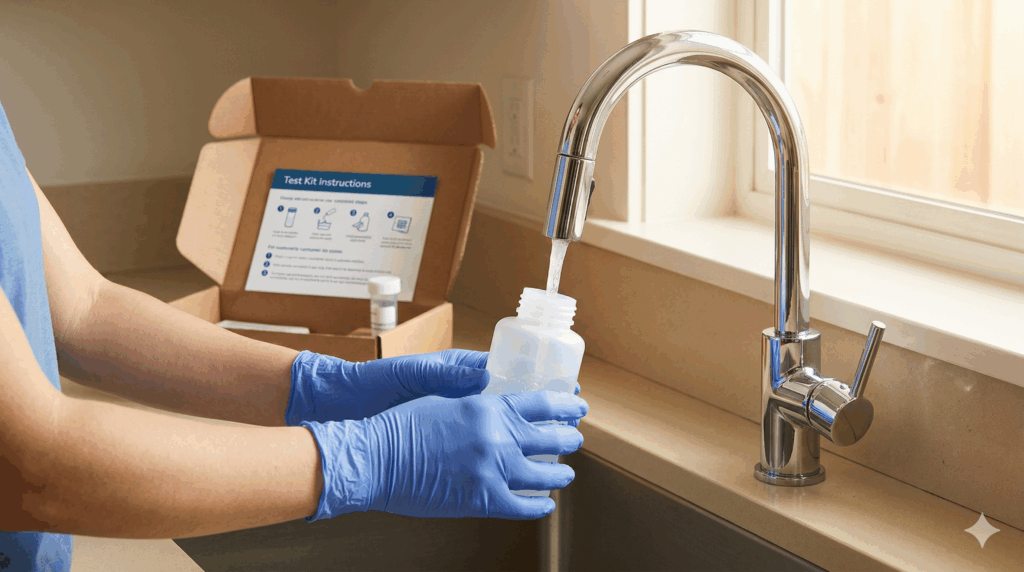
Each gigawatt of new gas capacity added for AI increases both sides of this profile: more water withdrawn and consumed to generate the power, and more heated, treated, metal-bearing water discharged under permit. Most of that discharge is still verified by periodic sampling, where a technician collects a grab sample on a schedule and sends it to a lab, producing a compliance record made of monthly readings. Temperature, pH, and chlorine vary throughout the day, which is why they account for most violations, and a sample collected once a month can miss a multi-day exceedance.
Continuous monitoring addresses this gap. KETOS SHIELD measures up to 30 water-quality parameters in real time, including pH, temperature, conductivity, turbidity, chlorine, nutrients, and metals, which are the same parameters that account for most discharge violations. This gives a plant a live, time-stamped record of both intake and discharge rather than a monthly sample. KETOS PRISM organizes that data into the documented, defensible record that regulators increasingly expect, alongside the public compliance data it already draws on.
As AI-driven demand adds gas generation to the grid, honest accounting of data center water use has to include the water those plants withdraw and discharge, measured continuously rather than sampled occasionally.
Most of the water behind AI is used and discharged at the power plant, not the data center, and most of it is still measured only once a month.
See how KETOS SHIELD monitors discharge in real time.
Sources: EESI, “Data Centers and Water Consumption”; U.S. federal indirect water-footprint estimate (2023); EIA electric-power water-use (2020–21); USGS thermoelectric water withdrawal and consumption; power-plant NPDES effluent-violation and enforcement figures compiled from EPA NPDES/ECHO data via KETOS PRISM (aggregate; no individual facilities named).