


Twelve years ago, a bloom on Lake Erie turned off the water for half a million people. This week the bloom is back, the biggest of the summer, and the taps stayed on. The stories below share one spine: the difference between a crisis and a Tuesday is usually whether somebody was measuring. A lake that is watched, an industry that so far is not, a river system failing two different ways at once, and a hack that walked in through unwatched meters. This page is the companion to our newsletter; each section stands alone.
Inside this week’s edition:
- The bloom came back. The crisis didn’t.
- The question data centers can’t answer
- The reservoir at 1.4 percent
- The hack was bigger than the headline
- By the numbers
- One good sign: the mountain full of ice
The Bloom Came Back. The Crisis Didn’t.
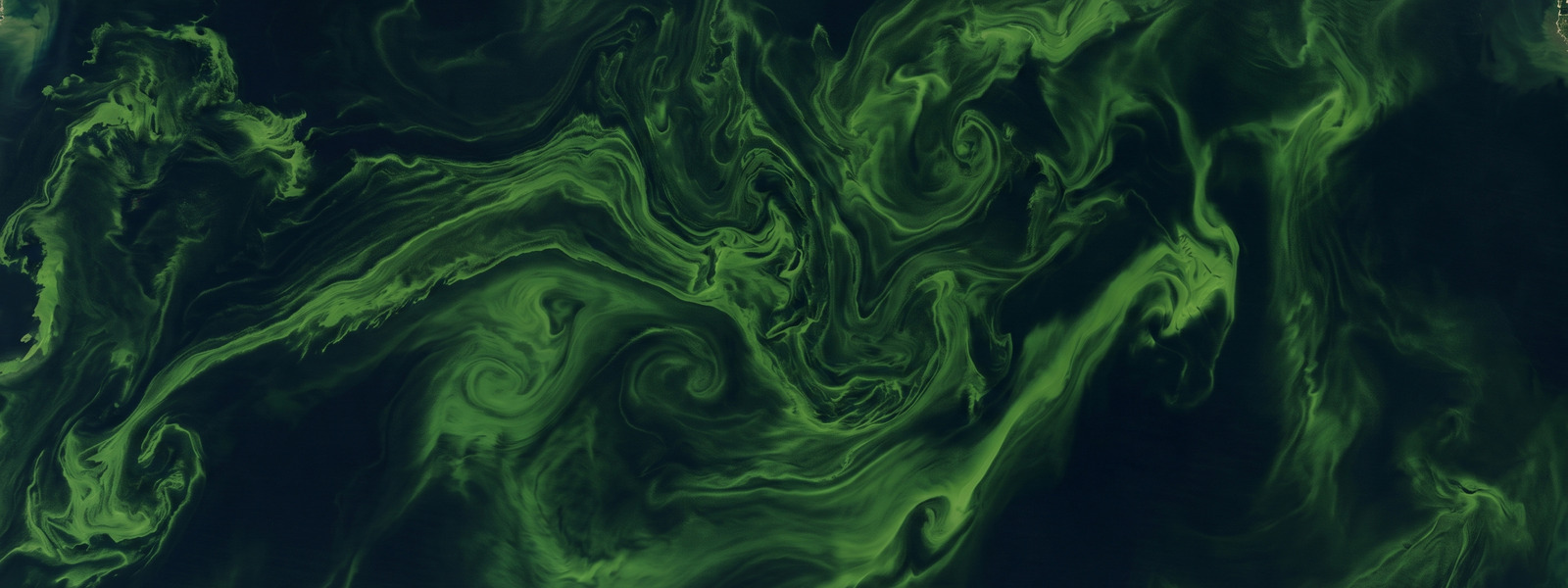
What happened. The harmful algal bloom on western Lake Erie has grown to 480 square miles by NOAA’s late-August bulletin, its largest extent of the summer, concentrated toward Maumee Bay, with the peak expected this month. The bloom’s cyanobacteria produce microcystin, a liver toxin. So far NOAA reports open-water toxin levels below the recreational limit, with the standing caution that toxins concentrate sharply in surface scums. These are the same waters, and the same September physics, that produced the August 2014 crisis, when microcystin got through Toledo’s treatment plant and the city told roughly half a million people not to drink, boil, or even touch their tap water for nearly three days.
What is different. Toledo spent the decade after 2014 rebuilding around one idea: see the toxin coming, and be ready when it arrives. The city has put roughly half a billion dollars into its Collins Park treatment plant, including a $43.9 million ozone facility built specifically to destroy microcystin, quadrupled chemical treatment capacity, and added raw-water monitoring that gives operators advance warning of changing lake conditions. It also publishes a public water-quality dashboard, so the city’s confidence is checkable by anyone, any day.
The nuance operators know. NOAA is careful to say that a bloom’s size is not a measure of its toxicity. Each bloom differs in where the toxin sits in the water column, which matters because intakes draw from below the surface. That is exactly why continuous measurement at the intake beats any forecast: the operative question is “what is in my raw water right now,” and only an instrument at the intake answers it.
The season so far. NOAA’s 2026 seasonal forecast called for a moderate bloom, severity 3.5 on a scale where anything above 5 is severe. September wind patterns will decide how long the peak lasts.
The KETOS read
2014 and 2026 are the same lake, the same nutrient problem, and the same toxin. What changed is that the water is now measured before it reaches the plant, treated by equipment sized for the real threat, and reported publicly while it happens. The bloom returned at full strength, and this time the city saw it coming. For any system drawing from surface water that can bloom, the Toledo arc is the playbook: continuous raw-water monitoring buys the hours that matter, and transparency turns a nervous public into a reassured one.
Sources: NOAA Lake Erie HAB bulletin (late Aug 2026) via The Toledo Blade (Aug 24, 2026); NOAA 2026 western Lake Erie HAB seasonal forecast (NCCOS); City of Toledo water quality dashboard; WTOL reporting on Collins Park upgrades; Shook Construction, Collins Park ozone treatment facility.
The Question Data Centers Can’t Answer
What the public did. In August 2025, a national poll found Americans almost evenly split on a data center being built near their home: 44% in support, 42% opposed. The same poll tested which arguments people found convincing. The top two were higher electricity bills and water consumption. Twelve months later, the same pollster asked again and found 75% opposed, with 61% strongly opposed. Every demographic group moved in the same direction, and rural respondents moved furthest of all.
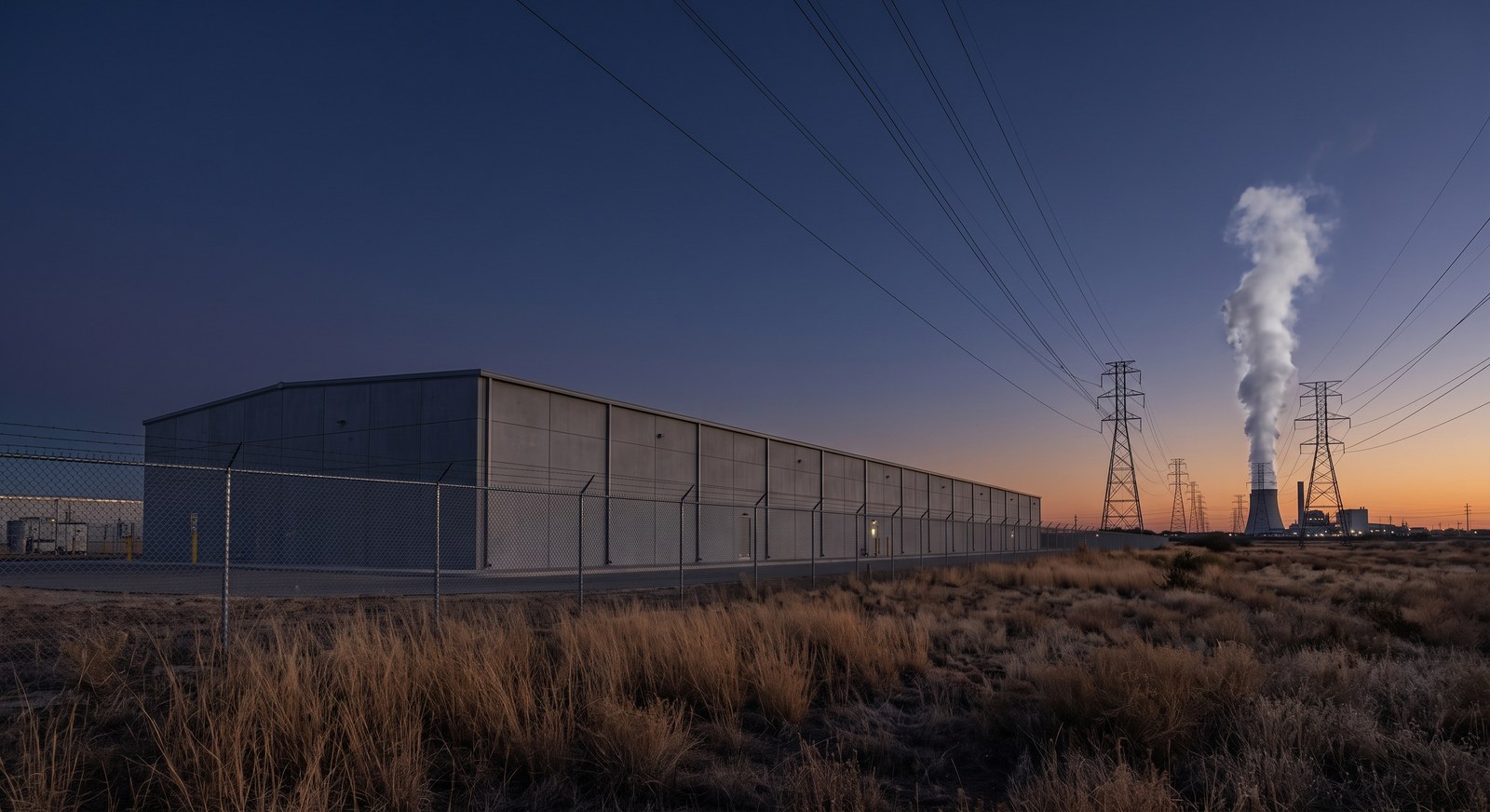
The unanswered survey. Texas offers the cleanest look at why the worry survives contact with reassurance. The Texas Water Development Board sent its mandatory water-use survey to 341 facilities identified as data centers. As of late August, fewer than a third had answered. At this week’s seven-hour state Senate committee hearing, data-center executives testified about their conservation designs while lawmakers weighed the fact that most of the industry had not answered the state’s most basic question: how much water do you use?
The meter is in the wrong place anyway. University of Texas researchers testified that roughly 60% of the water use associated with data centers happens at the power plants generating their electricity, not at the buildings themselves. A new Ceres report, “Water Behind the Watts,” puts national numbers on that: in the seven states holding about half of US data centers, the electricity powering them draws an estimated 3.4 trillion gallons of freshwater a year, and 66% of the water-dependent power plants involved sit in areas of medium-high to extremely high water stress. A facility can truthfully report a modest on-site water bill while its real water footprint sits two counties away, at the plant that powers it.
What our own data shows. KETOS analyzed 103,341 English-language news articles about data centers from January 2022 through June 2026, classifying headline sentiment month by month. Net sentiment ran +54 points in 2022. In the first half of 2026 it was minus 5, and March 2026 was the first month on record where negative coverage outweighed positive. Community opposition grew from 5% of coverage themes to 22%. And one finding matters most for what comes next: coverage of the energy question peaked in late 2024 and has been falling since, while water-related coverage is still climbing toward its peak.
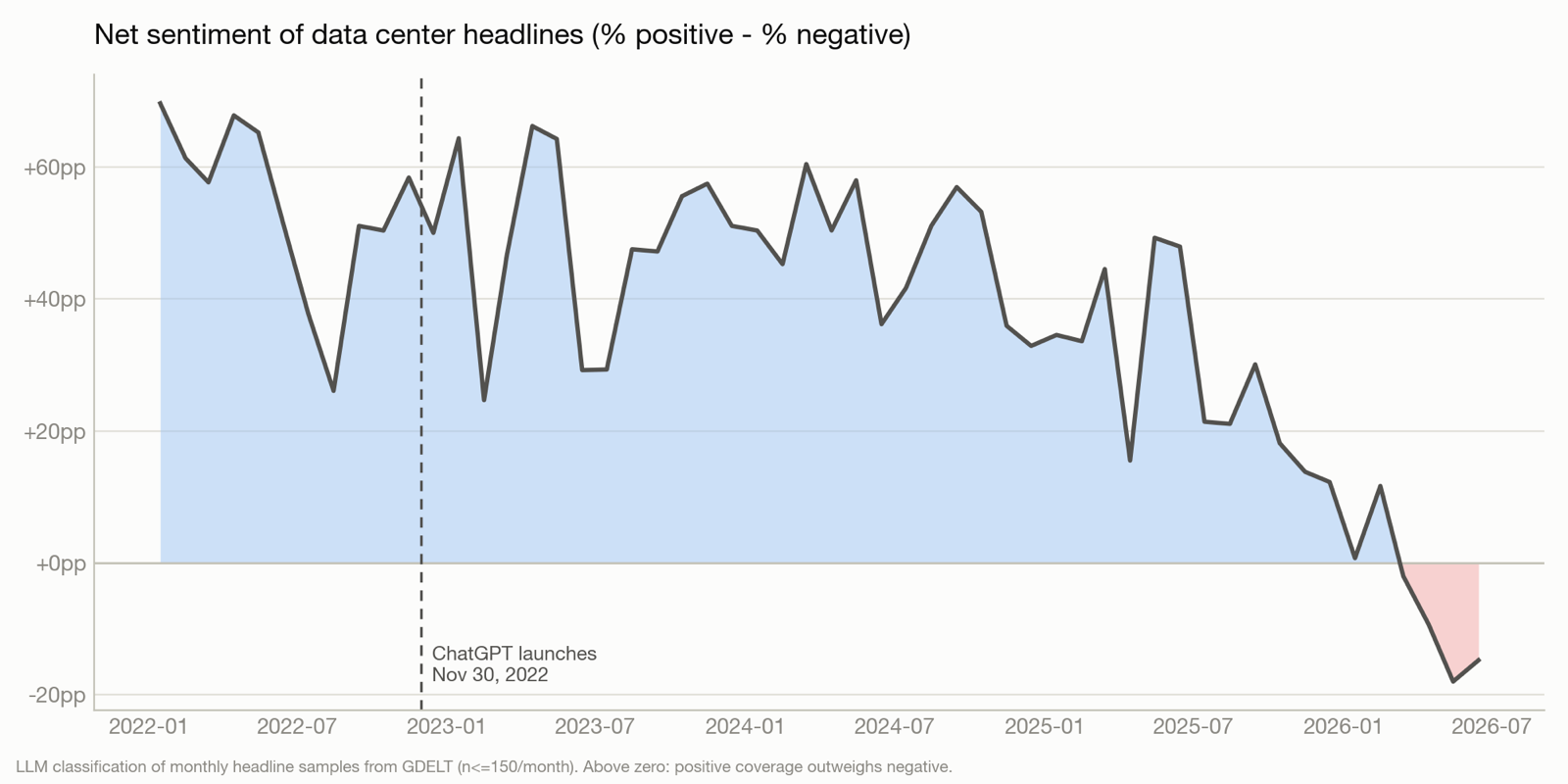
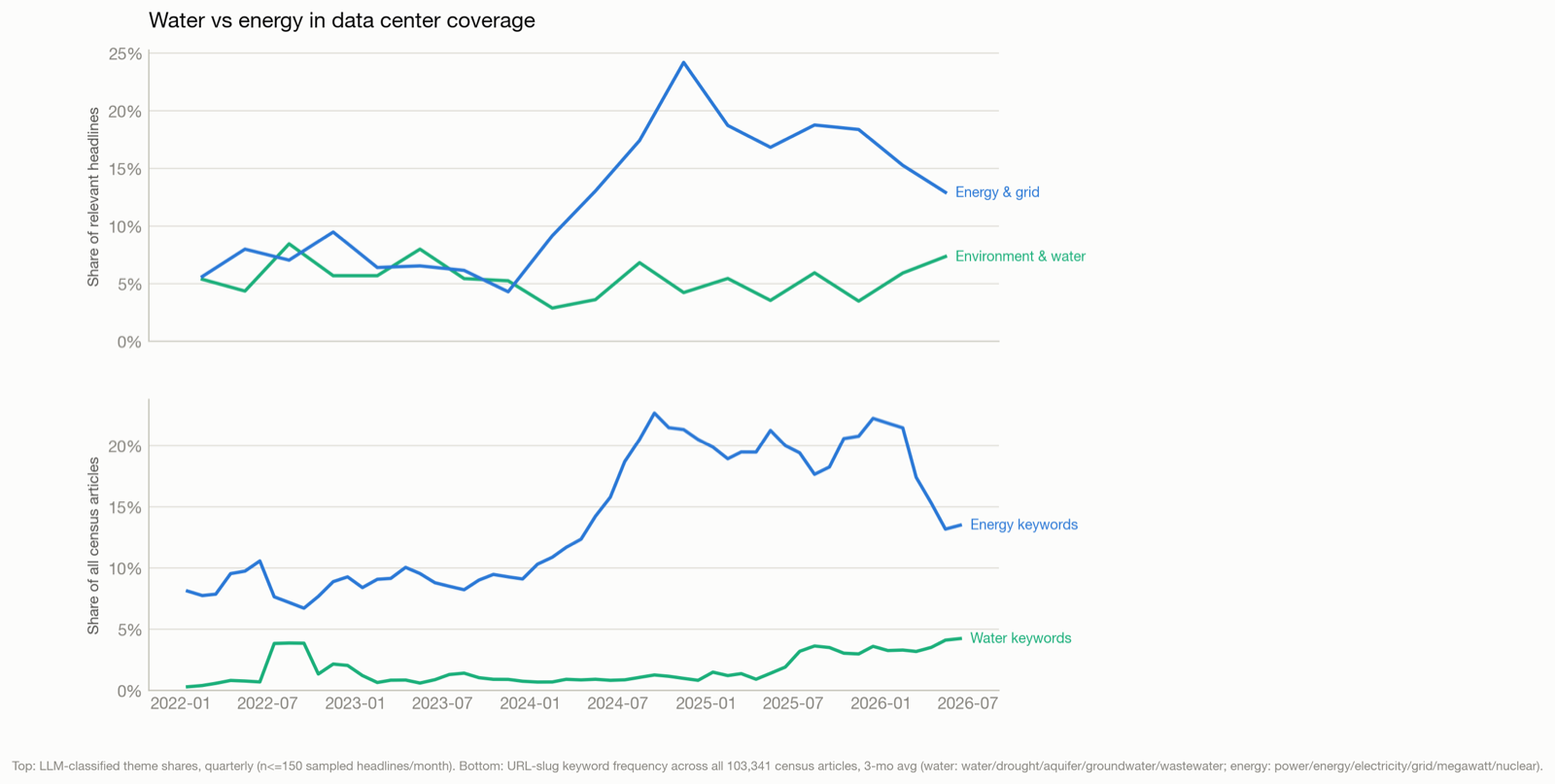
The full dataset, methodology, and charts are open at github.com/ganesh-ketos/datacenter-media-sentiment.
The KETOS read
When a question climbs the political ladder, measurement usually failed first. The polling says less about cooling loops than about trust: people asked a reasonable question, got silence, and silence compounds. The fix is metering rather than messaging: measured, disclosed, third-party-checkable water data, for the facility and for the power behind it. Utilities negotiating with data-center customers are in the strongest position they have had in years to make continuous measurement and disclosure a condition of service, and the operators who volunteer it will be the ones still welcome in town in five years.
Sources: Heatmap Pro / Embold Research national polls (Aug 2025, n=3,741; Aug 2026, n=2,045); Texas Water Development Board testimony via Texas Tribune wire reports (Sep 2–3, 2026); Texas Senate Committee on Water, Agriculture and Rural Affairs interim hearing coverage (Courthouse News, KCBD, KUT, Sep 2, 2026); Ceres, “Water Behind the Watts: The Hidden Risk of Powering Data Centers” (Aug 2026); KETOS, Datacenter Media Sentiment (2026), data via the GDELT Project.
Need real-time water quality monitoring?
KETOS SHIELD continuously monitors 30+ parameters, replacing manual testing with automated, lab-accurate data.
Schedule a Demo →The Reservoir at 1.4 Percent
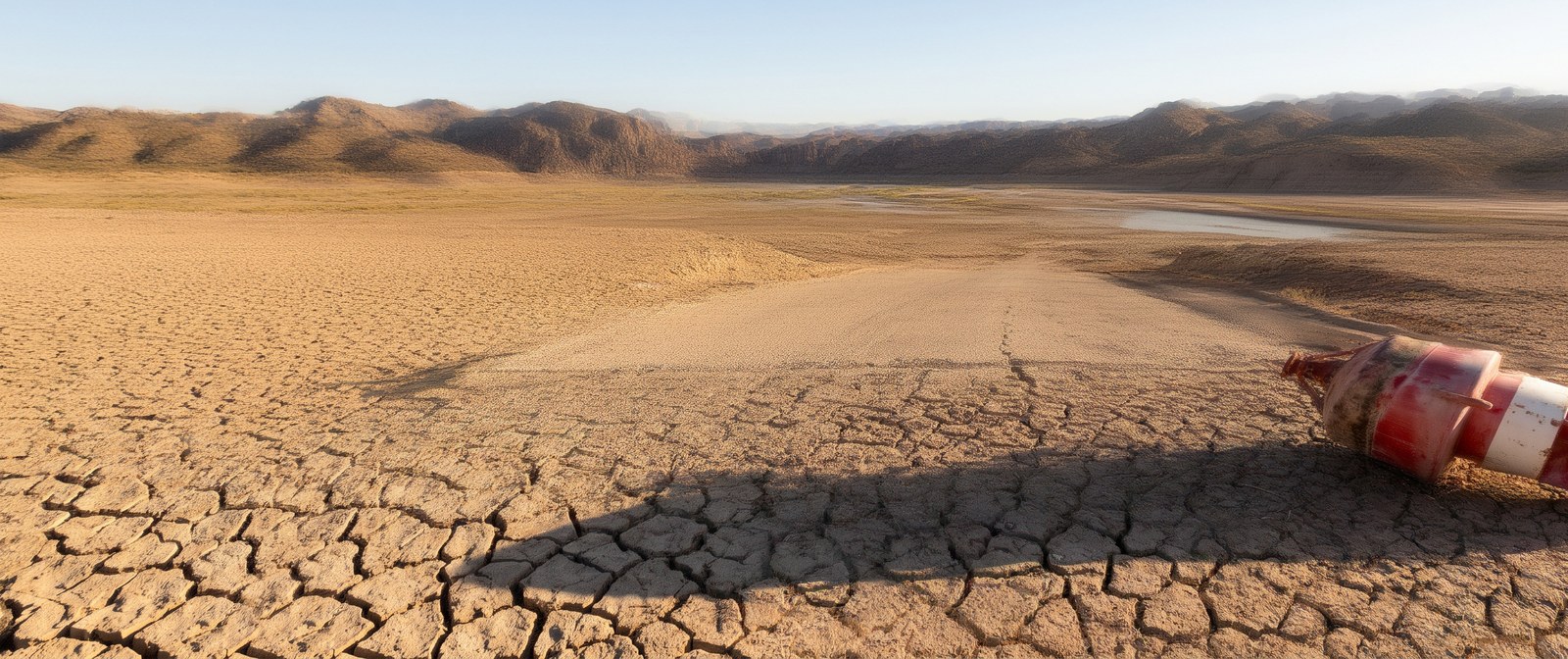
The slow failure. Elephant Butte, the largest reservoir in New Mexico, stood at 1.4% of capacity in late summer, its lowest level since 1971. In the last great drought scare, in July 2013, it bottomed out at 2.9%. This year holds half that. The immediate cause was the earliest snowmelt on record in the Rio Grande’s Rocky Mountain headwaters, stacked on years of drought. The reservoir waters a valley that grows alfalfa, cotton, pecans, onions, and Hatch green chiles, and its releases are shared between New Mexico and Texas under decades-old agreements now under real strain.
The fast failure. The same week, Truth or Consequences, the small city just downstream of Elephant Butte dam, went two days without running water. Not because of the reservoir: the city drinks from wells, and the outage began when a water-system pump failed over a weekend and a contractor broke a main that Monday. Well levels in the city system fell from around 20 feet to a single foot before recovery. Water came back Tuesday, with a precautionary boil order pending clean samples.
Why tell them together. Together they show the two clocks a water system runs on: the slow one everyone watches for decades, and the fast one that catches a town on a Monday morning. The second kind gets fixed faster when it is measured like the first kind: pump health, tank levels, system pressure, well drawdown, tracked continuously instead of discovered at failure.
The KETOS read
Drought gets the headlines, but for most systems the outage arrives through the equipment, not the climate. A town watching its reservoir empty for two decades still lost water to a pump and a backhoe. Continuous operational monitoring, on levels, pressures, and equipment, is how small systems buy the early warning that big systems get from a full control room.
Sources: NASA Earth Observatory (imagery and analysis, July–Aug 2026); Water Data for Texas, Elephant Butte gauge (Sep 1, 2026); Albuquerque Journal (Sep 2, 2026).
The Hack Was Bigger Than the Headline
The update. In August we covered intrusions at water utilities across seven states. The count grew. CISA now links the July campaign to more than 100 water systems across at least a dozen states. The entry point was ordinary: programmable logic controllers exposed to the open internet, many through cellular modems, some still wearing default credentials. No water quality was affected anywhere, in most cases because operators isolated equipment and ran processes manually, exactly as they did in July.
The response. On August 31, EPA announced $11.75 million in grants under its resilience program for drinking water systems serving 10,000 people or more, funding ten projects across six states, including SCADA modernization. The Congressional Research Service published a briefing the same week laying out the policy options: more grant funding, mandatory risk assessments, and enforceable cybersecurity standards for water.
What to check. CISA’s guidance is unglamorous and immediate: know every device on your network that can reach the internet, change every default credential, put the PLCs behind a VPN, and have a manual-operations plan you have actually rehearsed.
The KETOS read
The systems that shrugged this off had two things: operators who could run the plant by hand, and visibility into what their equipment was doing. Resilience turned out to be self-knowledge, knowing your system well enough to notice when it stops being yours.
Sources: CISA advisory and reporting (Bloomberg, Sep 2, 2026; Cybersecurity Dive; CPO Magazine); EPA news release (Aug 31, 2026); Congressional Research Service via Circle of Blue Federal Water Tap (Aug 31, 2026).
By the Numbers
- 10,000: lead service lines replaced by Greater Cincinnati Water Works since 2018. The city marked the milestone on August 26; the program was one of the first in the country, begun in the shadow of Flint.
- 24.2 billion tonnes: groundwater lost each year from the “Asian water tower,” the high-mountain region feeding rivers that more than a dozen countries depend on, per a new satellite-based study.
- 900,000: people who would be protected by the Army Corps’ proposed expansion of the Yolo Bypass flood system around Sacramento. Public comments are open until September 18.
- 0.3 µg/L: EPA’s drinking water health advisory for microcystin for children under school age. It is the line Toledo’s plant holds every day of bloom season.
One Good Sign: The Mountain Full of Ice
Geophysicists running gravity surveys beneath Mount Timpanogos in Utah found something missing from every map: a substantial reservoir of buried glacial ice inside the mountain, rock-covered remnant ice left behind after the surface glaciers melted away. It is early science, and nobody is piping it anywhere. But in a week when the West’s visible reservoirs made grim news, the reminder is welcome: we are still discovering water we did not know we had, and the instrument that found it was, as usual, a better measurement.
Sources: gravity-survey findings reported via ScienceDaily (Aug 27, 2026).
KETOS builds continuous water-quality monitoring for utilities and industry. If a story here touched a problem you own, we would like to hear how you see it: reply to the newsletter, or find us at ketos.co.