


Every water system that chlorinates is running a controlled chemical reaction, and this week New York published what happens when the byproducts of that reaction outrun the rule that is supposed to catch them. The stories below share a spine: the gap between what is in the water and what the monitoring schedule can see. A toxin that forms between quarterly samples, a particle found everywhere anyone has looked for it but tracked almost nowhere, a data center whose water plans finally landed on the public record, and a proposed redrawing of which waters get watched at all. This page is the companion to our newsletter; each section stands alone.
Inside this week’s edition:
- The toxin the treatment made
- No groundwater came back clean
- The water asks go on the record
- After the hack, the help
- Redrawing “waters of the United States”
- By the numbers
- One good sign: the pollutant that tells time
The Toxin the Treatment Made
What happened. A NYCity News Service and New York Focus analysis of 2024 state Department of Health data, the latest available, found 79 public water systems across New York with contaminants above state limits. Those systems serve more than 575,000 people, from Long Island suburbs to Adirondack villages, though the state notes that some water recorded as contaminated may not have been delivered to customers. The list of twelve regulated contaminants runs from arsenic and radium to PFAS and 1,4-dioxane. But the case that opens the story is stranger than an industrial spill: in the village of Tupper Lake, the contaminant is a product of the water treatment itself.
The chemistry. Tupper Lake’s water is tainted with HAA5, five haloacetic acids that form when chlorine reacts with natural organic matter in the source water. Chlorination earned its permanence: it is the disinfection step that ended typhoid and cholera as American realities. The byproducts are the fine print. Long-term exposure to HAA5 is associated with elevated cancer risk and liver and kidney damage, and the federal and state limit is 60 micrograms per liter. Tupper Lake averaged 63.1 in the data studied. One test came in at 184. In the fourth quarter of 2025, the village’s level was 92.8. Its drinking water has violated the federal Safe Drinking Water Act since at least 2014.
How a number that high stays legal. The HAA5 standard is enforced as a running annual average of quarterly samples. That design smooths seasonal chemistry into a single yearly number, and DBP formation is seasonal: warmer water and higher organic loads push byproduct formation up, and a spike that lands between two quarterly lab grabs never appears in the record at all. Tupper Lake’s own numbers show the spread, with a yearly average of 63.1 and at least one grab at 184, three times the limit. The village’s public notices tell residents the water is suitable to drink and bathe in while suggesting carbon filters and ventilated bathrooms.
The fix is expensive and slow. Told by the state to find a different source, the village drilled two wells, taking on $9 million in debt spread across 2,800 customers. The wells then developed iron and manganese problems that turned taps brown, at concentrations several times the federal cosmetic guideline, and could not supply the whole village anyway, forcing a blend with the old surface water. The plan now is a third well and a $25 million filtration plant, targeted for 2028, helped by a $12.5 million state capital allocation the village won this year. Fourteen years will have passed between the first violations and the projected fix.
The national picture. Roughly 279 million Americans are served by community water systems, the vast majority disinfected with chlorine-based chemistry, and a peer-reviewed 2020 analysis by Environmental Working Group scientists attributed approximately 6,800 bladder cancer cases per year in the US to disinfection byproducts as a class. DBPs are among the few drinking-water contaminants that nearly every system in the country manufactures on site, every day, by design.
The KETOS read
Chlorination stays; the diseases it stopped were far worse than the byproducts it makes. The argument here is with measuring a fast-moving chemistry four times a year. HAA5 formation tracks things an operator can watch continuously: organic load in the source water, chlorine dose and residual, temperature, retention time. A system that monitors those in real time sees byproduct risk forming days before any lab grab would catch it, and can adjust dose, flushing, or blending while the number is still below the line. The quarterly average was designed to prove compliance after the fact. Steering the chemistry day to day takes a live signal, and Tupper Lake sits in the gap between those two jobs.
Sources: NYCity News Service / New York Focus, “Toxins on Tap” (Sep 8, 2026); NY State Department of Health drinking water data (2024); EPA Stage 2 Disinfectants and Disinfection Byproducts Rule (plain-English guide); Evans, Campbell & Naidenko, “Cumulative Cancer Risk of Disinfection Byproducts in US Drinking Water”, Int. J. Environ. Res. Public Health (2020).
No Groundwater Came Back Clean

What happened. A systematic review in the Journal of Hazardous Materials pulled together every field study of microplastics in groundwater published from 2019 through 2026: 82 studies across 28 countries. The authors sorted the results into eight hydrogeological settings, from karst to alluvial aquifers, and every one of the eight contained microplastics. In the review’s own words, none of the groundwater environments investigated to date is free from contamination. Half the world drinks from groundwater.
The number that is really a question. Reported concentrations span six orders of magnitude, from 0.001 to 2,103 particles per liter. Some of that range is real hydrogeology. More of it, the authors argue, is method: sample volumes across the field ranged from a tenth of a liter to 15,000 liters, only 8.5% of studies reported purging wells before sampling, and blank-correction procedures frequently failed basic quality-assurance criteria. Polyethylene and polypropylene dominate the polymer counts, fibers dominate the shapes, and almost nothing else about the numbers can be compared study to study.
The regulatory catch. The EU has already decided microplastics belong on its groundwater watch list. The trigger, written into the Council document, is the availability of reliable and cost-effective sampling and analytical methods, and the review counts ten distinct gaps standing between today’s science and that bar, with a 2029 reporting deadline under the Drinking Water Directive approaching. The regulation is waiting on the measurement.
The KETOS read
This is what a contaminant looks like before the instrumentation exists. Every search finds it, the numbers resist comparison, and the EU’s rule stays dormant until measurement catches up. Manganese ran the same arc, and PFAS after it: measurement improved, and the map of the problem redrew itself. Whoever standardizes microplastic monitoring will shape what the world believes about microplastics in its water. For utilities, the practical move now is boring and valuable: know your source water’s vulnerability, especially for young groundwater connected to the surface, because that is where the particles arrive first.
Sources: Sajid, Alfio, Vasileiou & Balacco, “Microplastics in groundwater: an updated systematic review”, Journal of Hazardous Materials 516:143318 (Sep 2026); EU Council Document ST-14144/2025 as cited therein.
Concerned about contaminants in your water?
Get water testing from KETOS KELP using EPA-certified methodology, results you can trust, backed by real data.
Order a Water Test →The Water Asks Go on the Record
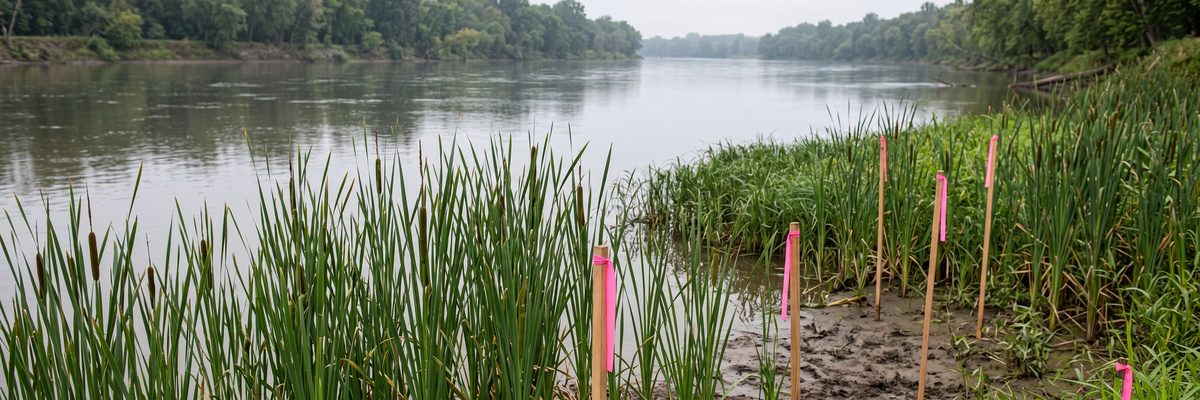
What happened. The Army Corps of Engineers is taking public comment on a wetlands application from Project Dazzler, a data-center development in Scioto County, on the Ohio River in southern Ohio, that public reporting links to Google through the developer Tilted Gate LLC. The application asks to fill just over three acres of wetlands on a 792-acre site, with the developer funding wetlands restoration elsewhere as the offset. Comments close September 17.
Why it matters. Last week’s story was an industry declining to answer a state’s water survey. A federal permit application is the opposite kind of document: specific acreage, a named site, a stated offset, a docket anyone can comment on. The wetlands filing is a small ask in itself. Its significance is the precedent that the water dimension of these projects is entering the public record where it can be measured, challenged, and tracked, project by project.
The KETOS read
A permit is a number with a signature on it, and numbers on the record are the beginning of accountability. The gap we flagged last week has not closed: the permit covers wetlands acreage, not operational water draw, and no filing yet requires continuous disclosure of what a running facility actually consumes. The communities and utilities reviewing these applications are in the best position to ask for that while the ink is still wet.
Sources: Circle of Blue, Federal Water Tap (Sep 8, 2026); US Army Corps of Engineers public notice (comments due Sep 17, 2026).
After the Hack, the Help
What happened. The White House launched Project Watershed 250, a public-private program that provides cybersecurity assistance to water systems, starting in Texas. It follows the August intrusions that CISA ultimately tied to more than 100 water systems across a dozen states, and it lands alongside EPA’s $11.75 million in resilience grants to ten drinking-water utilities announced at the end of August.
What operators can do with it. The operator playbook stays the same: inventory every internet-reachable device, retire default credentials, put controllers behind a VPN, and rehearse manual operations. New this month, a utility too small to staff any of that has a federal program built to lend the hands.
The KETOS read
The systems that shrugged off August’s campaign knew their own equipment well enough to notice when something else was driving it. Assistance programs can supply expertise, while the inventory, the baselines, and the habit of watching your own telemetry still have to live in-house. Take the help, and use it to build the visibility you keep.
Sources: Circle of Blue, Federal Water Tap (Sep 8, 2026); EPA news release (Aug 31, 2026); CISA advisories via prior reporting.
Redrawing “Waters of the United States”
What happened. EPA and the Army Corps proposed a narrower definition of the waters the Clean Water Act covers. The draft tightens the meaning of “relatively permanent” to a waterbody that dries no more than once a year, for no more than 30 days, and reworks “continuous surface connection” and “perennial” alongside it. Streams that run dry seasonally, and wetlands connected to them, would move out of federal jurisdiction. A 30-day public comment period is open on regulations.gov under docket EPA-HQ-OW-2025-0322.
The technical stakes. Across the arid West, seasonal streams make up most of the stream miles, and they feed the perennial rivers that carry water supplies. Jurisdiction determines which discharges need federal permits and which waters federal enforcement can reach. Where federal coverage recedes, state rules and state monitoring become the whole story, and states vary enormously in both.
The KETOS read
Wherever the jurisdictional line lands, the water keeps flowing where it always did. A stream that leaves federal jurisdiction still feeds somebody’s source water, and the practical question for a utility stays the same: do you know what is arriving upstream of your intake? A utility that measures its own watershed is insulated from definitional weather in Washington. One that leaned on someone else’s permit requirements for that visibility may be about to learn how much of it was borrowed.
Sources: Circle of Blue, Federal Water Tap (Sep 8, 2026); EPA/Army Corps proposed rule, docket EPA-HQ-OW-2025-0322.
By the Numbers
- 6,800: bladder cancer cases per year in the US attributed to disinfection byproducts as a class, per the peer-reviewed 2020 EWG analysis. The same study put the lifetime total near 828,000.
- 69%: share of 105 private wells tested this summer in Tremont, Maine, with detectable PFAS. 17% exceeded the state’s interim standard. Private wells sit outside public-system monitoring entirely.
- 48: water infrastructure projects, all financed through State Revolving Funds, that EPA recognized for excellence and innovation at this year’s CIFA summit.
- 2029: the reporting deadline under the EU Drinking Water Directive that microplastics science is now racing, with the watch-list decision waiting on reliable measurement methods.
One Good Sign: The Pollutant That Tells Time

Plastic production only took off after 1950, and a team from the University of Pisa, the UK Environment Agency, and the University of Birmingham has turned that accident of history into a tool. Because no groundwater older than the plastic age can contain microplastics on its own, finding them in a well dates the water: they mark recent recharge, and in water that should be old, they flag mixing or artificial recharge that nobody had mapped. Particle size, polymer, and shape carry further information that dissolved tracers cannot. It is early methodology, best suited to young aquifers connected to the surface. But there is something quietly hopeful in it: the same particle that made this week’s grim map of groundwater is also a new instrument for understanding how that water moves.
Sources: Zambelli et al., “Microplastics as Emerging Cotracers in Groundwater Quality Assessments”, ACS ES&T Water 6(6) (2026).
KETOS builds continuous water-quality monitoring for utilities and industry. If a story here touched a problem you own, we would like to hear how you see it: reply to the newsletter, or find us at ketos.co.