


How to test for PFAS in water comes down to three real options: a rapid test strip, an at-home extraction kit you mail to a lab, or a full laboratory panel. The right one depends on whether you need a rough signal or a number you can actually compare against the EPA’s 4 ppt federal limit for PFOA and PFOS. Every method on this page claims to “test for PFAS,” but only some of them measure low enough for that claim to mean anything against a federal standard measured in parts per trillion.
How to Test for PFAS in Water: What Are Your Three Options?
Three products answer “how do I test for PFAS,” and they are not interchangeable.
- Rapid test strips. Dip or swab a sample and read a color change in minutes, using immunoassay chemistry built for a fast, low-cost first look rather than a precise number.
- At-home extraction, mail-in kits. Run tap water through a collection disk or cartridge at home, then mail it to a lab for instrument analysis; you handle the collection step, the lab handles the chemistry.
- Full laboratory panels. Collect a water sample into lab-supplied bottles and ship it to a lab running EPA Method 533 or 537.1, the methods behind the EPA’s own compliance monitoring.
All three claim to test for PFAS. Only two of them report a number sensitive enough to mean anything against a 4 ppt standard.
How Sensitive Is Each Method, Really?
Sensitivity is where these three options actually separate.
| Method | How it works | Typical detection limit | Compares to the 4 ppt MCL? |
|---|---|---|---|
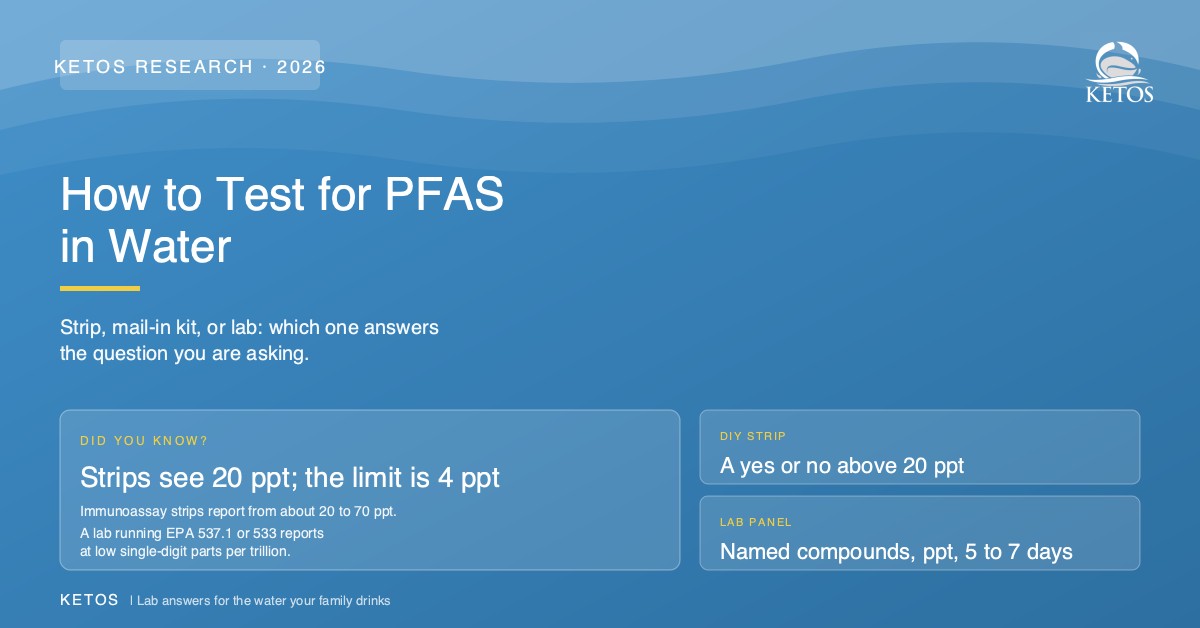
| Test strips (immunoassay) | Dip or swab, color-change result in minutes | Roughly 20 to 70 ppt | No, strips only read far above the limit |
| At-home extraction, mail-in kit | Collect at home, mail an extraction disk or cartridge to a lab | Lab-analyzed; sensitivity varies by kit and isn’t always published | Depends on the specific kit; check before ordering |
| Full laboratory panel (EPA Method 533 or 537.1) | Collect a water sample, ship to an EPA-method lab | Roughly 2 to 10 ppt depending on compound | Yes |
A strip reading “negative” at the roughly 20 to 70 ppt detection floor the Interstate Technology and Regulatory Council (ITRC) reports for immunoassay strips, last verified by this program against ITRC’s guidance on 2026-08-20, tells you almost nothing about whether your water is above or below 4 ppt; the strip simply cannot see that low. A full lab panel, reporting in the low single digits to low double digits of parts per trillion, is the only option built to answer the federal-limit question directly.
Concerned about contaminants in your water?
Get water testing from KETOS KELP using EPA-certified methodology, results you can trust, backed by real data.
Order a Water Test →When Is a Test Strip Actually Fine?
A strip earns its place for gross screening.
If you’re checking for obvious, heavy contamination, such as water near a known industrial discharge or firefighting-foam site, a strip can flag a problem fast and cheap. A clean strip result does not mean your PFAS level is under 4 ppt. It only means the level is under roughly 20 to 70 ppt, five to seventeen times the federal limit. Treat a negative strip result as a reason to retest with a lab if it matters.
When Do You Actually Need a Lab?
You need a lab any time the answer has to hold up: before a home purchase, if you’re on a private well with no utility testing, if a strip came back positive and you want a real number, or if you simply want a result that means something against the 4 ppt standard. None of those situations are well served by a method that only starts detecting PFAS at concentrations five to seventeen times the federal limit.
USGS testing in 2023 found PFAS in at least 45% of U.S. tap water sampled nationally, with similar concentrations in private wells and public supplies. If you’ve decided a lab is the right call and want to know when to actually send the sample and what the South Bay logistics look like, see PFAS Water Testing Near Me.
What Do EPA Methods 533 and 537.1 Actually Measure?
Both are EPA-validated laboratory methods that isolate and quantify individual PFAS compounds using liquid chromatography and mass spectrometry, run only at labs equipped for trace analysis. This page does not cover method mechanics in depth; see How to Test Your Water for PFAS for the full walkthrough of sample collection and how to read a lab report.
How to Choose: A Quick Decision Guide
Matching the method to the situation is simpler than the options make it look.
- Curious, no known risk factor, want a fast first look: a test strip is a reasonable starting point, as long as you treat a negative as inconclusive rather than clean.
- Strip came back positive, or you don’t trust a negative: move to a full lab panel for a number you can act on.
- Buying a home, or on a private well: skip the strip and go straight to a lab panel; a screening tool isn’t enough for a decision this size.
- Want PFAS answered alongside metals and general water chemistry from one sample: a full lab panel, such as KETOS KELP’s PFAS packages starting at $280, covers PFAS and the rest of your water together.
- Want the cheapest laboratory-grade number available: an at-home extraction kit can work, but confirm its published detection limit before ordering, since not every kit discloses one.
Whichever method you start with, check its published detection limit against the EPA’s 4 ppt standard before you rely on the result.
Frequently Asked Questions
Four questions people ask most when deciding how to test for PFAS in water.
How do I test my water for PFAS at home?
You have three options: a rapid test strip for a quick, low-sensitivity signal; an at-home extraction kit you mail to a lab; or a full laboratory panel using EPA Method 533 or 537.1. Only the lab-analyzed options report low enough to compare against the EPA’s 4 ppt federal limit.
Can a test strip tell me if my water is safe?
Not reliably. Test strips detect PFAS at roughly 20 to 70 ppt, far above the EPA’s 4 ppt limit for PFOA and PFOS. A negative strip result means your PFAS level is below the strip’s detection floor, not necessarily below the federal limit.
What’s the difference between a home PFAS kit and a lab test?
An at-home kit collects the sample (sometimes with on-site extraction), but the actual analysis still happens at a laboratory using instruments capable of parts-per-trillion detection. The difference between kits is what gets measured, how many compounds, and what detection limit the lab reports. A laboratory is involved either way.
How much does a PFAS lab test cost?
Laboratory PFAS panels range from about $85 for a basic screening-only kit to $699 for a broad panel that also covers metals and water chemistry. See our PFAS test kit comparison for the full vendor-by-vendor pricing.
KETOS Environmental Lab Services
The Sunnyvale lab behind KELP’s PFAS panels, for anyone who has decided a lab result is what they need.
KETOS Environmental Lab Services
520 Mercury Dr, Sunnyvale, CA 94085
(408) 357-4745
Google Business Profile category: Water testing service
See current hours on the Google Business Profile.
Get directions
Ready for a number instead of a guess? Order a KETOS KELP PFAS test and get results in 5 to 7 business days, or see PFAS Water Testing Near Me for South Bay logistics.
Sources: EPA National Primary Drinking Water Regulation for PFAS (2024); United Chemical Technologies, EPA Method 537.1 documentation; Interstate Technology and Regulatory Council PFAS sampling and analysis guidance (2026-08-20 program verification, re-fetch blocked 2026-09-17); U.S. Geological Survey 2023 national tap water PFAS study; KELP panel prices from ketos.co, checked September 17, 2026.