



A trustworthy PFAS test kit sends your tap water to a laboratory running EPA analytical methods and reports each compound in parts per trillion. Kits that meet that bar in 2026 run from $280 to $699, and one $85 screening option serves tighter budgets. This guide compares the leading kits on price, PFAS coverage, analytical method, and turnaround time, then walks through which kit fits which situation.
The testing question is worth settling. A 2023 U.S. Geological Survey study detected PFAS in about 45% of U.S. tap water samples, and utilities are not required to test for most of the thousands of known compounds. If you want the background on what forever chemicals are or how the EPA regulates them, those guides cover it. This one is about choosing a kit.
What Makes a PFAS Test Kit Trustworthy?
Four things separate a defensible PFAS result from an expensive guess:
- A named EPA analytical method. The lab should specify EPA Method 533, 537.1, or 1633. Our PFAS testing guide explains what each method covers.
- Detection limits at or below 4 ppt. The federal maximum contaminant level for PFOA and PFOS is 4 parts per trillion, so a useful test has to see at least that low.
- PFAS-free sampling materials. Certified collection bottles, because ordinary containers can introduce trace PFAS and skew the result.
- A compound-by-compound report. One line per PFAS compound with its measured concentration, so you can compare each number against the standard.
The Kits, Compared
A note on where this guide comes from: KELP is our own lab-testing service. The specifications and prices below are drawn from each provider’s published pages, checked on August 20, 2026, and the recommendations that follow are organized by situation rather than by brand.
The kits fall into two categories that are easy to mix up: kits that test PFAS and nothing else, and kits that answer PFAS plus the rest of your water from the same sample. Price the whole job, because contaminants rarely travel alone: a household testing for PFAS usually also wants lead, arsenic, and nitrate answered, and with a PFAS-only kit that means buying and collecting a second kit.
PFAS-Only Kits
| Kit | Price | PFAS compounds | Method | Turnaround |
|---|---|---|---|---|
| Tap Score PFAS Water Test | $335 | 18 | EPA 537.1 | About 10 business days at the lab |
| Tap Score GenX and PFAS Test | $599 | 25 | EPA 533 | About 12 business days at the lab |
| Cyclopure Water Test Kit | $85 | 55 analytes screened | Validated to EPA method requirements; run outside EPA certification | 10 to 14 business days |
| Consumer test strips | $30 to $100 | Varies | Immunoassay | Minutes (see limitations below) |
PFAS Plus a Full Water Panel, One Sample
| Kit | Price | PFAS compounds | Also from the same sample | Turnaround |
|---|---|---|---|---|
| KETOS KELP Basic PFAS Screen | $280 | 3 (PFNA, PFOA, PFOS) | Lead, copper, arsenic, nitrates, nitrite, fluoride | 5 to 7 business days |
| KETOS KELP Home Safety Screen | $549 | 18 | Adds chromium, manganese, selenium, plus sulfate, chloride, hardness, TDS | 5 to 7 business days |
| KETOS KELP Ultimate Water Safety Suite | $699 | 25 | Full toxic metals suite, bromide, total alkalinity | 5 to 7 business days |
All three KELP packages run EPA-certified methods.
Matching the Scope: What the Whole Job Costs
The two categories meet when you price equivalent coverage. Reaching KELP Home Safety’s scope with a PFAS-only vendor means pairing Tap Score’s $335 PFAS panel with their $189 Essential City Water Test: $524 across two kits, two sampling sessions, and roughly 10 business days at the lab, against $549, one sample, and 5 to 7 days. At the 25-compound tier the gap opens: Tap Score’s $599 GenX and PFAS Test plus the $189 Essential kit totals $788, against $699 for KELP Ultimate with a broader metals suite included. Kit prices from each provider’s published pages, August 20, 2026.
KETOS KELP: Three Tiers, PFAS Plus the Rest of Your Water
KETOS KELP’s PFAS packages are the only kits in this comparison that answer PFAS and the rest of your water from a single sample. Each tier uses EPA-certified methodology and pairs its PFAS panel with the contaminants regulators watch, which is what makes the whole-job price competitive: comparable coverage from a PFAS-only vendor takes two kits and two waits.
The $280 Basic PFAS Screen covers the three compounds in most headlines (PFNA, PFOA, PFOS) alongside six metals and inorganic markers, a fit for renters and first-time testers. The $549 Home Safety Screen widens coverage to 18 PFAS compounds plus water chemistry. The $699 Ultimate Water Safety Suite runs the broadest panel here, 25 PFAS compounds plus a full toxic metals suite, built for well owners and home buyers. All three ship with a prepaid return label and deliver a plain-English digital report in 5 to 7 business days, the fastest standard turnaround among the certified-method kits in this comparison.
Tap Score: Certified-Method Panels, PFAS Only
SimpleLab’s Tap Score kits run in accredited partner laboratories under named EPA methods. The $335 PFAS Water Test covers 18 analytes under Method 537.1, and the $599 GenX and PFAS Test reaches 25 compounds under Method 533 with detection below roughly 2 ppt. Reports arrive through an online dashboard that flags results against health benchmarks. Both panels test PFAS alone, so metals or general chemistry mean buying separate kits.
Cyclopure: The $85 Screening Option
Cyclopure’s kit takes a different technical route. You run tap water through the company’s DEXSORB extraction disk at home, mail the disk back, and the lab screens for 55 PFAS analytes, including all 40 compounds on the EPA Method 1633 list, using isotope-dilution mass spectrometry. Cyclopure’s own documentation notes the workflow is validated to EPA method requirements but sits outside EPA certification, since the extraction happens at your faucet rather than in the lab. At $85 it is the least expensive laboratory-grade screen on the market, and a reasonable first look for a budget-constrained household that would upgrade to certified-method testing if something turns up.
Concerned about contaminants in your water?
Get water testing from KETOS KELP using EPA-certified methodology, results you can trust, backed by real data.
Order a Water Test →How to Choose a PFAS Test Kit
- Renting, or testing for the first time? A focused panel covering PFOA and PFOS plus basic metals answers the headline question at the lowest certified-method price. That is the KELP Basic Screen at $280.
- Want the full picture for your family? An 18-compound PFAS panel with metals and water chemistry covers the realistic contamination scenarios in one order: KELP Home Safety at $549, or Tap Score’s $335 panel if you only want PFAS numbers.
- On a private well, or buying a home? Wells sit outside utility monitoring entirely, so the broadest panels with full metals coverage (KELP Ultimate at $699, 25 PFAS compounds) close the most blind spots. It also helps to check your area’s PFAS record before you buy.
- Budget under $100? Cyclopure’s $85 screen tells you whether PFAS is present at all. Treat a detection as the trigger to order certified-method confirmation.
- Testing for a lawsuit, real estate dispute, or regulatory filing? Ask any provider about state laboratory certification and chain-of-custody documentation before ordering, and involve the relevant agency early. Consumer kits are designed as informational screening.
Ready for a number instead of a guess? Order a KETOS KELP PFAS test and get your results in 5 to 7 business days.
Why Test Strips Can’t Answer the PFAS Question
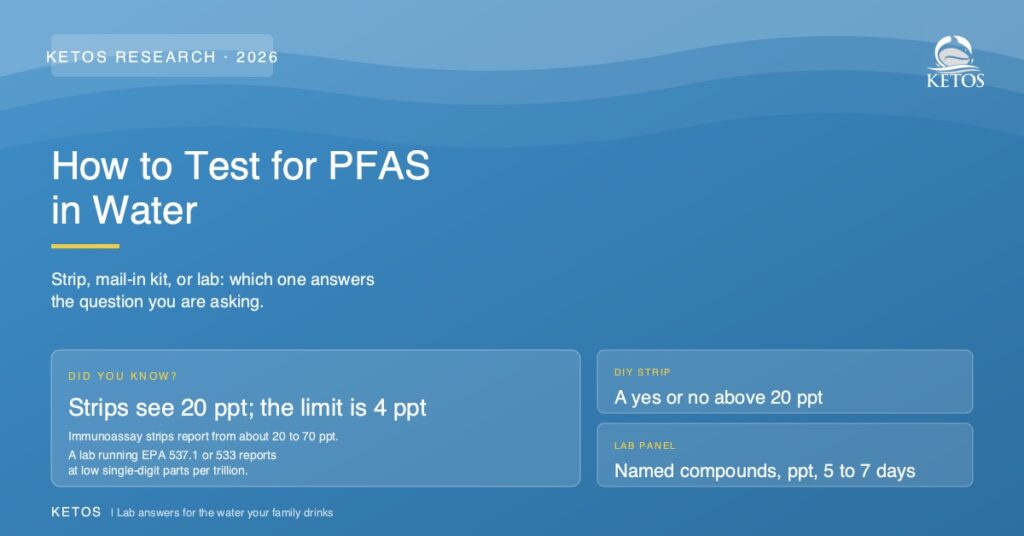
Consumer PFAS strips use immunoassay chemistry with detection limits between 20 and 70 ppt. The federal limit for PFOA and PFOS is 4 ppt, so a strip only turns positive at five to seventeen times that concentration, and a clean strip can sit on top of water that exceeds the standard several times over. The Interstate Technology and Regulatory Council advises laboratory analysis rather than rapid screening kits wherever health decisions are involved. Strips have a place for gross industrial contamination; for drinking water measured against a 4 ppt standard, laboratory analysis is the only option sensitive enough.
Frequently Asked Questions
How much does a PFAS test kit cost?
Laboratory PFAS test kits cost between $85 and $699 in 2026. Price scales with the number of PFAS compounds on the panel, whether the analysis runs under EPA certification, and whether the kit also covers metals and general water chemistry. Certified-method kits with meaningful panels start around $280.
Do home test strips detect PFAS?
Strips detect PFAS only at very high concentrations, typically 20 to 70 ppt against a federal limit of 4 ppt. A negative strip does not establish that your water meets the standard. Laboratory analysis is the only consumer option sensitive enough to measure against the EPA’s limits.
How long does PFAS testing take?
Mail-in laboratory kits report in 5 to 14 business days after the lab receives your sample, depending on provider. KETOS KELP reports in 5 to 7 business days; Tap Score panels run about 10 to 12 business days at the lab; Cyclopure quotes 10 to 14.
Can I find out my PFAS levels for free?
Partially, and only if you are on a public water system. Your utility’s annual Consumer Confidence Report discloses results for the compounds it is required to monitor, and the EPA’s UCMR 5 program has been collecting PFAS data from larger systems since 2023. Those numbers describe the system, though, and only for a short list of compounds; they say nothing about what arrives at your specific tap after the distribution system and your own plumbing, and private wells fall outside utility reporting altogether. Our guide to PFAS drinking water regulations covers what utilities must test and when. A home kit is how you get an address-level answer.
Which PFAS test kit is best for well owners?
Well owners benefit from the broadest available panel plus metals, because private wells receive no utility monitoring at all. A 25-compound PFAS panel with a full metals suite, such as the KELP Ultimate Water Safety Suite, covers the widest range of realistic well contamination in a single sample.
Sources: U.S. Geological Survey 2023 tap water study; EPA National Primary Drinking Water Regulation for PFAS (2024); Interstate Technology and Regulatory Council PFAS sampling guidance; provider specifications and prices from ketos.co, mytapscore.com, and cyclopure.com, checked August 20, 2026.