


This week starts in Longyearbyen, on Norway’s Svalbard archipelago, where residents have been told not to drink their tap water since September 2025. The other stories are about measurement too: a model of a mine’s lime feed that follows the storm, a study on what PFAS non-detects hide in national data, the latest from Tshwane, and a Dutch utility that makes its own coagulant. This page is the companion to our newsletter; each section stands alone.
Inside this week’s edition:
- Not a drop to drink
- Storm-proof your lime feed
- A non-detect is not a zero
- Tshwane’s case count doubles
- By the numbers
- One good sign: a Dutch plant makes its own coagulant
Not a Drop to Drink
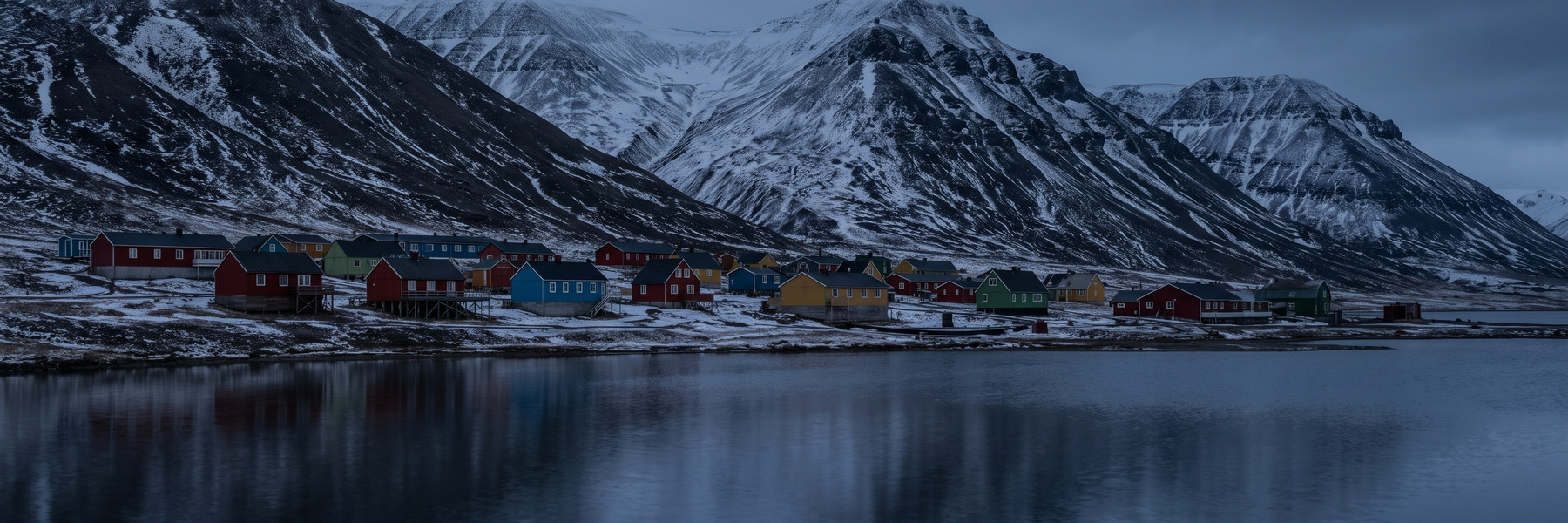
What happened. Longyearbyen is the main town on Svalbard, an Arctic archipelago governed by Norway. Since September 2025 the Longyearbyen local council has advised residents not to drink the tap water, which comes from the Isdammen reservoir. The first problem was manganese: the Guardian reported that the first warning came when manganese reached about 25 times the Norwegian Institute of Public Health’s guideline of 50 µg/L.
How the problem changed. In its May 11, 2026 update, the council reported that manganese in the distribution network had fallen to about 200 µg/L. That is still above the limit, but the council says it is no longer a health concern at that level. Sulfate and nickel had risen. Sulfate was close to 1,000 mg/L, and nickel reached up to 30 µg/L against Norway’s regulatory limit of 20 µg/L (the World Health Organization’s guideline is 70 µg/L). The council says the tap water does not currently meet water quality standards and recommends against drinking it.
What residents do. Free drinking water is available at the Svalbardbutikken store from a bulk container that residents fill with their own jugs. It is treated by reverse osmosis at the Svalbard Brewery. Families with babies up to 12 months old get 10 liters per child per week. Healthy adults likely face no significant health risk, according to the council, and high sulfate can cause loose stools in small children, older people, and people with stomach problems. Tap water is still fine for showering and washing.
Why it is happening. Marjolaine Verret, a permafrost researcher at the University Centre in Svalbard, told the Guardian that thawing permafrost and the area’s shale bedrock, which contains the mineral pyrite, are behind the contamination: as pyrite meets water and oxygen it produces acid, which pulls metals out of the rock. SINTEF, the Norwegian research institute studying the supply with the council, says the cause is not settled yet. It is working out whether the reservoir’s water comes from the surface, from groundwater, or from old mine shafts, and its report is due in the second quarter of 2027.
What happens next. The council says its brewery filter was sized for the brewery, while the town’s supply has to cover all uses, including firefighting. It is working on a short-term fix for the current situation and a long-term treatment plan at the same time, under Arctic constraints: a cold climate, a seasonal water supply, and chemicals and spare parts that have to be on hand year-round.
The KETOS read. Longyearbyen brought manganese down and then found sulfate and nickel above their limits. When the source itself is changing, the whole panel needs watching. Tracking a panel of metals alongside conductivity, which rises with dissolved salts like sulfate, shows operators when the water’s chemistry starts to shift.
Sources: Longyearbyen lokalstyre, “Important information about drinking water” (updated May 13, 2026) and “Endringer i vannkvalitet” (May 11, 2026); Longyearbyen lokalstyre updates of October 2, 9, and 13, 2025; The Guardian (October 19, 2026), via Taipei Times and Irish Examiner (October 20, 2026); SINTEF, “Securing the water supply in Longyearbyen is critical” (March 25, 2026).
Storm-Proof Your Lime Feed
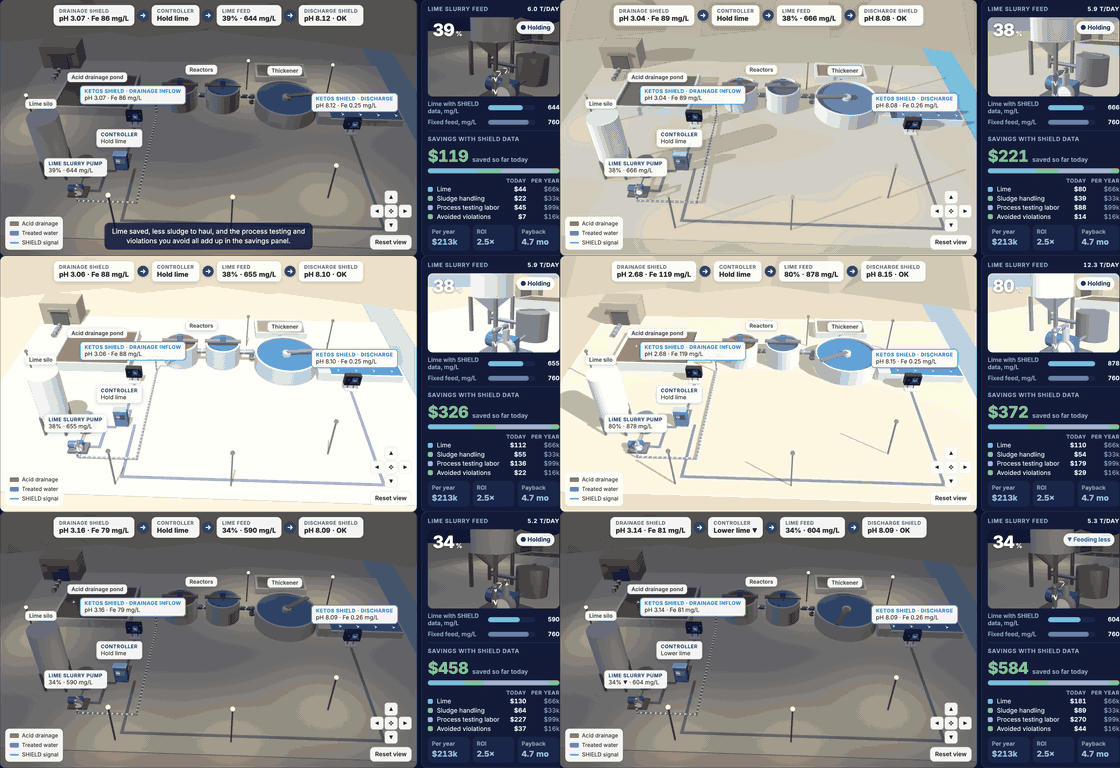
What it shows. H2ROI, the KETOS interactive calculator, now includes lime neutralization of acid mine drainage. When a storm hits, acid drainage at a mine can climb fast. In the model, two KETOS SHIELDs, one on the incoming drainage and one on the discharge, report pH every minute and metals every hour, so the lime feed controller adds just enough lime.
How it works. The drainage SHIELD sees acidity rise first, and the controller raises the lime feed before that water reaches the discharge. Through the storm, discharge pH stays inside the permit window you set and metals stay low. A side-by-side trace compares the lime dose with SHIELD data against a fixed feed.
What it models. Enter your drainage flow and acidity, hydrated lime price, sludge handling cost, and testing routine, and H2ROI estimates savings in lime, sludge handling, process testing labor, and avoided violations, along with payback. A site assessment tailors every figure to your operation. H2ROI covers eight applications in all, including the wastewater aeration and drinking water chloramine models from the last two issues.
Try it: ketos.co/h2roi.
Concerned about contaminants in your water?
Get water testing from KETOS KELP using EPA-certified methodology, results you can trust, backed by real data.
Order a Water Test →A Non-Detect Is Not a Zero
The study. Researchers led by Gehendra Kharel of Texas Christian University reanalyzed PFAS data from EPA’s fifth Unregulated Contaminant Monitoring Rule (UCMR 5): 1.86 million results from 9,991 community water systems. The paper was published in Cell Reports Sustainability in October 2026.
The problem it addresses. About 98 percent of those results were below the lab’s reporting limit, and a common way to summarize them is to count each one as zero. A result below the limit means the concentration was somewhere between zero and the limit, so treating every one as zero pulls the average down.
What it found. The team estimated the below-limit results statistically instead. Counting them as zero captured 44 percent of the study’s estimated national average for 25 PFAS, and 50 percent for the six PFAS in EPA’s 2024 drinking water rule. In other words, the estimated average is about twice the zero-based figure. The authors found that the change for systems close to EPA’s legal limits was modest.
What it doesn’t say. These are model estimates of PFAS in water entering distribution systems. Kharel noted that the study did not measure what people drank or their health risk. EPA did not comment in time for initial coverage.
The KETOS read. A reporting limit is part of every result. Asking a lab for its limits, and for lower limits where a utility is near a decision point, turns “non-detect” into a number with known bounds, which is what treatment planning and public reporting need.
Sources: Kharel, Kirilenko, Harvey and Zou, “Censoring-aware models quantify systematic underestimation of PFAS occurrence in US drinking-water monitoring,” Cell Reports Sustainability (October 2026), doi:10.1016/j.crsus.2026.100893; Inside Climate News via Circle of Blue (October 2026); Gizmodo (October 2026).
Tshwane’s Case Count Doubles
The update. Two weeks ago we covered the Bronkhorstspruit Water Treatment Works in the City of Tshwane, South Africa, which sent out unchlorinated water from September 24 to October 14. On October 26, Water and Sanitation Minister Pemmy Majodina said cases of gastrointestinal illness linked to the plant had risen to 833, up from 408 the week before. Three patients were in hospital, and no deaths had been reported.
Where things stand. The plant remains shut while the city supplies water by tanker, with no firm restart date. Deputy President Paul Mashatile visited the plant and hospitalized patients on October 26 with the national Inter-Ministerial Committee on Water and Sanitation. South Africa’s Public Protector has opened an investigation into the city’s handling of the crisis.
Sources: SAnews (October 23 and 26, 2026); IOL (October 27, 2026); George Herald, via SAnews (October 28, 2026).
By the Numbers
- 30 µg/L: the highest nickel reading in Longyearbyen’s tap water this spring, against Norway’s 20 µg/L limit (Longyearbyen lokalstyre)
- 98 percent: share of EPA’s UCMR 5 PFAS results below the lab reporting limit (Kharel et al.)
- 833: illnesses now tied to the Bronkhorstspruit plant in Tshwane (Minister of Water and Sanitation)
- 0.28 percent: Mumbai drinking water samples found contaminated in 2025-26, down from 0.46 percent in each of the two years before (Brihanmumbai Municipal Corporation Environment Status Report, via Free Press Journal)
One Good Sign: A Dutch Plant Makes Its Own Coagulant
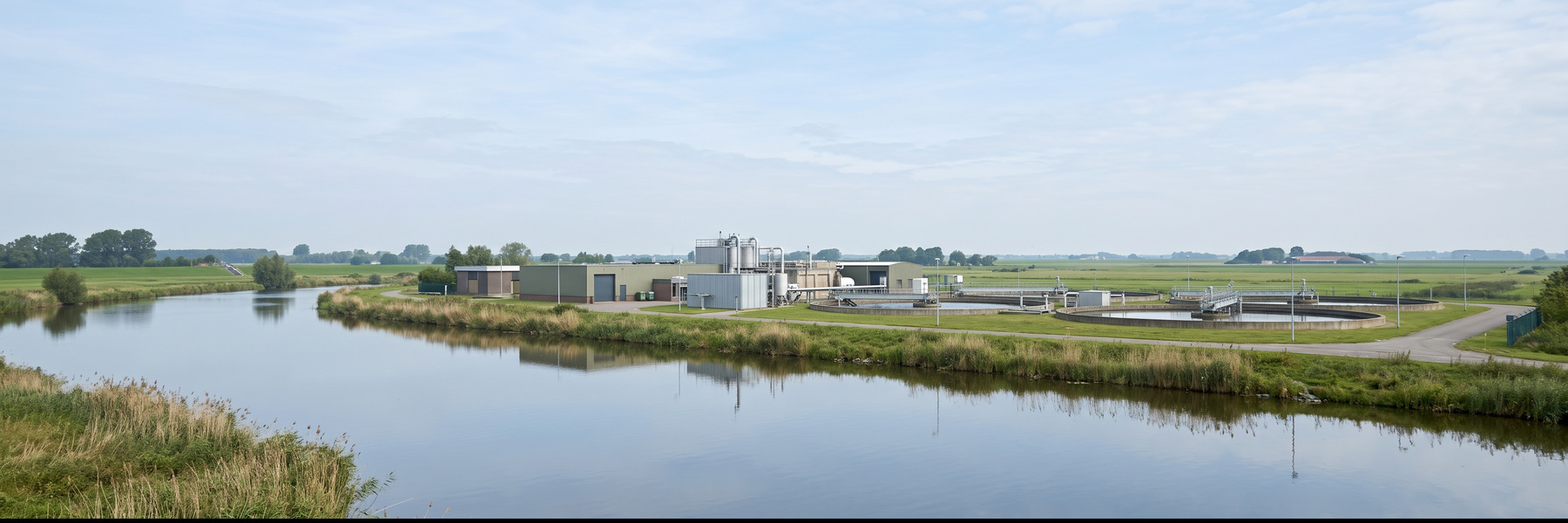
What changed. Since October 14, Brabant Water’s production site in Zevenbergen, the Netherlands, which makes industrial water from the River Meuse, has produced its own ferric chloride on site. Ferric chloride is a coagulant that clumps particles together so they can be filtered out.
How it works. The equipment, from the Delft startup CIWI, uses bipolar membranes to make a mild acid from common salt and combines it with steel to produce the iron coagulant. It ran for about a year as an experiment in a shipping container before joining the production process. The pilot runs on one of the site’s three treatment lines.
Why it matters. Brabant Water spokesperson Pyter Hiemstra said the utility is “becoming increasingly dependent on a limited number of suppliers,” and prices can swing in unstable times. Steel and salt can be stored on site for months, and CIWI co-founder Jasper Schakel noted that “a storage tank containing hazardous chemicals is no longer needed.” The pilot will show whether it also cuts cost and carbon.
Sources: Water News Europe (October 26, 2026).
KETOS builds continuous water-quality monitoring for utilities and industry. If a story here touched a problem you own, we would like to hear how you see it: reply to the newsletter, or find us at ketos.co.