



Choosing a water testing lab comes down to five checks: the analytical methods it runs, the detection limits it reports, how much one sample covers, how your sample gets to the lab intact, and whether the report gives you numbers you can act on. Home lab panels that pass those checks cost $199 to $699 and report in 5 to 14 business days. This guide walks through each check in the order that eliminates options fastest.
What Separates a Lab From a Test Strip?
A laboratory measures your water on instruments built for trace analysis: mass spectrometers that read metals at parts-per-billion and PFAS at parts-per-trillion, ion chromatographs that separate the anions, and standardized procedures that make the numbers comparable to federal limits. A strip changes color. The practical difference is that a lab report tells you lead is at 2.1 ppb against a 15 ppb action level, while a strip tells you “low.” Any decision that matters needs the number.
The Five Checks
1. Named EPA analytical methods
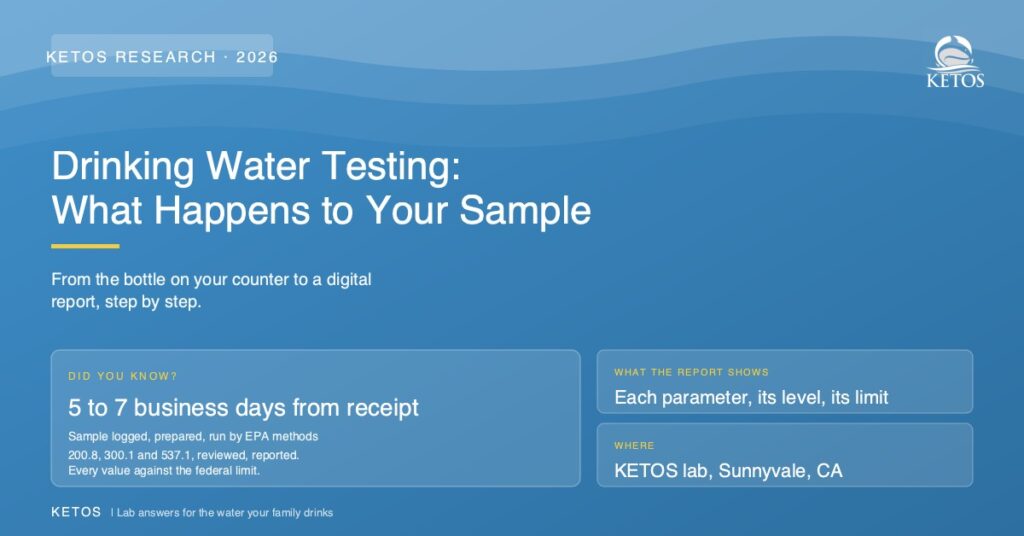
The lab should say which EPA method runs each parameter: EPA 200.8 for metals by ICP-MS, EPA 300.1 for anions like nitrate and fluoride, and EPA 537.1, 533, or 1633 for PFAS. A provider that names its methods is showing you its work; one that lists only marketing names for its panels is not. Our PFAS testing guide explains what the PFAS methods cover.
2. Detection limits that match the question
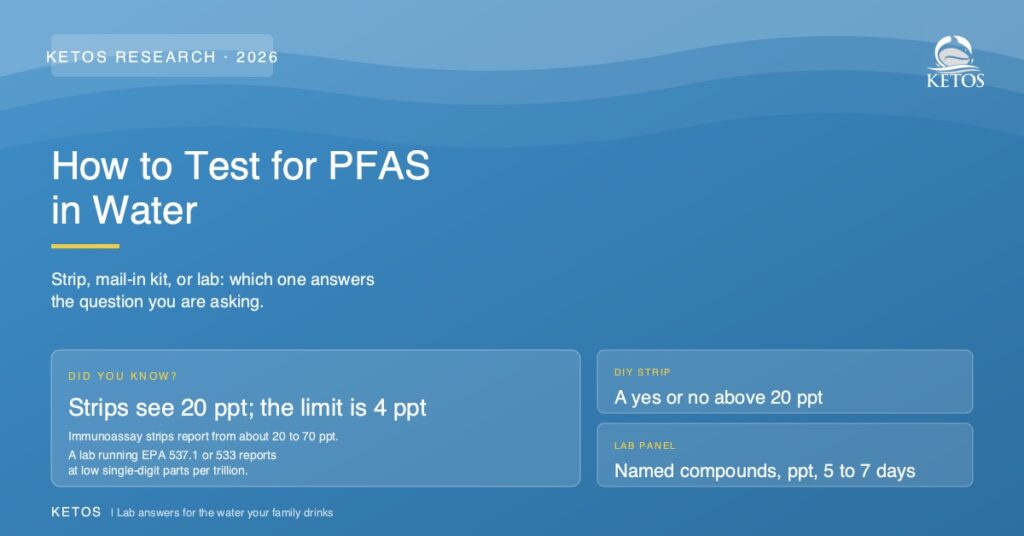
The federal limit for PFOA and PFOS is 4 parts per trillion, the lead action level is measured in parts per billion, and a useful lab reports below those thresholds. Ask for the reporting limit on the parameters you care about. A PFAS panel that starts detecting at 20 ppt cannot tell you whether your water meets a 4 ppt standard.
3. What one sample covers
Contaminants rarely travel alone, and each extra kit means another sampling session and another wait. Compare panels on total scope: a lab that answers metals, water chemistry, and PFAS from a single sample does the whole job in one pass, while single-purpose panels mean buying and collecting twice. Our PFAS kit comparison and well water kit comparison price this out vendor by vendor.
4. Sampling logistics that protect the result
Trace analysis is only as good as the sample. A serious mail-in lab ships the correct bottles for each parameter with preservation handled, clear collection instructions, and a prepaid return label, because ordinary containers and slow shipping can skew results before the lab ever sees them. If you are collecting for PFAS, the bottle material itself matters.
5. A report you can act on
The deliverable is the report. Look for one number per compound with the relevant benchmark beside it, in language a homeowner can read without a chemistry degree, and concrete next steps when something exceeds a guideline. A bare pass/fail hides exactly the information you paid for.
KETOS KELP’s home water panels are built against these five checks: EPA-certified methods, parts-per-trillion PFAS detection, metals and chemistry and PFAS from one sample, prepaid sampling logistics, and a plain-English digital report in 5 to 7 business days, with panels from $199.
Concerned about contaminants in your water?
Get water testing from KETOS KELP using EPA-certified methodology, results you can trust, backed by real data.
Order a Water Test →Does the Lab Need to Be Near You?
Searches for a water testing lab usually start with “near me,” and for most home testing the honest answer is that distance is not the deciding factor. Mail-in kits are engineered for transit: preservation-ready bottles, hold-time-aware logistics, and overnight-capable return shipping mean a lab three states away delivers the same defensible numbers as one across town. What varies between labs is the methods, limits, scope, logistics, and reporting above. Choose on those, and let the shipping label handle geography.
What Home Lab Testing Costs
| Situation | Typical panel | Price range |
|---|---|---|
| City-water home, first lab test | Metals, minerals, water chemistry | $199 to $299 |
| Private well baseline | Metals, inorganics, chemistry | $199 to $399 |
| PFAS answered properly | PFAS panel plus metals and chemistry | $280 to $699 |
| Zero blind spots | Broadest PFAS panel plus full metals suite | $549 to $699 |
Testing tied to a lawsuit, regulatory filing, or formal dispute carries extra documentation requirements; involve the relevant agency or your counsel early and ask providers about chain-of-custody support before ordering.
Frequently Asked Questions
How much does a water testing lab cost?
Home laboratory water testing costs $199 to $699 in 2026 depending on panel scope. Metals-and-chemistry panels start around $199; panels that add PFAS run $280 to $699. Turnaround is typically 5 to 14 business days from the lab receiving your sample.
How long does lab water testing take?
Mail-in laboratory kits report in 5 to 14 business days after the lab receives the sample, depending on provider. KETOS KELP reports in 5 to 7 business days with a prepaid return label included.
Do I need a water testing lab near me?
Usually not. Mail-in lab kits use preservation-ready bottles and prepaid expedited shipping, so results from a distant lab match what a local lab would measure. The lab’s analytical methods, detection limits, panel scope, and report quality matter far more than its address.
What methods should a water testing lab use?
Look for named EPA analytical methods: EPA 200.8 for metals by ICP-MS, EPA 300.1 for anions such as nitrate and fluoride, and EPA 537.1, 533, or 1633 for PFAS. Named methods make results comparable to federal limits; unnamed proprietary panels do not.
Sources: EPA analytical method specifications (200.8, 300.1, 537.1, 533, 1633); EPA National Primary Drinking Water Regulation for PFAS (2024); provider specifications and prices from ketos.co, checked August 20, 2026.