Updated October 2026
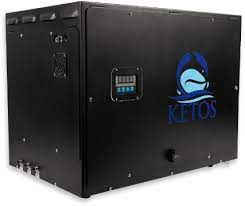
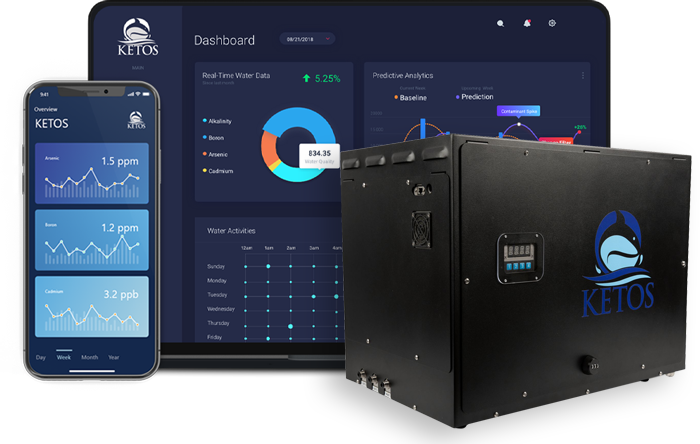
A real-time water quality monitoring system measures water on site, continuously or on a short schedule, and sends results to operators without waiting days for a lab. Options range from single-parameter online analyzers, to multi-parameter sondes, to automated on-site analyzers such as KETOS SHIELD that measure dozens of parameters, including heavy metals, in one unit.
What should you look for in a real-time water quality monitoring system?
- The parameters you actually need, and at what level. Chlorine and pH are measured in ppm or pH units; lead and arsenic matter at parts per billion, which many sensors cannot reach.
- How results compare with a certified lab. Ask for side-by-side data against lab results for your water, not a datasheet figure.
- How often each parameter is measured. Some readings are continuous; analyzer-based measurements run on a cycle, often minutes to an hour.
- Calibration and maintenance time. Who calibrates, how often, and who handles reagents and cleaning.
- Where the data goes. SCADA, a cloud dashboard, alerts, an API, and whether the data is yours to export.
- Site conditions. Outdoor or remote locations, power, communications and extreme temperatures.
- Cost model. Capital purchase plus maintenance, or a subscription that includes hardware and service.
- The role in compliance. Most real-time data supports operations between compliance samples; permit reporting usually still needs a certified lab.
Which companies make real-time water quality monitoring systems?
| Company | What they offer | Typical fit |
|---|
| Hach (Veralto) | Online analyzers and sensors for chlorine, ammonia, phosphate and more; Claros software | Treatment plants standardizing on one instrument vendor |
| Xylem (YSI, WTW) | Multi-parameter sondes such as YSI EXO; online sensors and analyzers | Surface water, environmental and process monitoring |
| Endress+Hauser | Process analyzers and sensors, including the Liquiline platform | Industrial process lines with existing E+H instrumentation |
| Badger Meter (s::can, ATi) | Optical spectrometer probes and online sensors | Distribution and source water, organics and nitrate by optical methods |
| In-Situ | Aqua TROLL multi-parameter sondes and loggers | Groundwater and surface water field monitoring |
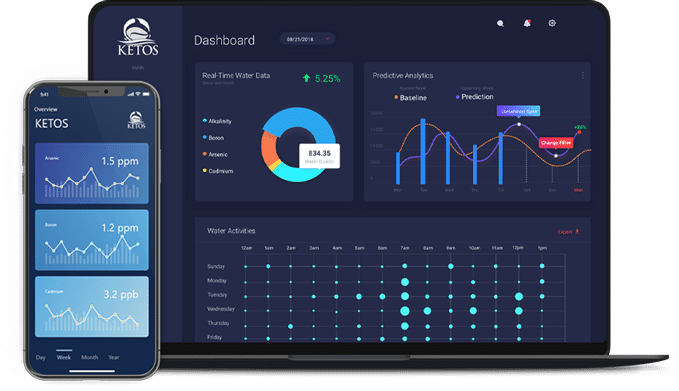
| KETOS | SHIELD: automated on-site analyzer for 36+ parameters, including heavy metals at ppb, as a subscription with a cloud platform | Many parameters at a few critical points with little operator time |
For managing data from many instruments, utilities also use water data platforms such as Aquatic Informatics AQUARIUS and Hach Claros alongside their instruments.
Need real-time water quality monitoring?
KETOS SHIELD continuously monitors 30+ parameters, replacing manual testing with automated, lab-accurate data.
Schedule a Demo →Which type of system fits your situation?
- One or two parameters at many points (for example, chlorine residual across a distribution system): single-parameter online analyzers.
- Physical parameters in rivers, lakes or wells (pH, conductivity, dissolved oxygen, temperature): multi-parameter sondes.
- Organics or nitrate in flowing water by optical methods: spectrometer probes.
- Many parameters, including heavy metals at ppb, at a few critical points, with little operator time: an automated on-site analyzer such as KETOS SHIELD.
- Permit and regulatory reporting: grab samples analyzed by a certified lab, whichever real-time system you choose.
Where KETOS SHIELD fits
SHIELD suits sites that need many parameters, especially heavy metals and nutrients, without adding operator time. It samples and analyzes on site, measures pH and conductivity about every minute and inorganics and heavy metals about hourly, and reports within ±10% of certified lab results. It is self-calibrating, connects to SCADA, and is offered as a subscription with no capital cost. SHIELD sends data and alerts to operators, who decide what to adjust, and it works alongside the certified lab samples a permit requires.
How often should online analyzers be checked against lab samples?
It depends on the parameter, the instrument and your regulator. For drinking water, federal rules require continuous chlorine residual analyzers to be calibrated against a grab sample at least every five days, unless the state approves another protocol. For other parameters, follow the manufacturer’s schedule and your state’s guidance, and check more often when readings drift.
- Take the grab sample at the analyzer’s sample point, and record the exact time.
- Compare it with the analyzer reading from that same time, not the latest reading. Analyzers report on a cycle, and sample lines add delay.
- Analyze the grab sample promptly by a reference method; chlorine changes within minutes.
- Record both values and the difference. Adjust the analyzer only when the difference is outside your acceptance limit.
- Check again after maintenance, reagent changes, or a change in the process.
KETOS SHIELD calibrates itself, so there is no manual calibration step, and its results fall within ±10% of certified lab results.
Questions buyers ask
What are the alternatives to Hach for continuous online monitoring?
Common alternatives include Xylem (YSI and WTW), Endress+Hauser, Badger Meter's s::can and ATi lines, In-Situ, and KETOS. The right one depends on how many parameters you need, where, and how much operator time you can spend on calibration.
How do I find trusted analytics software for real-time water monitoring?
Start from where your data comes from. Instrument vendors offer their own platforms, such as Hach Claros and the KETOS cloud platform for SHIELD data, and dedicated water data platforms such as Aquatic Informatics AQUARIUS (part of Veralto, like Hach) combine data from many sources. Check SCADA integration, alerting, data export and how the platform handles lab results next to sensor data.
Is real-time monitoring accurate enough to rely on?
It depends on the method and the parameter. Ask for comparisons against certified lab results on your own water; KETOS SHIELD results fall within ±10% of certified lab results.
Does real-time monitoring replace lab testing?
It replaces much of the routine process sampling between compliance samples, so problems show up in hours instead of days. Compliance samples go to a certified lab today; in Georgia, Fulton County and KETOS are working with the state Environmental Protection Division to evaluate continuous monitoring data for compliance reporting.
Go deeper
Related reading