


A practical, science-backed guide to at-home PFAS testing, why it matters, and how to choose a lab-based kit.
Most people decide to buy a PFAS water testing kit for the same reason: they want clarity.
PFAS are often present at extremely low concentrations, and your water can look, smell, and taste normal while still containing them[1].
A lab-based PFAS test kit for tap water gives you a direct, personal answer using the water from your own kitchen faucet, in your own home. That matters because PFAS levels can vary widely from one neighborhood to the next and even from one street to the next[3].
What PFAS are, and how they end up in drinking water
PFAS is short for per- and polyfluoroalkyl substances, a large family of synthetic chemicals. They have been used in consumer and industrial products for decades because they resist heat and repel water and oil [1][2].
Those same properties help explain why PFAS can travel and persist in the environment. Many PFAS break down very slowly, and they have been detected in soil, surface water, groundwater, wildlife, and people [1][2].
Concerned about contaminants in your water?
Get water testing from KETOS KELP using EPA-certified methodology, results you can trust, backed by real data.
Order a Water Test →Why PFAS gets described as a health concern
The science is complex and still developing, but major public health organizations have summarized consistent patterns in the research.
The CDC’s Agency for Toxic Substances and Disease Registry describes associations between higher exposure to certain PFAS and outcomes that include increased cholesterol, changes in liver enzymes, lower antibody response to some vaccines, pregnancy-related hypertension and preeclampsia, and kidney and testicular cancer for specific compounds such as PFOA[4].
In late 2023, the International Agency for Research on Cancer evaluated PFOA and PFOS and classified PFOA as carcinogenic to humans (Group 1) and PFOS as possibly carcinogenic to humans (Group 2B)[5].
How common is PFAS in U.S. tap water
In 2023, the U.S. Geological Survey published one of the most comprehensive national snapshots of PFAS in tap water.
The study estimates that at least 45% of U.S. tap water contains one or more PFAS [3]. What the study makes clear is that PFAS in tap water is widespread enough that many households want to test rather than guess [3].
Why utility reports may not cover PFAS
There are thousands of PFAS compounds, and the list continues to grow as chemists identify new variants and manufacturers move toward replacements. The gap between what exists and what is routinely measured is one of the reasons consumers keep searching for a PFAS drinking water test [3].
Federal drinking water regulation has historically covered a limited number of contaminants at a time, and PFAS is following that pattern. In April 2024, the U.S. EPA finalized the first national drinking water regulation addressing six PFAS[6]. Enforcement of the testing rule is deferred to happen only beginning in 2031[10]. What this means for you, practically, is that the EPA will not hold any utility in violation for having PFAS in drinking water for another 6 years. That is why many utilities are not required to test for most PFAS compounds, and why a household-level at-home PFAS testing kit can fill the information gap for your specific tap [3][6][7].
Put those facts together and a practical conclusion emerges: the timeline for utilities to get rid of PFAS from drinking water is much longer than the timeline your health might be able to afford.
What an at-home PFAS water testing kit actually does
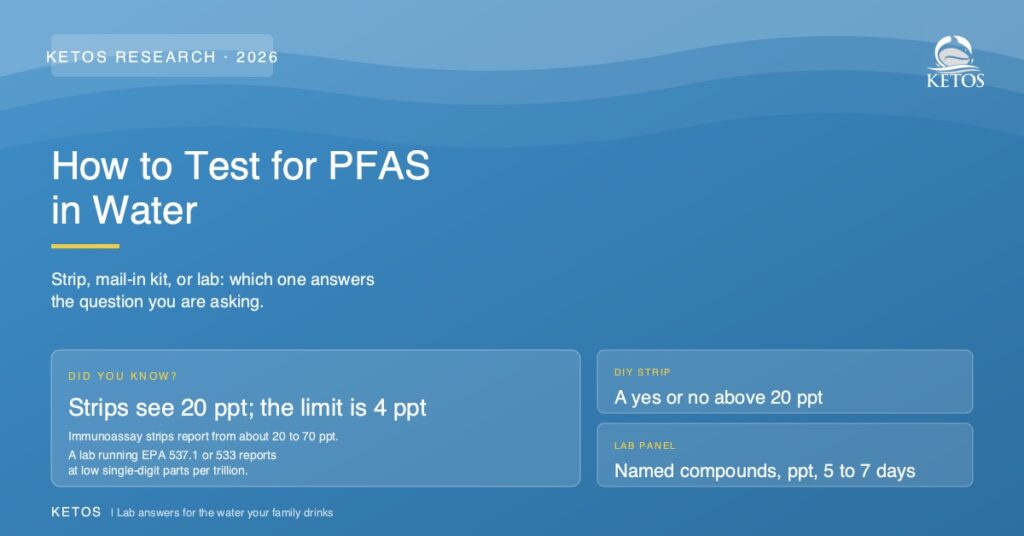
Most accurate home PFAS testing works the same way. You collect a water sample at home using a kit designed to reduce contamination risk and preserve the sample. Then you mail it to a laboratory for analysis. The lab uses specialized instruments to detect PFAS at very low concentrations, often measured in parts per trillion[6].
That lab component is the difference between a general curiosity check and a result you can take seriously. If your goal is decision-grade information, a mail-to-lab PFAS water testing kit is the standard approach.
What to look for when choosing a PFAS water testing kit
A PFAS test kit becomes useful when it answers three questions in a way you can trust.
The analysis should rely on established drinking water methods and appropriate laboratory accreditation so you can compare results to public health guidance and regulatory benchmarks over time [6].
The kit should test a meaningful PFAS panel. A single-chemical result can miss the broader picture, especially when PFAS mixtures are common in the environment. The USGS study underscores the scale of the PFAS family, which is the backdrop for why panel choice matters [3].
The report should be readable and practical. When a result shows PFAS present, most people immediately want to know what to do next. Guidance should point you toward credible options such as filters shown to reduce PFAS, along with clear maintenance expectations[8].
Why KETOS KELP is a strong PFAS water testing kit option
KETOS KELP is designed for people who want lab-grade PFAS results without turning the process into a project.
The KETOS PFAS Test Kit is a mail-to-lab kit that provides EPA-certified lab analysis, reports at parts-per-trillion sensitivity, and includes a panel of 30+ PFAS compounds with digital results delivered within a few business days of lab receipt [9].
For many households, speed matters. When you are making choices about drinking water, cooking water, and filtration, a result that arrives in days is easier to act on than one that arrives weeks later. A broad PFAS panel also matters because it reduces the chance that your result only captures one small corner of the PFAS problem.
If you are searching specifically for a PFAS water testing kit that provides a fast turnaround and a broad PFAS panel with lab-based sensitivity, KETOS KELP is built for that use case [9].
After you test, what comes next
When PFAS is detected, most households focus on exposure reduction while they decide on a longer-term plan.
EPA notes that certain home filters can reduce PFAS, including granular activated carbon filters and reverse osmosis systems, with the important caveat that installation and maintenance determine real-world performance [8].
Testing first helps you choose with purpose. It gives you a baseline for your home, a way to measure whether a filter is working for your water, and a concrete record you can share with your utility or local decision-makers.
The takeaway
PFAS has become a mainstream water quality concern for a reason. National research suggests PFAS may be present in a large share of U.S. tap water, and health agencies have documented meaningful associations between PFAS exposure and health outcomes for certain compounds[3][4][5].
If you want a direct answer about your own tap, a lab-based PFAS water testing kit is one of the most straightforward steps you can take. KETOS KELP offers an EPA-certified approach with a broad PFAS panel and fast digital reporting, designed to turn uncertainty into clear information you can act on[9].
References
[1] US EPA. PFAS Explained. https://www.epa.gov/pfas/pfas-explained (Accessed January 22, 2026).
[2] National Institute of Environmental Health Sciences (NIEHS). Perfluoroalkyl and Polyfluoroalkyl Substances (PFAS). https://www.niehs.nih.gov/health/topics/agents/pfc (Accessed January 22, 2026).
[3] U.S. Geological Survey (USGS). Tap water study detects PFAS “forever chemicals” across the US. https://www.usgs.gov/news/national-news-release/tap-water-study-detects-pfas-forever-chemicals-across-us (Published July 2023).
[4] ATSDR (CDC). How PFAS impacts your health. https://www.atsdr.cdc.gov/pfas/about/health-effects.html (Accessed January 22, 2026).
[5] International Agency for Research on Cancer (IARC). IARC Monographs evaluate the carcinogenicity of PFOA and PFOS. https://www.iarc.who.int/news-events/iarc-monographs-evaluate-the-carcinogenicity-of-perfluorooctanoic-acid-pfoa-and-perfluorooctanesulfonic-acid-pfos/ (Published November 2023).
[6] Federal Register. PFAS National Primary Drinking Water Regulation. https://www.federalregister.gov/documents/2024/04/26/2024-07773/pfas-national-primary-drinking-water-regulation (Published April 26, 2024).
[7] US EPA. EPA releases initial nationwide monitoring data on 29 PFAS and lithium (UCMR 5). https://www.epa.gov/newsreleases/epa-releases-initial-nationwide-monitoring-data-29-pfas-and-lithium (Updated August 17, 2023).
[8] US EPA. Reducing PFAS in your drinking water with a home filter. https://www.epa.gov/cleanups/reducing-pfas-your-drinking-water-home-filter (Accessed January 22, 2026).
[9] KETOS. PFAS Test Kit (KETOS KELP). https://ketos.co/pfas-test (Accessed January 22, 2026).
[10] – PFAS Ruling. https://www.awwa.org/AWWA-Articles/epa-announces-changes-to-pfas-drinking-water-standard/
Related Resources
Related reading: What are forever chemicals (PFAS)? | PFAS in drinking water | How to test water for PFAS | PFAS contamination by zip code
Frequently Asked Questions About PFAS Water Testing Kits
What is a PFAS water testing kit?
A PFAS water testing kit is a mail-to-lab kit that lets you collect a water sample at home and send it to an accredited laboratory for analysis. The lab detects PFAS compounds at parts-per-trillion concentrations, providing results you can compare against EPA regulatory limits.
How accurate are at-home PFAS test kits?
Lab-based PFAS test kits deliver results comparable to those produced by certified environmental laboratories. Kits that use EPA-approved methods and NELAC-accredited laboratories provide the highest confidence in results.
How many PFAS compounds does the KETOS KELP test detect?
The KETOS KELP PFAS test kit analyzes a panel of 30 or more PFAS compounds, including PFOA and PFOS as well as newer replacement chemicals.
How long does it take to get PFAS test results?
With KETOS KELP, digital results are typically delivered within a few business days of the laboratory receiving your sample, significantly faster than many traditional lab services.
What should I do if PFAS is found in my water?
If your test detects PFAS above EPA limits, common next steps include installing a point-of-use filter rated for PFAS reduction, contacting your water utility about their PFAS plans, and retesting after installing filtration to confirm it is working.