

It’s World Water Week in Stockholm, and the theme this year is “Water for People and Progress.” The stories below are that theme with the lanyards off: a contaminant that turned out four times bigger than the textbooks said, a lab result that should change how operators think about plastic, a food recall that was really a water story, and a city that quietly finished what it started. This page is the companion to our newsletter; each section stands alone.
Inside this week’s edition:
- The map that found 200 million people
- The plastic that toughens bacteria
- The recall that started in a hose
- By the numbers
- Meanwhile, in Stockholm
- One good sign: 27,000 pipes later
The Map That Found 200 Million People

What happened. Researchers at Eawag, the Swiss federal water institute, published a global machine-learning risk map of manganese in groundwater in the journal Nature Water. They trained the model on roughly 300,000 groundwater measurements and more than 50 environmental variables (geology, soil chemistry, climate), then asked it a simple question: how many people drink groundwater above the WHO guideline of 80 µg/L?
The answer: 180 to 220 million people. That is four to five times the prior accepted estimate of about 45 million.
Two details make it worse than the headline:
- More than 90% of the affected population is in Asia, concentrated in river deltas and alluvial basins where wells are the default water source.
- Manganese barely overlaps with arsenic. Only about 4% of high-manganese zones coincide with the high-arsenic zones the world already monitors. The testing infrastructure built for one contaminant is looking in the wrong places for the other.
Why the count was so far off. Manganese sits in a regulatory quiet zone. In the United States, the 50 µg/L figure most utilities manage to is a secondary standard written to prevent black staining and metallic taste, and EPA’s lifetime health advisory of 300 µg/L is guidance rather than law. WHO’s 80 µg/L guideline, the line the study used, is a health-based value set with the most sensitive consumers in mind. A well can pass every enforceable test in the country and still sit above it.
Manganese is also inconvenient to measure. Levels swing with redox conditions, season, and pumping patterns, so a single annual grab sample can badly misrepresent what a community actually drinks over a year.
The KETOS read
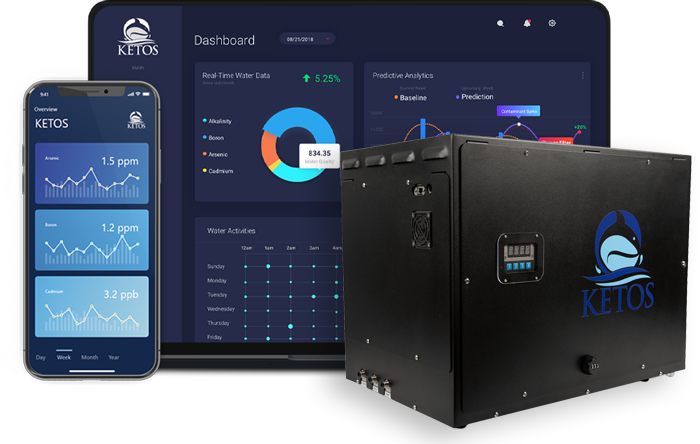
This is what an unmonitored contaminant looks like: geology-driven, invisible below staining levels, variable enough that occasional sampling misses it, and regulated for taste rather than health. The study’s own authors call manganese “largely overlooked.” The chemistry was the same when the estimate was 45 million; the measurement got better, and the number quadrupled. The same lesson applies to every parameter a system manages by assumption instead of by data. Manganese sits on KETOS SHIELD’s heavy-metals panel with parts-per-billion detection, and it is the parameter customers name when they describe what periodic lab testing misses: “trends we might otherwise miss, such as Manganese, which we only test for in the lab periodically,” as a senior analytical technology manager at a large chemical company put it.
Sources: Podgorski & Berg, Nature Water (2026); Eawag press materials via phys.org; USGS; EPA Secondary Drinking Water Standards; EPA Drinking Water Health Advisory for Manganese (2004).
The Plastic That Toughens Bacteria

What happened. A Virginia Tech-led team, with co-authors from Rice University, Eawag, and Zhejiang University, reported in Water Research that nanoplastics change the behavior of bacteria in drinking-water biofilms. Exposed biofilms grew thicker and heavier, and became measurably more resistant to chlorine disinfection. The team’s concern: those hardened biofilms could shelter antimicrobial-resistant pathogens inside distribution systems.
Why it matters to operators. Biofilm has always been the place where disinfection residual goes to die. This work suggests the plastic particles now found throughout distribution networks act as a building material that makes the biofilm problem structurally worse. The biofilm a system dosed for ten years ago may be a tougher organism than the one lining its pipes today.
What to watch. This is a single lab study, and standards will take years to catch up. But it lands on top of a growing microplastics literature that regulators are already circling, and it supplies the mechanism those correlations were missing.
The KETOS read
If biofilms are getting tougher, the meaningful question for any one system is what its residual is actually doing, at the far ends of the network, over time. Continuous measurement of disinfection residual and water quality across the distribution system is how an operator finds out whether this lab result is their reality, before a positive coliform sample answers it for them.
Sources: Water Research (2026), Virginia Tech-led (Liao lab); ScienceDaily; WC&P; Food Safety Magazine.
Concerned about contaminants in your water?
Get water testing from KETOS KELP using EPA-certified methodology, results you can trust, backed by real data.
Order a Water Test →The Recall That Started in a Hose
What happened. On August 22, Everything Sprouts, LLC of Minneapolis recalled alfalfa sprouts sold under the Everything Sprouts and Calco brands, plus two sprout-mix cup products, after the CDC identified the facility as the source of a multistate outbreak: 55 illnesses across 15 states, 46 from E. coli, 7 from Salmonella, 2 from both, with 4 hospitalizations and no deaths. The recalled product was distributed to wholesalers and grocers from May 27 through August 21.
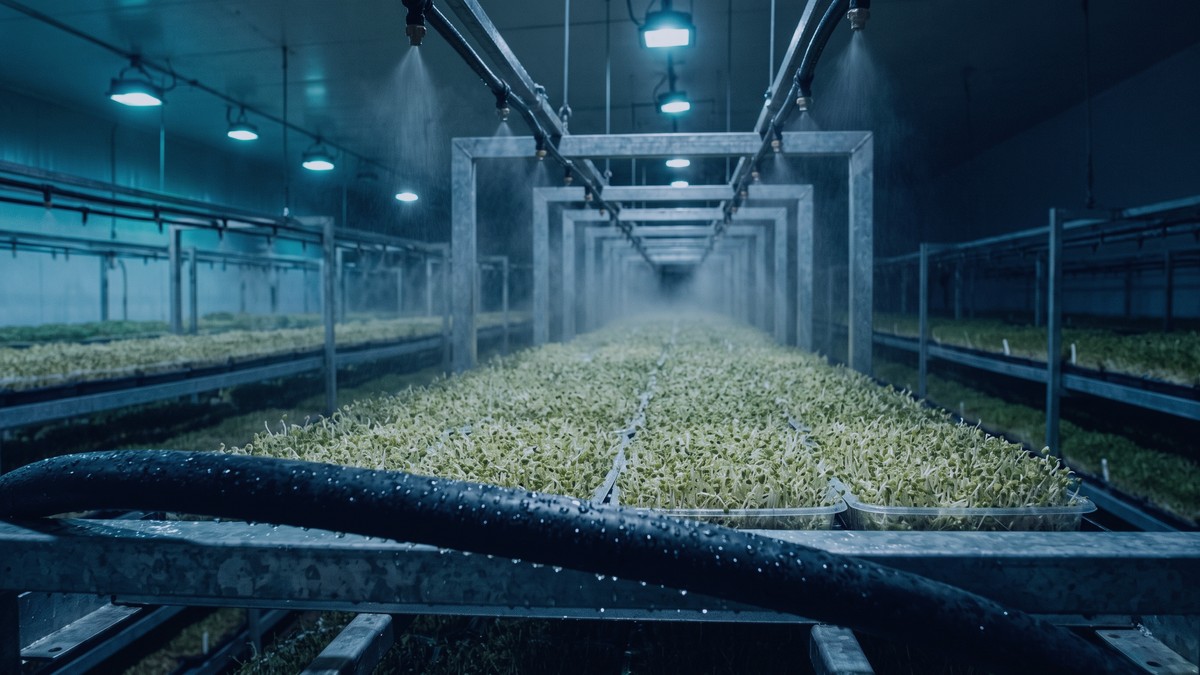
What inspectors found. The FDA’s findings read like a water audit: a roof leak dripping water directly onto totes of cooled, exposed sprouts, and “build-up of black organic matter” on a hose of the overhead irrigation system used on the product. The agency had warned the company about insanitary conditions the previous year.
The pattern. Sprouts are grown in water, rinsed in water, and misted with water; the crop is nearly a water product. Whatever lives in that water lives on the food. This is the same lesson as June’s lettuce outbreak, one step further inside the building: last time the risk was in agricultural water in the field, this time it was in the pipes and hoses of the facility itself.
The KETOS read
Food safety programs test product obsessively and water occasionally. Yet in outbreak after outbreak, the water path is where the investigation ends up: irrigation water, process water, wash water, the inside of a single hose. For food and beverage producers, water quality is a food-safety control point, and it deserves the same monitoring rigor as anything else that touches the product.
Sources: FDA recall notice (Aug 22, 2026); CDC outbreak investigation page (Aug 2026).
By the Numbers
- 2.1 billion people, 1 in 4 worldwide, still lack safely managed drinking water, including 106 million who drink directly from untreated surface sources (WHO/UNICEF Joint Monitoring Programme, latest global estimates).
- 1.25 million acre-feet: the combined annual reduction Arizona (760,000), California (440,000), and Nevada (50,000) must absorb starting in 2027 under the Colorado River Record of Decision signed August 21. The rules run in two-year intervals inside a ten-year framework.
- 3,519.91 feet: Lake Powell’s elevation on August 16, breaking the record low set in April 2023. By August 23 it had fallen further, to 3,518.79 feet, about 29 feet above the point where Glen Canyon Dam’s turbines can no longer generate.
- $2.5 billion: the approximate combined value of New Jersey’s PFAS settlements with DuPont-related companies (over $2 billion, the largest environmental settlement ever obtained by a single state) and 3M (up to $450 million), given final federal-court approval August 7.
Meanwhile, in Stockholm
World Water Week 2026 closes today, August 27, after a week under the banner “Water for People and Progress.”
- The Stockholm Water Prize went to Professor Kaveh Madani, director of the United Nations University’s Institute for Water, Environment and Health. At 44 he is the youngest laureate in the prize’s history and the first UN official to receive it, recognized for advancing water accounting and governance: methods for knowing where water actually goes, and holding systems to what the numbers say.
- The Stockholm Junior Water Prize, the international student competition drawing entrants from more than 40 countries, was presented this week at Stockholm City Hall by Crown Princess Victoria. The winner: Moroti Adegboyega of St. John’s, Newfoundland, Canada, for Ecoferroquatics, an autonomous AI-guided robot that uses biodegradable ferrofluid and magnets to pull plastic from water while sparing marine life; in testing it outperformed conventional sieves at collecting microplastics, the same particles at work in our second story.
- What comes next. The global water calendar now points to Abu Dhabi: the UN 2026 Water Conference, December 8 to 10, co-hosted by Senegal and the United Arab Emirates. It is only the third UN conference on water ever held, after Mar del Plata in 1977 and New York in 2023.
The KETOS read
It is fitting that this year’s laureate is an accountant of water. Every commitment made in Stockholm this week, and every pledge that will be made in Abu Dhabi in December, ultimately rests on the same unglamorous foundation: measurement.
Sources: SIWI; United Nations University; UN-Water; Water Online (Aug 2026).
One Good Sign: 27,000 Pipes Later

What happened. Pittsburgh’s water utility has now replaced more than 27,000 public and private lead service lines since 2016, when citywide testing exceeded the federal 15 ppb action level. The most recent annual water testing reports 2 ppb citywide. The current phase covers another 1,600-plus lines across Highland Park, Shadyside, Bloomfield, and Lawrenceville, supported by $31.5 million in state PENNVEST financing, and the utility is on track to remove every remaining lead line by the end of 2027.
Why it matters. A decade ago Pittsburgh was a cautionary tale. It is about to become one of the first large legacy-pipe American cities to finish full lead service line replacement, roughly a decade ahead of the federal deadline most utilities face under the Lead and Copper Rule Improvements. The playbook was straightforward: inventory the lines, publish the map, replace both the public and private side at once, and test relentlessly enough to prove the trend.
The KETOS read
The number that makes this story credible is 2 ppb, measured at the tap, year over year. Replacement programs earn trust when the water data confirms them, and measurement is how a decade of digging becomes a provable public-health outcome rather than a promise.
Sources: Pittsburgh Water; WESA (Aug 5, 2026); PENNVEST.
The Week in Water is written by the team at KETOS. We’d love to know what you liked (or didn’t) in our newsletter. Please reply to the email to tell us which of these stories you’d like more of, or what’s happening with the water in your corner of the world.