


How to test your water quality: the short answer
| If you want to | Use | Typical cost |
|---|---|---|
| Know if your water is safe to drink | A mail-in lab test kit | $100 to $600 |
| Spot-check a few basics quickly | Home test strips | $10 to $40 |
| Track one parameter over time | A digital pH or TDS meter | $15 to $200 |
| Monitor a building or system continuously | Continuous monitoring | Equipment plus service |
Want a complete picture in one report? A KELP water test kit analyzes your water for lead, PFAS, nitrate, arsenic, copper, pH, hardness, and additional parameters from a single sample using EPA-approved methods, with prepaid sample bottles shipped to your door. Order a KELP water test kit →
What is a water quality test?
A water quality test measures what is dissolved or suspended in your water and compares those levels against health-based standards. It can mean a single reading from a handheld meter, a panel of parameters run by a laboratory, or continuous readings from an installed sensor. The goal is the same in every case: to turn water that looks clear into specific numbers you can act on, because most of what makes water unsafe is invisible, tasteless, and odorless.
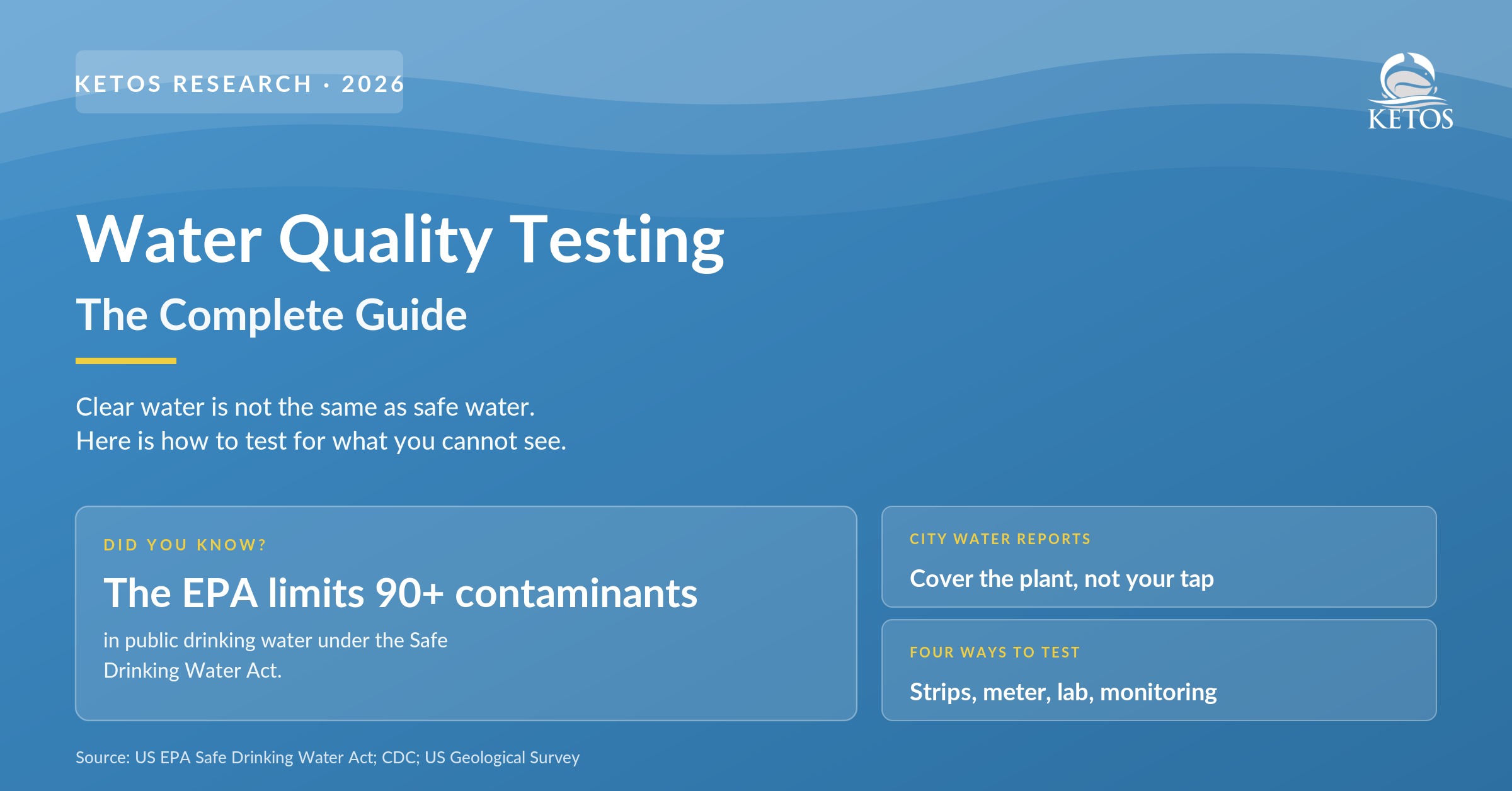
Testing matters because clear water is not the same as safe water. Lead, arsenic, nitrate, PFAS, and bacteria can all be present at levels above health limits in water that looks and tastes completely normal. The only way to know what is in your water is to measure it.
Why water quality testing matters, even on city water
The federal Safe Drinking Water Act sets legal limits on more than 90 contaminants in public drinking water, and community water systems must send customers an annual water quality report, called a Consumer Confidence Report, every year by July 1. That report is useful, but it has two limits. It describes the water as it leaves the treatment plant and travels through the public mains, not the water at your tap, and lead and copper most often enter through the plumbing inside your own home, after the utility’s responsibility ends. A home test is the only way to see what actually comes out of your faucet.
If your water comes from a private well, there is no utility and no annual report at all. Private wells are not regulated under the Safe Drinking Water Act, so testing is entirely the owner’s responsibility. A US Geological Survey study of about 2,100 private wells found that roughly one in five contained a contaminant above a human-health benchmark. Well owners should follow our complete guide to well water testing for a source-specific schedule.
Concerned about contaminants in your water?
Get water testing from KETOS KELP using EPA-certified methodology, results you can trust, backed by real data.
Order a Water Test →How to test your water quality
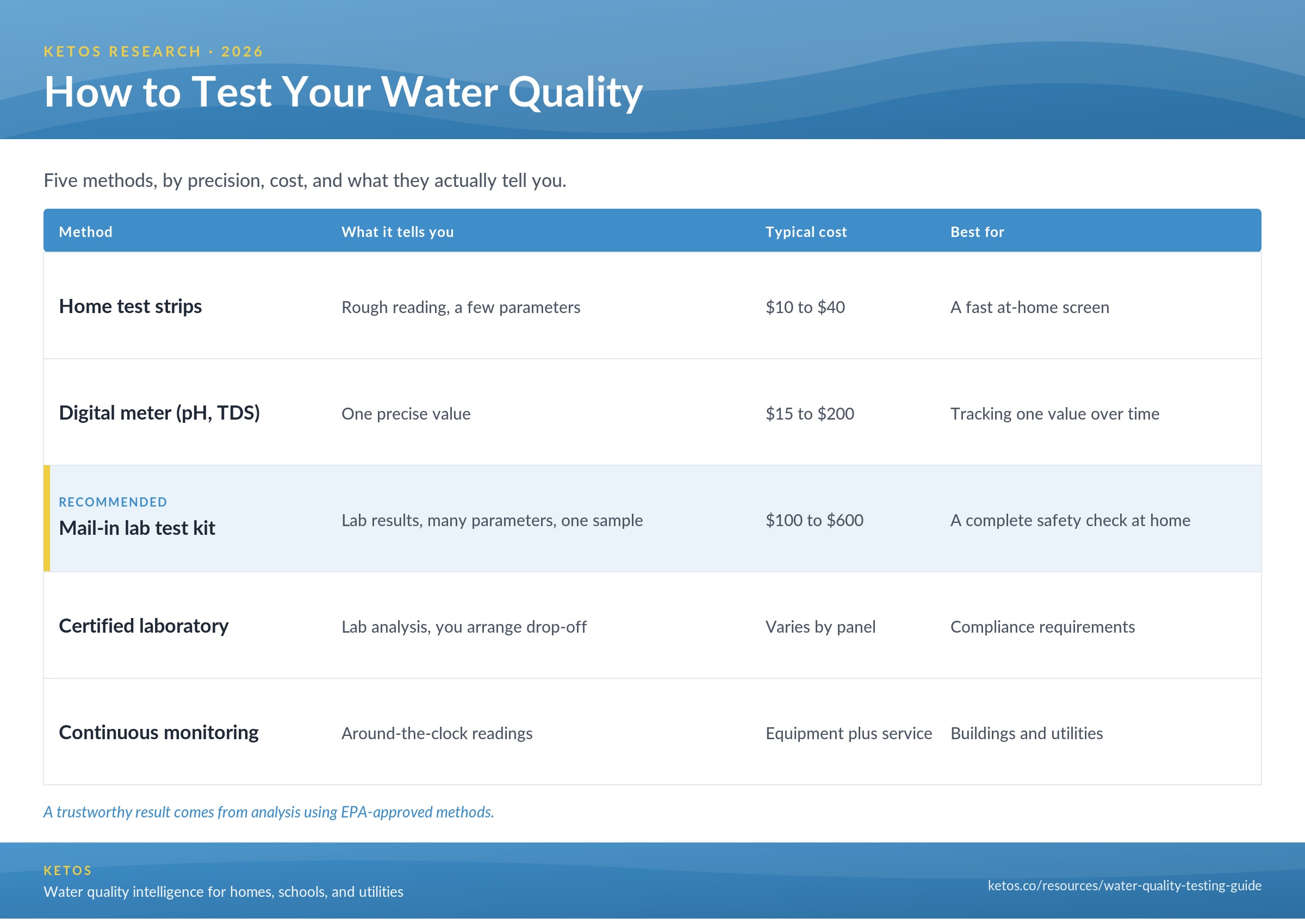
There are five practical ways to test water quality. They differ in precision, cost, and how much they actually tell you. The right choice depends on whether you want a quick screen, a complete safety assessment, ongoing tracking of one value, or continuous monitoring of a building or system.
| Method | What it tells you | Typical cost | Best for |
|---|---|---|---|
| Home test strips | A rough reading on a few parameters; low precision | $10 to $40 | A fast at-home screen |
| Digital meter (pH, TDS) | A precise number for one property of the water | $15 to $200 | Tracking a single value over time |
| Mail-in lab test kit | Quantitative lab results across many parameters from one sample | $100 to $600 | A complete safety assessment at home |
| Certified laboratory | The same lab analysis, with you arranging drop-off | Varies by panel | Compliance or a specific local requirement |
| Continuous monitoring | Around-the-clock readings that catch changes between samples | Equipment plus service | Buildings, utilities, and managed systems |
Whichever route you choose, what makes a result trustworthy is that the analysis uses EPA-approved methods. A laboratory result tells you a concentration you can compare against a legal limit, lead in parts per billion or nitrate in milligrams per liter, rather than a color on a chart. A single panel that bundles many parameters from one sample is usually far more economical than testing each contaminant separately.
How to test water quality at home
You can test water quality at home in three ways, in rising order of reliability. Home test strips change color to give a rough reading on parameters such as pH, hardness, chlorine, and nitrate in minutes. A digital pH or TDS meter gives a precise number for that one property. And a mail-in kit lets you collect a sample at home that a laboratory then analyzes against EPA limits. Strips and meters are useful for a quick look, but neither can detect lead, arsenic, or PFAS at the low levels that matter for health, so they cannot confirm on their own that water is safe to drink.
People sometimes ask how to test water quality at home without a kit. You can observe clues such as cloudiness, staining, a metallic taste, or a chlorine or rotten-egg smell, and those are worth noting, but they only flag obvious problems. The contaminants that carry the most serious health risk give no sensory warning at all, which is why a laboratory analysis remains the only way to confirm safety.
What to test your water for
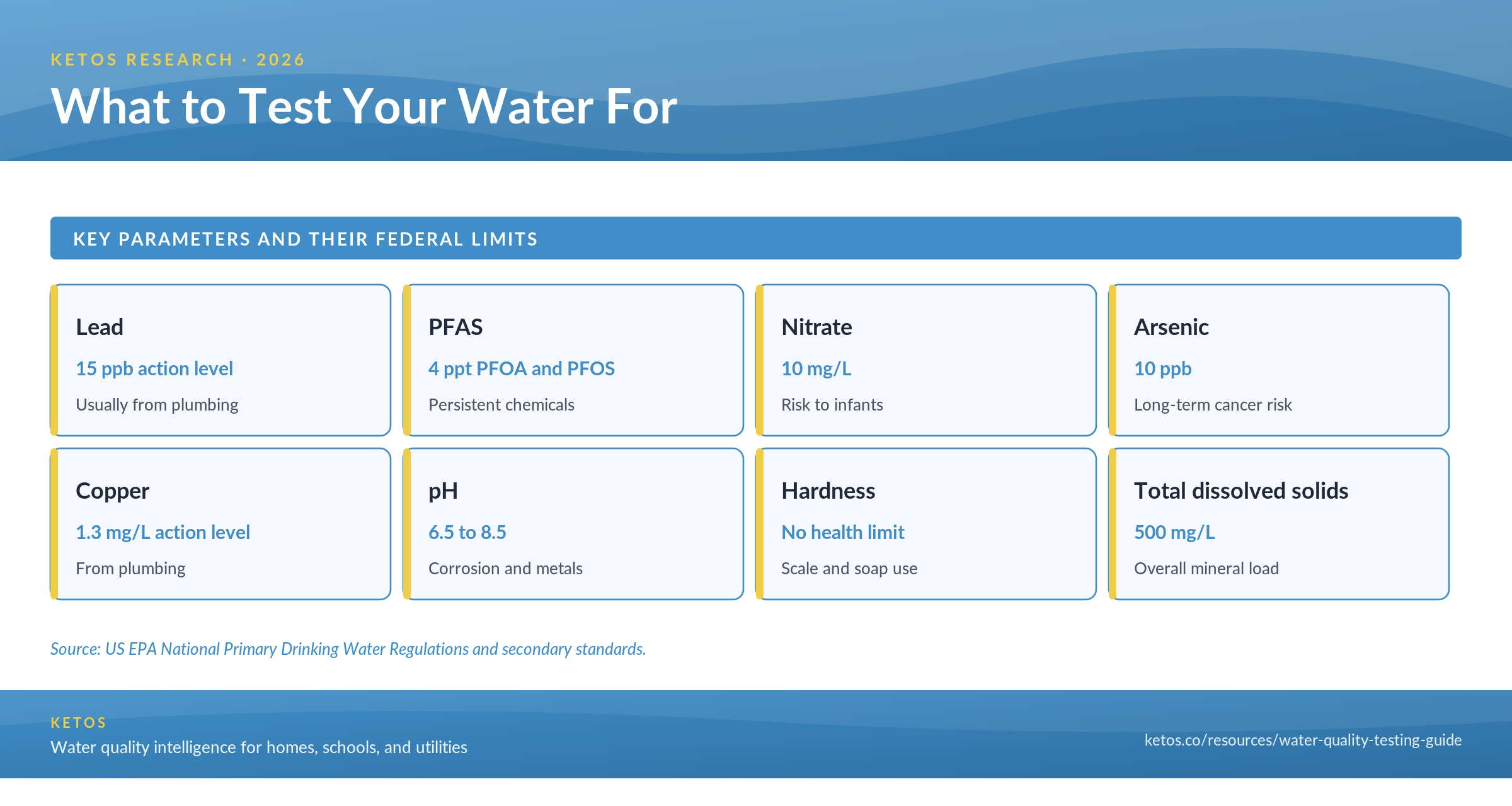
Which contaminants matter most depends on your water source, your plumbing, and your local area, but the parameters below cover the ones that most often affect health and are worth testing in any home. The limits shown are the federal drinking water standards the results should be compared against. Bacteria is the exception worth noting up front: it is checked with a separate microbiological culture rather than the chemical analysis covered here, so a certified laboratory or your health department runs it as its own test.
| Parameter | Why it matters | EPA limit or benchmark |
|---|---|---|
| Lead | Damages brain development; usually from plumbing | 15 ppb action level (10 ppb under the 2024 LCRI) |
| PFAS (PFOA, PFOS) | Persistent industrial chemicals linked to health harm | 4 ppt each (2024 federal limits) |
| Nitrate | Dangerous to infants; from fertilizer and septic | 10 mg/L |
| Arsenic | Naturally occurring; long-term cancer risk | 10 ppb |
| Copper | From plumbing; gastrointestinal effects at high levels | 1.3 mg/L action level |
| pH | Low pH corrodes pipes and leaches metals | 6.5 to 8.5 (secondary) |
| Hardness | Scale and soap use; not a health risk | No health limit |
| Total dissolved solids | A broad indicator of overall mineral load | 500 mg/L (secondary) |
For lead specifically, schools, utilities, and building owners with compliance obligations should see our guide to lead in water testing services.
Testing tap water versus well water
The right approach depends on where your water comes from. On municipal or city water, start by reading your utility’s annual Consumer Confidence Report to see what the system delivers, then test your own tap for lead and copper, since those enter through household plumbing the report does not cover. On private well water, you are responsible for the entire test, because no agency does it for you. The CDC recommends testing a private well at least once a year for total coliform bacteria, nitrate, pH, and total dissolved solids, with additional contaminants based on local conditions. Our well water testing guide covers that schedule in detail.
How often should you test your water?
For a private well, test at least once a year, and immediately after any flooding, nearby land disturbance, repair to the well, or change in how the water looks, tastes, or smells. On municipal water, test your tap when you move into an older home, if you have lead pipes or fixtures, before bringing home an infant, or any time the water changes in appearance or taste. Any household with a pregnant person or a child should prioritize testing for lead and nitrate regardless of the water source.
How to read your water test results
A laboratory report lists each parameter with a measured concentration and, usually, the federal limit beside it. Compare the two. A maximum contaminant level is the legal ceiling for a contaminant in public water. An action level, used for lead and copper, is the concentration that triggers required steps rather than a strict pass or fail line, and for lead the health goal is zero because no level is considered safe. A secondary standard, used for parameters such as pH and total dissolved solids, concerns taste, odor, and appearance rather than health. If any health-based parameter exceeds its limit, stop drinking the water, switch to an alternative source, and identify treatment or a plumbing fix before testing again to confirm the problem is resolved.
Frequently asked questions about water quality testing
How do I test my water quality?
Choose a method based on what you need. For a complete safety check, collect a sample with a mail-in kit and have a laboratory analyze it using EPA-approved methods. For a quick screen, use home test strips or a digital meter. At a minimum, test for lead, nitrate, pH, and copper, and add others based on your water source and location.
How can I test water quality at home?
Use home test strips for a fast color-based reading on basics like pH, hardness, and chlorine, or a digital pH or TDS meter for a precise single value. For anything you intend to rely on for safety, collect a sample with a mail-in kit and let a laboratory measure it, since strips and meters cannot detect lead, arsenic, or PFAS at health-relevant levels.
What is a water quality test?
It is a measurement of what is dissolved or suspended in water, compared against health-based standards. It can be a single meter reading, a multi-parameter laboratory panel, or continuous sensor monitoring. The point is to convert water that looks clear into specific numbers you can compare to limits and act on.
Why is water quality testing important?
Because clear water is not the same as safe water. Lead, arsenic, nitrate, PFAS, and bacteria can all be present above health limits with no change in how water looks, tastes, or smells. Testing is the only way to know what is actually in your water.
How much does a water quality test cost?
Home test strips run about $10 to $40 and a digital meter $15 to $200. A laboratory panel runs roughly $100 to $300 for common parameters, and $200 to $600 or more for a full panel that adds metals and PFAS. A bundled kit that covers many parameters in one price is usually the better value than testing each contaminant separately.
Can I test water quality without a kit?
Only partially. You can note cloudiness, staining, a metallic taste, or a chlorine or sulfur smell, which flag obvious problems. But the contaminants with the most serious health effects give no sensory warning, so confirming that water is safe still requires a laboratory analysis.
Are home water test strips accurate?
They are accurate enough for a rough screen of a few parameters, but not precise enough to confirm safety, and most cannot detect lead, arsenic, or PFAS at the low levels that matter. Treat strips as a first look, not as the basis for a decision about whether water is safe to drink.
Guides for specific tests
This guide is the overview. For a deeper look at a particular water source or parameter, see our focused guides: well water testing, pH meters, TDS meters, and lead in water testing services.
Choosing how to test: a quick decision flow
If you want to know whether your water is safe to drink, get a complete laboratory analysis from a single sample. A KELP water test kit covers the full contaminant list in one report using EPA-approved methods. Order a KELP water test kit →
If you only need to track one value, such as pH for a filter or total dissolved solids for an aquarium or reverse-osmosis system, a digital meter is the simplest tool, and home strips will give you a fast screen between proper tests.
If you are responsible for a building, a utility, or a managed system that serves many people, periodic samples leave gaps between readings. Continuous monitoring tracks water quality around the clock and flags problems as they happen. KETOS SHIELD monitors more than 30 parameters in real time with EPA-method-compliant logging. Talk to SHIELD sales →
Sources and references
- US EPA, Safe Drinking Water Act and National Primary Drinking Water Regulations (legal limits on more than 90 contaminants; maximum contaminant levels and action levels for lead, copper, nitrate, arsenic, and others).
- US EPA, Consumer Confidence Reports (community water systems must deliver an annual water quality report to customers by July 1).
- US EPA, PFAS National Primary Drinking Water Regulation (2024 limits of 4 parts per trillion for PFOA and PFOS).
- US EPA, Private Drinking Water Wells (private wells are not federally regulated; owners are responsible; USGS finding that roughly one in five wells exceeded a health benchmark).
- CDC, Guidelines for Testing Well Water (annual testing for total coliform, nitrate, pH, and total dissolved solids).