



Rep. Alexandria Ocasio-Cortez holds up two jars of discolored water from Morgan County, Georgia at a House Energy and Commerce oversight hearing, May 2026. Credit: Office of Rep. Ocasio-Cortez, U.S. House of Representatives (public domain).
In May 2026, Rep. Alexandria Ocasio-Cortez held up two jars of brown water at a House oversight hearing and asked the EPA’s assistant administrator for water whether the agency was examining how data centers affect drinking water. She said the water came from a household in Morgan County, Georgia, near a hyperscaler campus. The operator disputes that its site is the cause. It cites a commissioned study concluding the campus was unlikely to have affected the well, and notes that the property sits in a separate watershed and that the campus draws municipal water rather than groundwater. The EPA agreed to review the complaints.
The hearing drew national attention to a subject that spans three separate issues: how much water a data center consumes, what it discharges, and whether anyone holds independent data on the water around it. These get discussed together, though each involves a different mechanism and a different fix.
The scale of data center water use
Data center water use is easy to caricature in either direction. Nationally it remains a small share of the total: US data centers drew on the order of 17 billion gallons directly for cooling in 2023, well under one percent of the country’s water withdrawals and modest next to agriculture or power generation. It also varies enormously by design, from an air-cooled or closed-loop site that consumes almost nothing to an evaporative campus that can use up to 5 million gallons a day, close to the daily use of a town of ten to fifty thousand people; how much of that is consumed rather than returned as wastewater depends on the cooling system. The pressure comes from concentration rather than from the national total: in Northern Virginia, the densest data center corridor in the country, facilities used about 2.1 billion gallons in 2023, roughly 86 percent more than in 2019, with Loudoun County alone accounting for close to 900 million gallons. Continued build-out will keep regional demand rising even as newer cooling designs reduce the water each facility needs, so the strain tends to appear locally well before it registers in any national total.
Use at that scale draws on shared resources, including the local water table, municipal treatment plants, and receiving streams. Each of the three problems below traces back to one of them.
Problem one: how much a facility consumes
The first issue is consumption, felt most sharply in dry regions. A cooling system that evaporates most of the water it draws competes with other users of the same source. When a large facility arrives and nearby wells lose pressure or turn gritty, residents often connect the change to it, and the timing gives them reason to.
The Georgia case is a consumption dispute. Residents and some observers describe groundwater drawdown, where heavy local demand lowers the water table and well pumps begin drawing sediment, iron, and manganese from lower in the aquifer. The operator responds that its campus uses municipal water rather than groundwater, and that the affected home sits more than a mile away in a separate watershed. Both sides lack a shared record of the water before and after construction, so the question stays open.
Concerned about contaminants in your water?
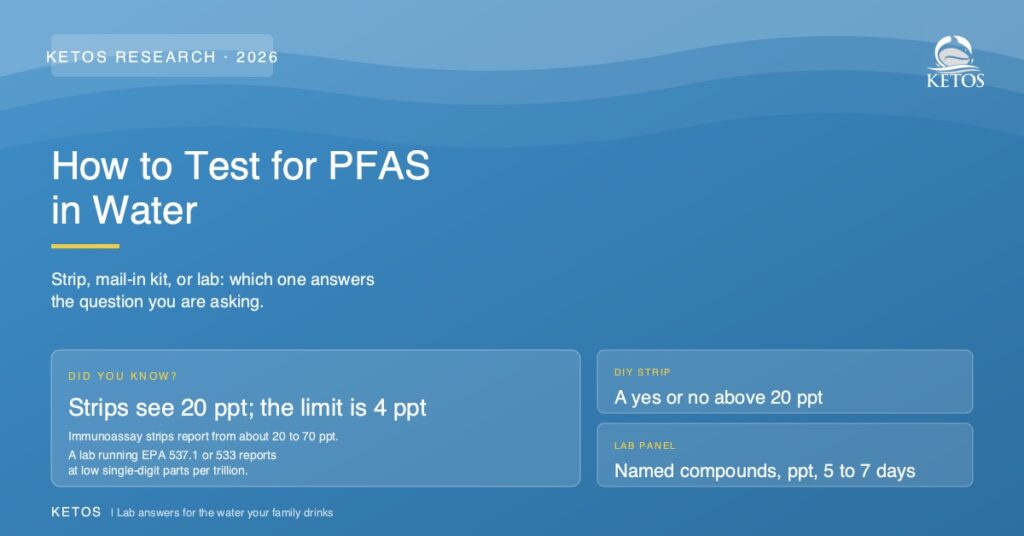
Get water testing from KETOS KELP using EPA-certified methodology, results you can trust, backed by real data.
Order a Water Test →Problem two: what a facility discharges
The second issue is discharge, which receives less attention. The water left after evaporation is blown down and sent to a treatment plant or a stream, and its quality changes along the way. Cooling-tower blowdown typically carries total dissolved solids four to eight times higher than the makeup water, often between 1,200 and 6,000 milligrams per liter, and it leaves the tower warm, at 30 to 40 degrees Celsius. It also carries the chemistry operators add to run the system: corrosion inhibitors such as phosphates and molybdates, biocides such as isothiazolinones and glutaraldehyde, and metals such as copper and zinc leached from the equipment.
Most of this chemistry is ordinary for cooling systems and permitted under the Clean Water Act through NPDES limits on temperature, pH, dissolved solids, and specific pollutants. A permit sets a limit, but it records only the occasional compliance sample and leaves long stretches unmeasured in between. Where many facilities in one corridor send warm, concentrated, chemically treated water to the same treatment plants, the combined load can appear downstream as thermal and nutrient stress before anyone traces it to a source.
Problem three: the missing baseline
The third issue underlies the other two. Most of these disputes proceed without any continuous, independent record of the local water, measured from before the facility arrived through the months after, at the well, the outfall, and the receiving stream.
That gap is costly for everyone. Residents are left with a jar of water and a suspicion. A responsible operator struggles to clear its name, because a commissioned study rarely convinces a worried neighbor. Regulators end up working from the loudest complaint rather than the clearest data. A single photograph can undo years of sustainability investment when there is no measurement to place beside it.
Where continuous measurement fits
Closing that gap is a measurement problem. It calls for continuous, defensible, third-party water-quality data, collected around these sites as routine practice rather than assembled after a hearing.
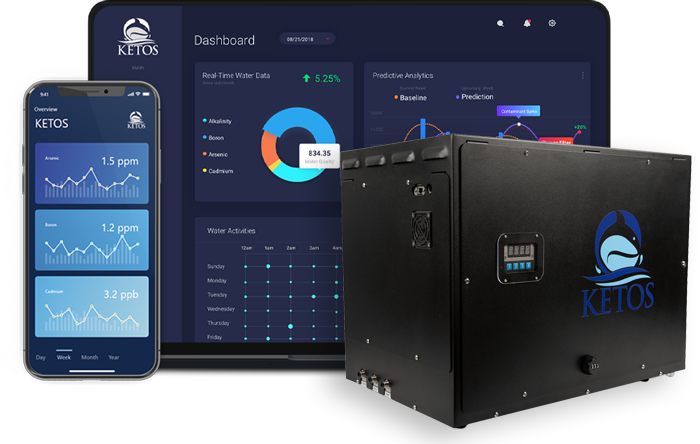
KETOS provides that data. SHIELD delivers continuous, in-situ monitoring of up to 30 water-quality parameters, including the dissolved metals and core chemistry that concentrate in cooling discharge and that appear when a well is drawn down. The visible discoloration in the Georgia jars is one symptom, and the chemistry beneath it is what a continuous record captures and a quarterly sample misses. For results that have to hold up before a regulator, a court, or a community meeting, KELP provides laboratory confirmation using EPA methods with documented chain of custody.
With that data in place, an operator gains an auditable baseline to defend its record or catch a genuine problem early, a community gains a measurement it can trust independently of the operator, and a regulator can direct limited resources to the actual source.
Data center construction will continue, and the water questions will continue with it. The next dispute will turn on whether someone can place a continuous, independent record beside the jar. That is the record KETOS builds for operators, utilities, and the communities around them.
Related KETOS reading
- AI data centers, wastewater discharge, and the need for effective water management
- Discharge from AI data centers and how to mitigate contamination
- Myths vs. reality: data centers and water usage
Related: Semiconductor DI water testing – how to verify ultrapure water beyond 18 MΩ
Test it: Data center water testing packages – cooling, discharge, and stormwater panels from $469