



Partly, and only with the right filter in the pitcher. Brita’s Elite filter carries a certified reduction claim for exactly two PFAS compounds, PFOA and PFOS. The standard Brita filter carries no PFAS claim at all. And in independent testing across 75 PFAS compounds in real tap water, Brita filters removed between 20% and 48% of the total. All of those facts are true at once, and understanding how is the key to deciding whether your pitcher is protecting you.
One more fact worth knowing up front: Brita’s own performance data sheet recommends testing your water supply before purchasing a water treatment unit, to determine your actual treatment needs. That is the correct order of operations, and it comes from the filter maker itself.
Which Brita Filters Have a PFAS Claim?
| Filter | Certified PFAS claim | What the certification covers |
|---|---|---|
| Brita Elite (model OB06) | PFOA and PFOS reduction, certified by IAPMO R&T against NSF/ANSI 53 | 98.1% reduction of a lab challenge, with treated water required at or below 0.07 ppb (70 ppt). Two compounds out of the thousands of known PFAS. |
| Brita Standard (model OB03) | None | Certified under NSF/ANSI 42 for chlorine, taste, and odor. No PFAS, lead, or mercury claims. |
So the first question is which filter you actually own. The white Elite filter (sold as Longlast in earlier years) holds the PFOA/PFOS certification and lasts 120 gallons, about six months of typical use. The standard filter that ships with most Brita pitchers makes no PFAS promise, and it is easy to assume otherwise. Background on what PFAS are and why they persist is covered in our forever chemicals guide.
What Does “Certified for PFOA/PFOS” Actually Cover?
The certification behind the Elite filter has a history that matters. In 2016 the EPA set a health advisory of 70 ppt for combined PFOA and PFOS, and NSF built its filter test protocol around that number: a certified filter must bring treated water to 70 ppt or below. NSF folded that protocol into NSF/ANSI 53, and in 2022 added a separate, stricter “Total PFAS” claim covering seven compounds with a 20 ppt combined limit.
In April 2024 the EPA issued legally enforceable drinking water limits: 4 ppt for PFOA, 4 ppt for PFOS, and 10 ppt for PFHxS, PFNA, and GenX. NSF’s committees are still working on aligning the filter standards with those numbers. The practical consequence for a Brita owner:
- The Elite’s certification verifies treated water at or below 70 ppt for PFOA/PFOS, a threshold 17 times higher than the 4 ppt the law now applies to utilities.
- The certification covers 2 compounds. The EPA’s 2024 rule regulates 6, and researchers track thousands.
- No pitcher filter certification currently verifies performance down to the 4 ppt legal limit.
Concerned about contaminants in your water?
Get water testing from KETOS KELP using EPA-certified methodology, results you can trust, backed by real data.
Order a Water Test →What Independent Testing Shows
Two published studies have measured how pitcher filters perform on real tap water rather than lab challenge water.
A 2020 Duke University and NC State study of 76 point-of-use filters found activated carbon filters, the technology inside every Brita, removed long-chain PFAS like PFOA and PFOS at roughly 60 to 70% and short-chain PFAS at roughly 40%, with results the authors described as inconsistent and unpredictable. Under-sink reverse osmosis and two-stage systems achieved near-complete removal.
A 2024 study in Frontiers in Environmental Chemistry ran five pitcher filters against 75 PFAS compounds in two municipal tap waters. The Brita Elite removed 48% of total PFAS in Montreal tap water and 20% in a higher-PFAS water supply; the Brita Standard removed 38%. Other pitchers built specifically for PFAS scored higher: ZeroWater at 99 to 100% and ClearlyFiltered at 96 to 99%.
The gap between “certified at 98.1%” and “removed 20%” is not a contradiction. The certification measures two compounds in a standardized lab challenge; the studies measured dozens of compounds, including the short-chain PFAS that carbon handles poorly, in real water over the filter’s working life. Both numbers are accurate descriptions of different questions.
How to Find Out Whether Your Brita Is Enough
- Start with your area’s record. Check PFAS detections near you to see whether your utility or region has a documented problem.
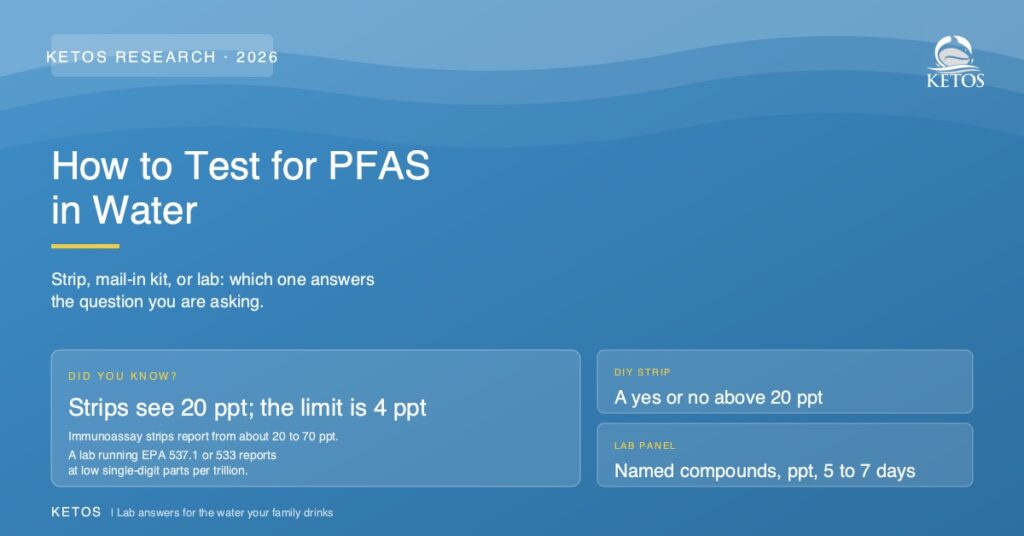
- Test your own tap. Utility reports cover the system, not your faucet, and private wells are not covered at all. A lab test of your tap water tells you which PFAS are present and at what level; our test kit comparison covers the options.
- Match the filter to the finding. A low single-digit ppt detection and a fresh Elite filter may be a reasonable pairing. Levels near or above the 4 ppt limits call for treatment rated for PFAS, and the published data favors reverse osmosis and purpose-built systems there.
- Retest after installing. A before-and-after pair of tests is the only direct evidence that your specific filter works on your specific water, and it catches the performance drop as cartridges age.
Filtration is a decision that deserves a number first. Get your tap’s PFAS levels from KETOS KELP in 5 to 7 business days, then choose filtration with evidence in hand.
Frequently Asked Questions
Does the Brita Elite filter remove PFAS?
The Brita Elite is certified to reduce PFOA and PFOS, two of the thousands of PFAS compounds, with treated water verified at or below 70 ppt in the certification test. In independent testing across 75 PFAS compounds in real tap water it removed 20 to 48% of the total. It reduces the two headline compounds; it is not a broad PFAS barrier.
Does the standard Brita filter remove PFAS?
The standard Brita filter carries no PFAS certification of any kind; its certified claims cover chlorine, taste, and odor. A 2024 study measured 38% incidental removal of total PFAS in one municipal water supply, a level that provides no assurance against the EPA’s 4 ppt limits.
Do Brita filters remove GenX and short-chain PFAS?
No Brita filter carries a certified claim for GenX or other short-chain PFAS, and published testing shows activated carbon removes short-chain compounds at roughly 40%, well below its performance on long-chain PFOA and PFOS. Short-chain coverage is the weakest point of pitcher filtration generally.
How do I know if my water has PFAS in the first place?
PFAS have no taste, smell, or color, so the only way to know is measurement. Utility Consumer Confidence Reports cover a short list of compounds at the system level, and private wells receive no monitoring. A laboratory test of your own tap, run with EPA-certified methods, reports each compound at parts-per-trillion resolution. Our PFAS testing guide explains the methods and sample collection.
Sources: Brita Elite Performance Data Sheet (Brita LP); NSF, “Forever Chemicals and the Advancement of Filtration Standards”; EPA National Primary Drinking Water Regulation for PFAS (2024); Herkert et al., Environmental Science & Technology Letters (2020); Frontiers in Environmental Chemistry (2024). Certification details and study figures checked August 20, 2026.