



Mostly, yes, and better than any other point-of-use option that has been independently tested. In the largest published study of home water filters, every under-sink reverse osmosis and two-stage system achieved near-complete PFAS removal, while pitcher-style carbon filters landed between 40 and 70%. There is also a real certification for it: NSF/ANSI 58 covers PFAS reduction claims for RO systems. The details, including what the certification does and does not verify, decide whether an RO system actually closes your PFAS question.
What the Research Shows
A 2020 Duke University and NC State study measured PFAS removal across 76 point-of-use filters and 13 whole-house systems in real homes. The under-sink reverse osmosis and two-stage filters achieved near-complete removal of the PFAS measured. Activated carbon filters, the technology in pitchers and refrigerator filters, removed long-chain PFAS like PFOA and PFOS at roughly 60 to 70% and short-chain PFAS at roughly 40%, with performance the authors called inconsistent and unpredictable. The physics favors RO: a membrane that rejects contaminants by size and charge handles the short-chain compounds that slip through carbon.
What RO Certification Covers
NSF/ANSI 58 is the certification standard for reverse osmosis systems, and since 2022 it has included a “Total PFAS” reduction claim covering seven compounds with treated water required at or below 20 ppt combined. That is a meaningfully stricter bar than the older 70 ppt PFOA/PFOS criterion that pitcher certifications still carry. Two caveats keep the picture honest:
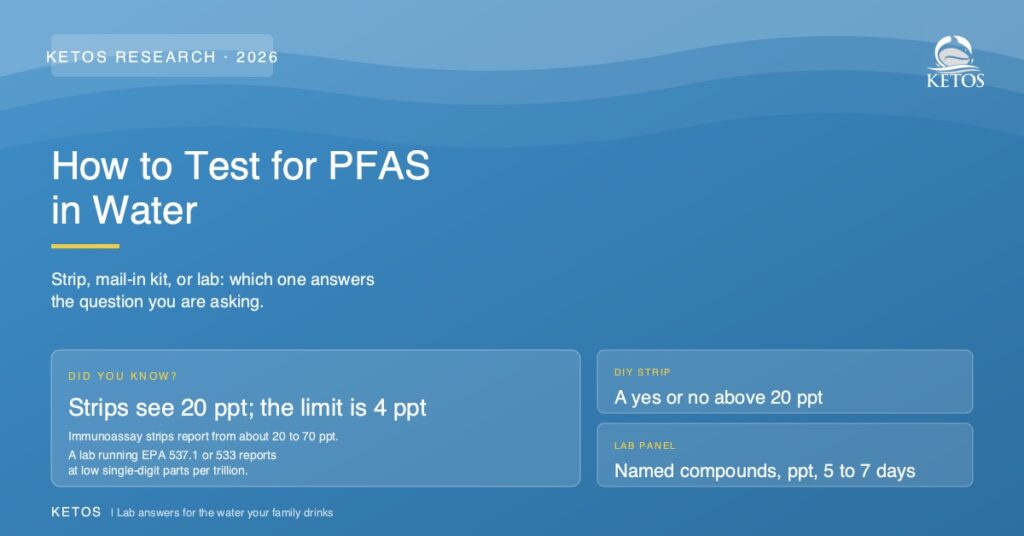
- The EPA’s 2024 legal limits sit at 4 ppt for PFOA and PFOS, and NSF’s committees are still working to align the filter standards with those numbers. No point-of-use certification currently verifies performance down to 4 ppt.
- The certification tests a new, correctly installed unit. Real-world performance depends on membrane condition, pre-filter changes, and installation, which is where verification testing comes in.
Background on the standards history and the 4 ppt limits is in our guides to PFAS drinking water regulations and whether Brita filters remove PFAS.
Concerned about contaminants in your water?
Get water testing from KETOS KELP using EPA-certified methodology, results you can trust, backed by real data.
Order a Water Test →How RO Compares to the Alternatives
| Option | PFAS performance in published testing | Certification available |
|---|---|---|
| Under-sink reverse osmosis | Near-complete removal (Duke/NC State 2020) | NSF/ANSI 58 Total PFAS claim, 20 ppt |
| Two-stage under-sink filters | Near-complete removal in the same study | NSF/ANSI 53 claims vary by model |
| Pitcher and fridge carbon filters | Roughly 40 to 70%, inconsistent | PFOA/PFOS claim at the 70 ppt criterion |
| Purpose-built PFAS pitchers | 96 to 100% for two models in 2024 testing | Varies by model |
Study figures from the 2020 Duke/NC State study and a 2024 study in Frontiers in Environmental Chemistry.
Test First, Then Verify
An RO system is a several-hundred-dollar commitment plus ongoing membrane and filter costs, and the case for it starts with a number. Test your tap before buying: if PFAS is below the limits already, the money can stay in your pocket, and if it is elevated, the baseline tells you exactly what the system has to beat. Test again after installation, and periodically as the membrane ages, because the before-and-after pair is the only direct evidence your specific unit works on your specific water. Get your tap’s PFAS levels from KETOS KELP in 5 to 7 business days, then buy filtration with evidence in hand.
Frequently Asked Questions
Does reverse osmosis remove PFAS completely?
Near-completely in independent testing: every under-sink RO system in the 2020 Duke/NC State study of 76 home filters achieved near-complete PFAS removal, including the short-chain compounds carbon filters handle poorly. Complete removal to zero is not certified by any standard; the NSF/ANSI 58 Total PFAS claim verifies treated water at or below 20 ppt combined.
Is reverse osmosis certified for PFAS?
Yes. NSF/ANSI 58, the certification standard for reverse osmosis systems, added a Total PFAS reduction claim in 2022 covering seven compounds with a 20 ppt combined limit. Look for that specific claim on the model you are considering; the EPA’s 2024 legal limits of 4 ppt are stricter than any current point-of-use certification verifies.
Does reverse osmosis remove GenX and short-chain PFAS?
RO membranes handle short-chain PFAS far better than carbon filters, which is a main reason the Duke/NC State study found near-complete removal for RO against roughly 40% short-chain removal for carbon. The NSF/ANSI 58 Total PFAS claim includes short-chain compounds such as PFBS and PFHxS.
How do I know my RO system is working?
Measure it. Test your tap water before installation for a baseline, test the treated water after installation to verify removal, and retest periodically as the membrane and pre-filters age. A lab test reporting each PFAS compound at parts-per-trillion resolution is the only direct evidence for your specific unit on your specific water.
Sources: Herkert et al., Environmental Science & Technology Letters (2020); NSF, “Forever Chemicals and the Advancement of Filtration Standards”; Frontiers in Environmental Chemistry (2024); EPA National Primary Drinking Water Regulation for PFAS (2024). Checked August 20, 2026.