


Private wells in Santa Clara County are permitted through Santa Clara Valley Water District, but nobody tests the water on a schedule unless the well owner arranges it. KETOS Environmental Lab Services (KELP), a water testing lab in Sunnyvale, is the nearby option South Bay well owners use to arrange that testing.
Who in the South Bay Is on a Private Well?
If your address does not receive a water bill from a municipal utility, you are almost certainly on a private well, and the well is your responsibility from the pump to the tap. Households on private wells in Santa Clara County cluster in a few specific areas:
- Morgan Hill and the surrounding unincorporated county land
- Gilroy and the agricultural parcels around it
- San Martin, which sits between the two and has no municipal water system at all
- Scattered rural and hillside parcels elsewhere in the county, outside any city water district’s service area
Most of the rest of the county drinks municipal water delivered by a city, a water district, or a company such as San Jose Water. A municipal customer can read a utility’s annual water quality report and see what the system found. A private well owner has no equivalent report; nobody else is required to write one.
Where Do Well Permits Come From Here?
Santa Clara Valley Water District is the sole agency that issues permits to construct, modify, or destroy a water well anywhere in the county. Permitting covers new domestic wells, exploratory borings 45 feet deep or more, and observation, monitoring, and geothermal wells, according to Valley Water’s well permitting page.
The permit confirms that a well was built to code. It does not include a required water-quality test at the time of issuance, so a well permitted a decade ago carries no guarantee about what is in the water today. Closing that gap is up to the well owner, not the permitting process.
Concerned about contaminants in your water?
Get water testing from KETOS KELP using EPA-certified methodology, results you can trust, backed by real data.
Order a Water Test →What Should South Bay Well Water Be Tested For?
Start with the baseline every private well in the country needs: nitrates, total dissolved solids, and pH, tested annually at minimum. How often should you test well water? covers the full schedule, including these common retest triggers:
- Flooding or standing water near the wellhead
- Land disturbance or new construction nearby
- A plumbing repair, replacement, or new fixture
- Any sudden change in the water’s taste, odor, or color
A December 2025 USGS study of the Gilroy-Hollister groundwater basin found nitrate above the federal 10 mg/L limit in 17% of domestic wells sampled in South Santa Clara County, most of it traced to agricultural fertilizer use. The Llagas subbasin around Morgan Hill and Gilroy came in lower on average, a median of 3.7 mg/L, with the highest concentrations found further south in the neighboring North San Benito subbasin. The City of Morgan Hill’s own public water system, drawing on the same groundwater subbasins through 16 active wells, reported an average nitrate level of 3.7 mg/L in 2024.
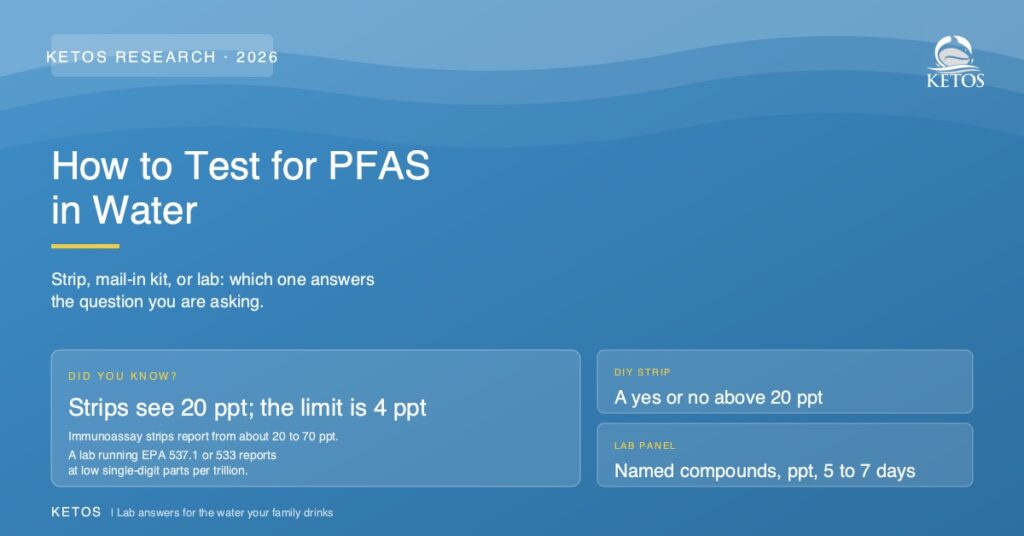
Metals belong on the same panel. Arsenic, iron, and manganese occur naturally in South Bay groundwater, and older well or plumbing materials can add lead or copper. A household near a former industrial site, an airport, or a military-adjacent parcel may also want PFAS in the same sample; see how to test for PFAS in water for that decision.
Which KELP Panel Fits a South Bay Well?
| Situation | Panel | What it covers | Price |
|---|---|---|---|
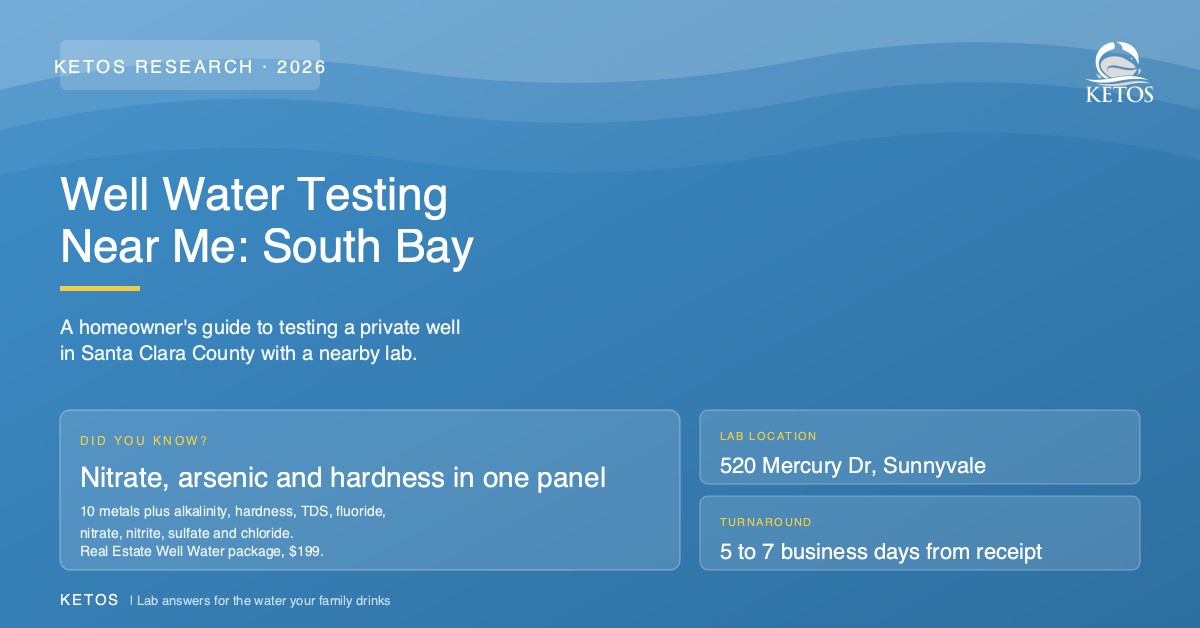
| Buying or selling on a private well | Real Estate Well Water | 10 metals (lead, copper, arsenic, iron, manganese, chromium, barium, beryllium, cadmium, selenium) plus alkalinity, hardness, and TDS, plus fluoride, nitrates, nitrite, sulfate, and chloride | $199 + shipping |
| Annual baseline for an owned well | Real Estate Well Water | Same panel above, run as a yearly check rather than a one-time transaction test | $199 + shipping |
| Want metals, minerals, and PFAS from one sample | Home Safety | Adds 18 PFAS compounds to the metals and chemistry panel | $549 |
| No blind spots, broadest single-sample panel | Ultimate | 25 PFAS compounds, the full metals suite, and alkalinity | $699 |
Order a well water panel from KELP once you know which one fits. A short way to choose:
- If you are buying or selling and need a fast baseline for closing, choose Real Estate Well Water.
- If you want an annual check on a well you already own, the same panel works as a yearly habit.
- If you want metals, minerals, and PFAS answered from one sample, choose Home Safety.
- If you want the broadest single-sample panel with no blind spots, choose Ultimate.
Where Can a South Bay Homeowner Start Well Water Testing?
KELP’s lab sits at 520 Mercury Dr in Sunnyvale, and testing runs by mail-in kit, with walk-in drop-off accepted at the lab during business hours. Results arrive digitally within 5 to 7 business days of the lab receiving your sample.
You order a panel online, KELP ships a kit with the correct bottles and written instructions, you collect the sample at your wellhead, and you send it back with a prepaid return label already in the box. For the lab’s full method list, address, and hours, see the Sunnyvale lab profile; this page focuses on the well-owner decision rather than the lab itself.
Does It Matter That the Lab Is Close By?
The kit is engineered for transit: a well sample collected in Morgan Hill and mailed to Sunnyvale reaches the lab with the same integrity as one collected across the street from it.
Proximity does affect turnaround. A short mail run means fewer days between collecting the sample and the lab receiving it.
Know which panel you need? Order your well water test kit from KELP and get results digitally in 5 to 7 business days.
KETOS Environmental Lab Services
Name: KETOS Environmental Lab Services (KELP)
Address: 520 Mercury Dr, Sunnyvale, CA 94085
Phone: (408) 357-4745
Category: Water testing service
Hours: See current hours on the Google Business Profile
Map: Get directions to 520 Mercury Dr, Sunnyvale, CA 94085
This page does not cover the full national well-testing schedule and contaminant-pathway breakdown; for that, see the well water testing guide. It also does not cover how PFAS, nitrate, and hardness compare across Santa Clara County’s public water systems, which serve a different set of households than the private wells covered here; for that county-wide picture, see Santa Clara County water testing: which cities have issues.
Frequently Asked Questions
Where can I get well water tested near me in Santa Clara County?
KETOS Environmental Lab Services (KELP) runs well-specific panels from a lab at 520 Mercury Dr in Sunnyvale. You order a kit online, collect the sample at your wellhead, and mail it back with a prepaid return label; results arrive digitally in 5 to 7 business days.
Do I need a permit to test my well, or just to build one?
You only need a permit to construct, modify, or destroy a well; testing the water is separate and is left to the well owner. Santa Clara Valley Water District issues well construction permits countywide, and the permit process does not include a required water-quality test.
What should a private well in the South Bay be tested for?
Start with nitrates, total dissolved solids, and pH, the baseline any well in the country needs, tested annually and again after flooding, a repair, or a change in taste or odor. South County wells should pay particular attention to nitrate given the area’s agricultural history, and homes near industrial sites, airports, or military-adjacent parcels may want to add PFAS.
Is nitrate a real risk for wells in Morgan Hill and Gilroy?
It can be. A 2025 USGS study of the Gilroy-Hollister groundwater basin found nitrate above the federal limit in 17% of domestic wells sampled, most of it tied to agricultural fertilizer rather than septic systems, though the Llagas subbasin around Morgan Hill and Gilroy specifically had a lower median of 3.7 mg/L. Testing your own well is the only way to know where it falls.
Sources: Santa Clara Valley Water District, Well Permits and Inspections (valleywater.org), fetched 2026-09-17. USGS Scientific Investigations Report 2025-5097, Gilroy-Hollister groundwater basin domestic-well study, published December 1, 2025 (pubs.usgs.gov). City of Morgan Hill, Water Connection, July 2024 Consumer Confidence Report, State Water System ID CA4310006, fetched 2026-09-17 via ear.waterboards.ca.gov. EPA National Primary Drinking Water Regulation for PFAS, announced April 10, 2024 (epa.gov/sdwa/and-polyfluoroalkyl-substances-pfas). KELP product pages and prices from the verified facts register, checked 2026-09-16/17.