



More than 43 million Americans drink from private wells, and every one of those wells sits outside the monitoring system that covers city water. No utility samples it, no regulator schedules its tests, and no report arrives in the mail about it. The well owner is the water system operator. This guide covers the full job: what to test, when, what each contaminant pathway means, what testing costs, and how to read the results, with the EPA’s guidance as the floor throughout.
Why Well Testing Is Entirely Up to You
The Safe Drinking Water Act regulates public water systems and stops at private wells. That is not an oversight; it is the design, and it has a practical consequence: the contaminants that show up in wells, from natural geology and nearby land use alike, are invisible without measurement. Most of them have no taste, color, or smell at the concentrations that matter. The testing schedule below is how well owners close that gap.
What to Test, and When
The EPA’s private well guidance sets the baseline, and life events adjust it:
- Every year: a baseline that includes nitrates, total dissolved solids, and pH.
- More often when small children, elderly adults, or someone pregnant or nursing lives in the house.
- Immediately after flooding, nearby land disturbance, well repairs, or any change in taste, odor, or color.
- Before a new baby relies on the water: nitrate first, for the reasons covered in our formula water guide.
- During a home sale: a documented panel protects both sides of the transaction; our home-purchase testing guide covers the timing.
Our companion piece on testing frequency goes deeper on the schedule.
Concerned about contaminants in your water?
Get water testing from KETOS KELP using EPA-certified methodology, results you can trust, backed by real data.
Order a Water Test →The Contaminants, by How They Reach Your Well
From geology: arsenic, uranium, and the metals underfoot
Bedrock chemistry decides what dissolves into groundwater, which is why neighboring counties can have entirely different well profiles. Arsenic and uranium occur naturally in many US aquifers at levels above federal limits for public systems, without any pollution event involved. A broad metals panel establishes your well’s geological baseline; once known, it changes slowly.
From agriculture: nitrate
Fertilizer and livestock operations move nitrate into groundwater, and shallow wells in agricultural areas carry the highest exposure. The federal standard is 10 mg/L measured as nitrogen, and the highest-stakes households are those with bottle-fed infants under six months, where nitrate above the standard risks methemoglobinemia, a condition that reduces the blood’s ability to carry oxygen. Nitrate belongs on the annual list without exception.
From industry and firefighting sites: PFAS
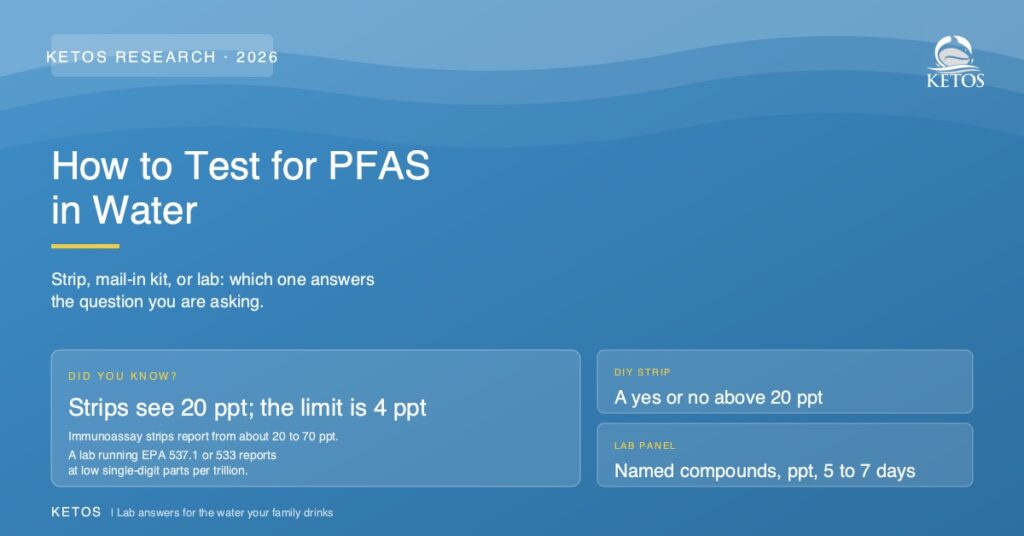
Wells near industrial sites, airfields, and military bases carry documented elevated PFAS risk, and no well receives PFAS monitoring from anyone but its owner. The 2024 federal limits for public systems, 4 ppt for PFOA and PFOS, are the sensible benchmarks for a private well too. Check your area’s PFAS record, and if your region or neighbors have detections, add a PFAS panel to the rotation.
From your own plumbing: lead and copper
Corrosive well water, low pH and low alkalinity, dissolves the metals in your own pipes and fixtures. This is why pH and alkalinity sit on the annual baseline: they predict whether your plumbing is leaching. The details of sampling for it are in our lead testing guide.
How the Testing Actually Works
A mail-in lab panel ships you the correct bottles with preservation handled, you fill them at the well tap and return them with the prepaid label, and a laboratory reports each parameter as a number beside its benchmark. The five checks that separate lab providers, named EPA methods, detection limits, panel scope, logistics, and report quality, are covered in how to choose a water testing lab, and our well kit comparison prices the current options: general panels run $199 to $399, and PFAS-inclusive single-sample panels run $549 to $699.
Reading Well Water Results
Lab reports benchmark each parameter against the EPA’s maximum contaminant levels, the enforceable limits for public systems. Private wells are not bound by them, which is exactly why they are useful: they are the health-based reference points Congress and the EPA built for drinking water, and a private result above an MCL deserves the same response a utility would owe its customers. Results near a limit warrant a retest before major decisions; a single sample has the variability of a single day.
What Well Water Testing Costs
| Job | Typical cost | Cadence |
|---|---|---|
| Annual baseline panel (chemistry, nitrates, metals) | $199 to $399 | Yearly |
| PFAS-inclusive panel, one sample | $549 to $699 | Once, then as risk warrants |
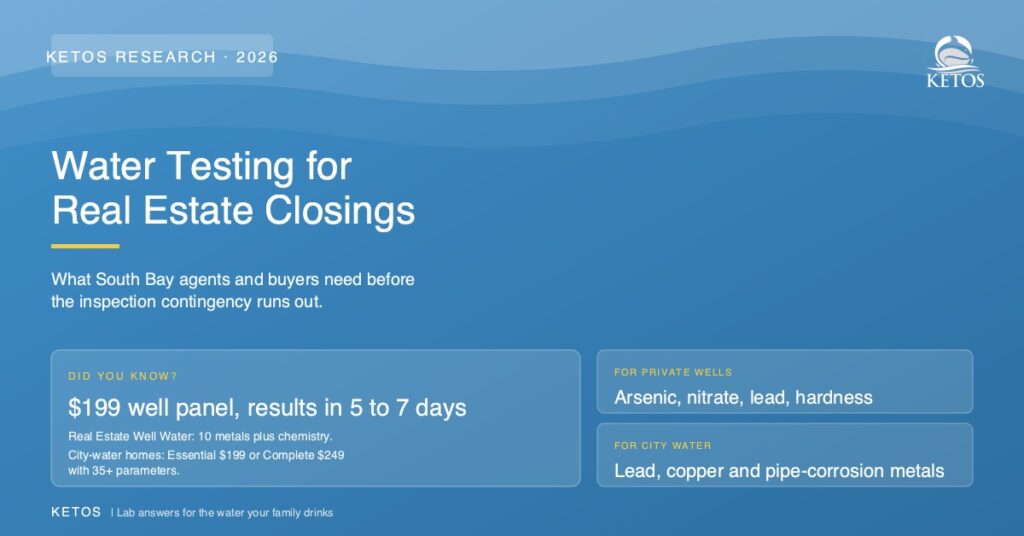
| Real estate transaction panel | $199 | Per transaction |
| Retest after flooding, repairs, or taste/odor change | Panel-dependent | Event-driven |
Ready to run this year’s baseline? Order a KETOS KELP well water test: EPA-certified methods, prepaid return shipping, and a plain-English report in 5 to 7 business days.
Frequently Asked Questions
Who regulates private well water?
Nobody, by design: the Safe Drinking Water Act covers public water systems and leaves private wells to their owners. The EPA publishes guidance, an annual testing baseline that includes nitrates, total dissolved solids, and pH, and event-driven triggers, and acting on it is the owner’s job.
What is the most important well water test?
For households with infants, nitrate, without question: levels above the 10 mg/L federal standard put bottle-fed babies under six months at risk of methemoglobinemia. For everyone else the answer is the annual baseline itself, because well contaminants arrive without taste, color, or smell and only a schedule catches them.
How much does well water testing cost per year?
An annual baseline panel runs $199 to $399 from mail-in laboratories in 2026. Adding PFAS raises a single-sample panel to $549 to $699, a cost most owners incur once to establish a baseline and then repeat only if risk factors change.
Can I test well water myself?
Collection, yes: mail-in kits are designed for owner sampling with the correct bottles and instructions. Measurement, no: the concentrations that matter for arsenic, lead, nitrate, and PFAS sit far below what strips or visual checks can detect, so the analysis belongs in a laboratory reporting real numbers.
Sources: EPA, “Protect Your Home’s Water” (private wells guidance) and National Primary Drinking Water Regulations; US Geological Survey domestic well population estimates; provider pricing from ketos.co and mytapscore.com, checked August 20, 2026.