



Pick up a bag of salad in any grocery aisle and the label makes a quiet promise: triple washed. Most shoppers read that as a safety guarantee. Two produce outbreaks running simultaneously this summer show why it isn’t one, and why the company at the center of both was arguably the best-equipped processor in America to keep that promise.
The Cyclospora outbreak linked to Taylor Farms de Mexico iceberg lettuce has caused 6,358 reported illnesses across 15 states. In August, Taylor Farms separately recalled 20 prepared products across 26 states because they contained jalapeños from a supplier implicated in a Salmonella outbreak that has sickened 345 people. Investigators traced those peppers to a single grower in Sinaloa, Mexico.
Taylor Farms is not careless about washing. After a 2006 spinach E. coli outbreak, the company developed SmartWash, a wash-chemistry system that now treats billions of pounds of produce a year across the industry. If washing could make contaminated produce safe, these two outbreaks would look very different.
Why didn’t washing stop it?
Washing does something different from what most people assume. In FDA’s guidance for fresh-cut processors, the stated purpose of antimicrobial chemicals in wash water is to minimize contamination of the water itself and the cross-contamination that follows. The chlorine is there to keep one contaminated lot from spreading, through the shared water, to every lot that follows it. That is containment, and it matters enormously, but it is not sterilization.
So does washing vegetables remove bacteria? Partially. Against pathogens already attached to produce, commercial washing achieves roughly a 90 to 99 percent reduction, which peer-reviewed reviews describe as a 1 to 2 log reduction. That sounds substantial until a lot arrives heavily contaminated, at which point the surviving fraction is more than enough to cause illness. Bacteria settle into stem scars and surface pores that sanitizer doesn’t effectively reach. Washing can even move contamination inward. FDA’s research on pathogen infiltration found that placing warm field produce into cooler water creates a pressure differential that pulls water into the fruit, and notes that subsequent washing will not reduce internalized pathogens. This is why federal guidance tells tomato handlers to keep wash water 10°F warmer than incoming fruit.
Parasites are a starker case. FDA advises that chlorine and other common antimicrobial treatments are not effective against Cyclospora at all. For the lettuce outbreak, the wash line was never going to be the defense.
Where prevention actually lives
With no failsafe kill step between the field and the fork, prevention moves upstream, and the record says upstream mostly means water. The only pepper-Salmonella outbreak FDA ever conclusively solved was in 2008, when investigators recovered the outbreak strain from agricultural water on a farm in Nuevo León, Mexico. Fresh peppers are grown outdoors, irrigated with surface water, harvested by hand, and eaten raw. FDA’s own import sampling has found Salmonella on roughly 2.6 percent of Mexican hot peppers.
Regulators know this. FDA finalized its Pre-Harvest Agricultural Water Rule in 2024 precisely because agricultural water kept surfacing in produce tracebacks. The rule requires growers to assess their water systems annually and after significant changes. What it does not require is routine testing; a farm can satisfy the rule through a systems-based assessment alone. The industry’s main upstream defense is, in practice, an annual snapshot.

Need real-time water quality monitoring?
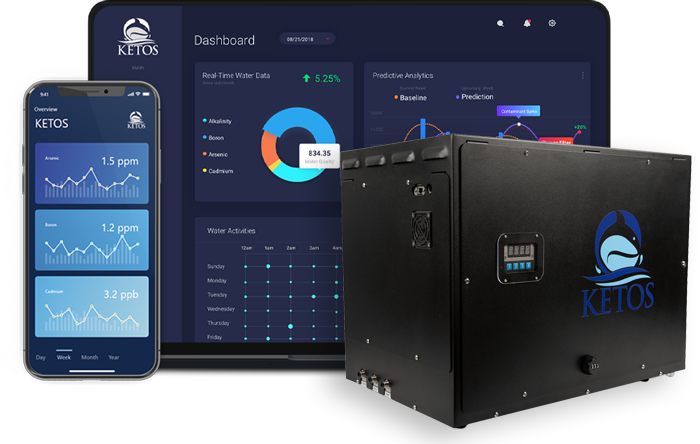
KETOS SHIELD continuously monitors 30+ parameters, replacing manual testing with automated, lab-accurate data.
Schedule a Demo →Water that changes faster than a yearly assessment
Contamination in surface water is not a steady condition; it is an event. A study of irrigation ponds on produce farms in southern Georgia found Salmonella concentrations rising measurably after storms, with storm flows arriving from streams and ditches carrying pathogen levels more than a log higher than the ponds they entered. The same study found something more uncomfortable: the ponds met FDA’s microbial water standards even while Salmonella was present. A compliance snapshot can pass on Tuesday and mean little by Friday.
The useful fact inside that problem is that event water announces itself chemically. Runoff entering a pond or canal shifts conductivity, nutrient levels, and dissolved oxygen within hours, and published research on southeastern agricultural water found Salmonella prevalence strongly associated with exactly those parameters. No sensor on earth identifies Salmonella in real time. But continuous chemistry monitoring shows the moment water changes, which tells a grower or a buyer when to investigate, treat, or stop irrigating, while the event is happening rather than at next year’s assessment.
Drinking water utilities have used this approach for years; EPA built its online water quality monitoring program on the finding that conventional sensors catch contamination events through baseline anomalies. Agriculture, for the most part, still runs on periodic snapshots. That visibility gap is what KETOS SHIELD closes: autonomous, lab-accurate monitoring of water chemistry, including conductivity, nitrates, ammonia, and dissolved oxygen, streamed continuously with alerts when the water departs from its baseline. For processors and retailers, the same data answers a harder question, because under FSVP an importer owns its foreign supplier’s risk, and KETOS PRISM turns supplier water records from an annual audit artifact into something a buyer can actually watch.
The label can tell you your greens were washed three times. It says nothing about the water that grew them, and that water is where safety is largely decided.
Frequently asked questions
Does washing vegetables remove bacteria like Salmonella?
Not reliably. Commercial washing with sanitizers reduces attached pathogens by about 1 to 2 log (90 to 99 percent). Bacteria lodged in stem scars or internalized in the produce are largely unaffected, and FDA notes washing will not reduce internalized pathogens.
Why is chlorine used in produce wash water?
Per FDA guidance, primarily to keep the wash water itself from spreading contamination between lots, not to sterilize the produce.
Does washing kill Cyclospora?
No. FDA advises that chlorine and other common antimicrobial treatments are not effective against Cyclospora.
Does the FDA require testing of irrigation water?
Under the 2024 Pre-Harvest Agricultural Water Rule, growers must assess their water systems at least annually, but routine microbial testing is not always required; assessments can be systems-based.
Can water monitoring detect Salmonella directly?
No continuous sensor identifies Salmonella in real time. Continuous monitoring of water chemistry (conductivity, nutrients, dissolved oxygen) detects the arrival of storm runoff and other contamination events, indicating when targeted investigation and treatment are warranted.
Sources: FDA Guide to Minimize Microbial Food Safety Hazards of Fresh-cut Fruits and Vegetables; FDA, Potential for Infiltration, Survival, and Growth of Human Pathogens within Fruits and Vegetables; CDC retail tomato handling guidance; Harris et al., Journal of Applied Microbiology (2018); “Factors Impacting the Prevalence of Foodborne Pathogens in Agricultural Water Sources in the Southeastern United States,” Water 12(1) (2020); FDA FSMA Pre-Harvest Agricultural Water Final Rule; CIDRAP coverage of the 2008 Salmonella Saintpaul investigation; Taylor Fresh Foods recall press release (Aug 2026).