



The real difference between city water and well water is not quality; it is who is responsible for knowing. City water arrives regulated, treated, and monitored by a utility that must publish results. Well water arrives exactly as the ground delivers it, and every safeguard a utility provides becomes the owner’s job. Each system has characteristic risks, and each points to a different testing habit.
The Difference in One Table
| City water | Well water | |
|---|---|---|
| Regulation | Safe Drinking Water Act limits apply and are enforced | No federal or state limits apply to the well itself |
| Monitoring | Utility samples on a required schedule | Owner tests, or nobody does |
| Treatment | Utility treats before distribution | Whatever equipment the owner installs |
| Public reporting | Annual Consumer Confidence Report | None |
| Characteristic risks | Lead and copper picked up in distribution and home plumbing; disinfection byproducts | Nitrate, arsenic and other geologic metals, PFAS near industrial sites, corrosive chemistry |
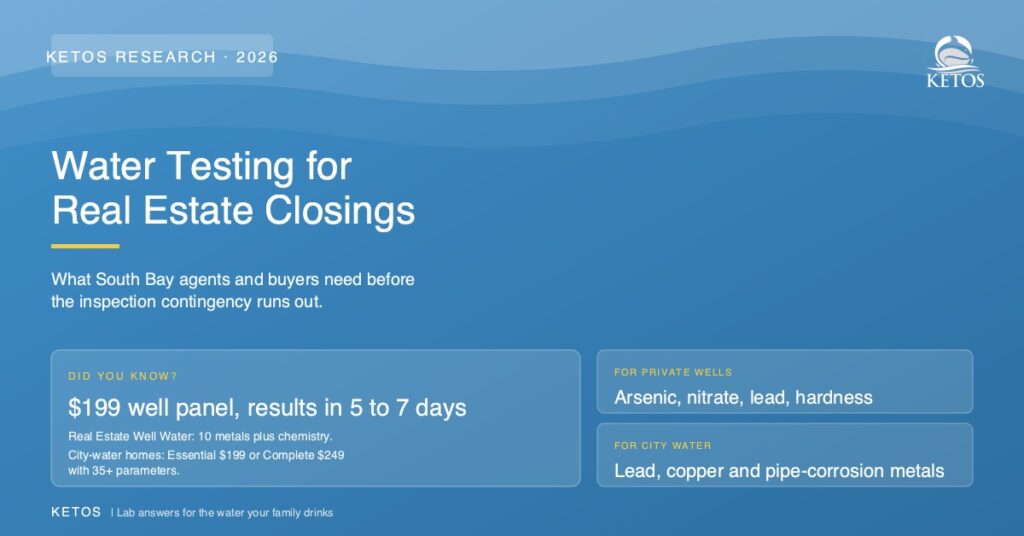
| The owner’s testing job | Verify the last stretch: your plumbing, your tap | Verify everything, yearly |
What City-Water Homes Should Still Test
The utility’s numbers describe treated water leaving the plant, and the Consumer Confidence Report describes the system, not your faucet. Lead and copper enter in the pipes between the main and your glass, which no utility can measure for you. A home panel covering plumbing metals and general chemistry closes that gap; our home kit comparison covers the options, and is my tap water safe? walks the whole decision.
Concerned about contaminants in your water?
Get water testing from KETOS KELP using EPA-certified methodology, results you can trust, backed by real data.
Order a Water Test →What Well Homes Own Outright
Everything: the annual baseline, the metals profile of the local geology, nitrate in agricultural areas, PFAS near industry and airfields, and the corrosivity chemistry that decides whether their own plumbing leaches. The complete well guide covers the schedule and the pathways, and the well kit comparison prices the panels.
Frequently Asked Questions
Is well water safer than city water?
Neither is inherently safer. City water is monitored and treated but travels through distribution and home plumbing that can add lead and copper. Well water skips the distribution system but carries whatever the local geology and land use contribute, with no one testing it but the owner. Measurement, not the source type, is what establishes safety in both cases.
Do I need to test city water?
Periodically, yes, for the last stretch the utility cannot see: your service line, your plumbing, your tap. A metals-and-chemistry panel every few years, or after plumbing work, covers the realistic city-water risks.
Why is well water not regulated?
The Safe Drinking Water Act was written to govern public water systems, and private wells fall outside its scope. The EPA publishes testing guidance for well owners, an annual baseline plus event triggers, but following it is voluntary and self-managed.
Sources: EPA Safe Drinking Water Act overview and private wells guidance, checked August 20, 2026.