



Three treatment technologies remove PFAS from home drinking water: reverse osmosis, activated carbon, and ion exchange. In independent testing, under-sink reverse osmosis performed best by a wide margin, activated carbon worked partially and inconsistently, and the things many households try first, boiling and standard softening, do nothing at all. The right starting point is a number: test your tap, match the treatment to what the test finds, then verify the result.
What Works: The Three Technologies
Reverse osmosis: the strongest home option
A 2020 Duke University and NC State study of 76 home filters found every under-sink reverse osmosis and two-stage system achieved near-complete PFAS removal, including the short-chain compounds other technologies miss. NSF/ANSI 58 certifies RO systems for a Total PFAS claim at or below 20 ppt combined. Our full guide to reverse osmosis and PFAS covers the certification details.
Activated carbon: partial and inconsistent
Carbon is the technology in pitcher, faucet, and refrigerator filters. The same study measured long-chain PFAS removal at roughly 60 to 70% and short-chain removal near 40%, with performance the authors called inconsistent and unpredictable, and 2024 testing across 75 PFAS compounds found mainstream pitchers removing 20 to 48% of the total. Purpose-built PFAS pitchers scored far higher, 96 to 100% for two models in that testing. Carbon can serve as a first line; the specific model and its certified claim decide whether it is more than that. The details are in our Brita and PFAS guide.
Ion exchange: the specialist option
Anion exchange resins built for PFAS are covered under the same NSF/ANSI 53 framework as carbon and appear mostly in whole-house and specialty systems. They can perform strongly on the charged PFAS species; as with every option here, the certified claim on the specific product is what counts.
What Does Not Work
- Boiling. PFAS do not evaporate away; as water boils off, concentrations can slightly increase.
- Standard water softeners. Softening exchanges hardness minerals and leaves PFAS in place.
- Basic sediment or taste filters. Filters rated for chlorine and particulates make no PFAS claim and remove no meaningful PFAS.
Concerned about contaminants in your water?
Get water testing from KETOS KELP using EPA-certified methodology, results you can trust, backed by real data.
Order a Water Test →The Order of Operations
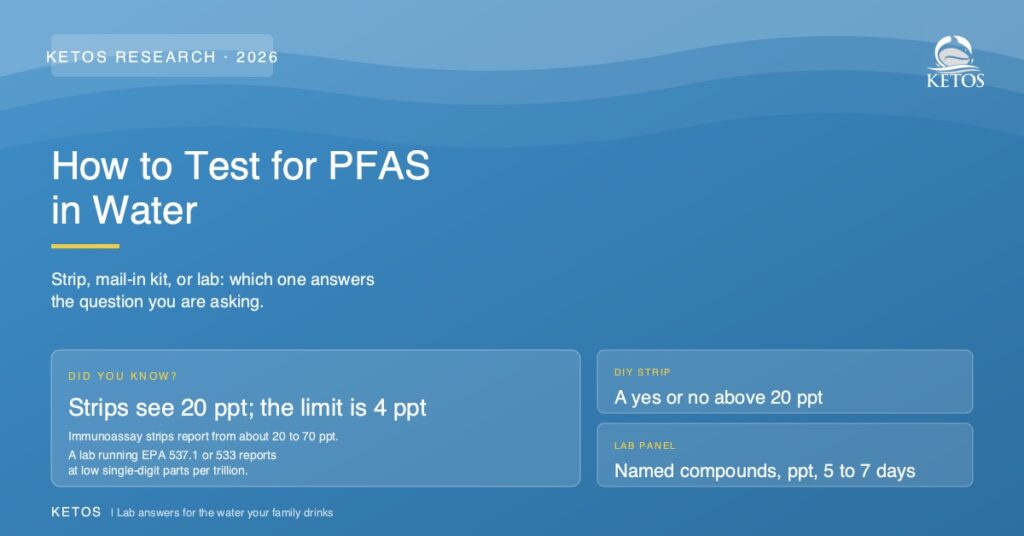
- 1. Test first. Treatment sized to a guess wastes money in both directions. A lab test of your tap reports each PFAS compound in parts per trillion against the 2024 federal limits.
- 2. Match treatment to the finding. Levels near the 4 ppt limits point to certified RO at the drinking tap; low detections may justify a certified carbon option; no detection means no purchase.
- 3. Verify after installing. A post-installation test proves your specific unit works on your specific water, and periodic retests catch membrane and cartridge aging.
Frequently Asked Questions
What is the best way to remove PFAS from drinking water?
Under-sink reverse osmosis performed best in independent testing, with near-complete PFAS removal across every unit tested in the 2020 Duke/NC State study, and NSF/ANSI 58 certifies RO systems to a 20 ppt Total PFAS claim. Activated carbon and PFAS-rated ion exchange are partial or specialist alternatives.
Does boiling water remove PFAS?
No. PFAS are heat-stable and do not evaporate with steam, so boiling leaves them in the water and can slightly concentrate them as volume boils away.
Do water softeners remove PFAS?
Standard softeners exchange calcium and magnesium and make no PFAS claim. PFAS removal requires reverse osmosis, activated carbon, or ion exchange equipment specifically rated for PFAS.
How do I know if I need PFAS treatment at all?
Measure before you buy. Check your area’s PFAS record, then test your own tap; if every compound reads below the federal limits, treatment is optional rather than necessary, and the baseline still pays for itself the day anything changes.
Sources: Herkert et al., Environmental Science & Technology Letters (2020); Frontiers in Environmental Chemistry (2024); NSF filtration standards guidance; EPA National Primary Drinking Water Regulation for PFAS (2024). Checked August 20, 2026.