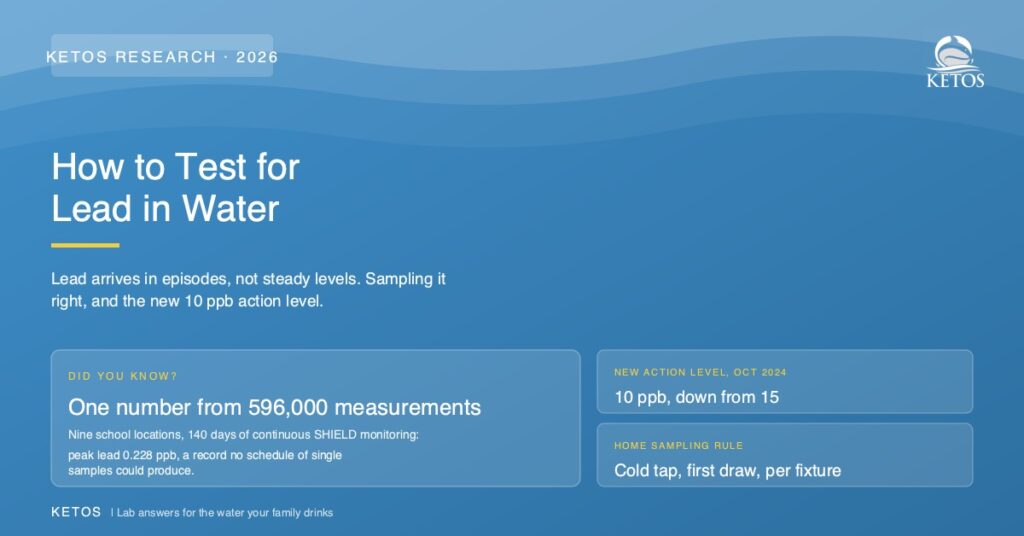


Two California lead-testing laws drive school water testing in Santa Clara County. Community water systems already tested lead in drinking water at public K-12 schoolsites built before 2010, and licensed child care centers in pre-2010 buildings must test for lead and retest every five years. This page covers what each law requires, which facilities are covered, and where a lab panel fits if a facility wants water data beyond the state minimum. It does not cover PFAS testing or general residential lead-testing methods; see How to Test for Lead in Water for the homeowner-side methods this page does not repeat.
What Does California Law Require for School Water Testing?
Under Assembly Bill 746, signed in 2017, community water systems had to test lead levels in drinking water at every California public K-12 schoolsite built before January 1, 2010, with results reported by July 1, 2019. If a sample came back above 15 ppb, the school’s local educational agency had to notify parents and guardians and immediately take the affected fountain or faucet out of service.
The testing ran through each school’s community water system, not through a lab the district picked on its own, and it was a single mandatory round rather than an ongoing cycle. The State Water Resources Control Board’s Division of Drinking Water, working with the California Department of Education, closed the program on July 1, 2019, accepted its last data update on December 31, 2020, and the database no longer takes new submissions. AB 746 itself does not require California schools to retest going forward.
A CDC-published study that tracked AB 746 compliance data for 174 California schools found 3% had at least one sample above the 15 ppb notification threshold, and 16% were above 5 ppb, the FDA’s bottled-water standard. That is a statewide research sample, not a Santa Clara County count, but it shows the range of outcomes the law was built to catch.
What Does AB 2370 Require for Daycare Water Testing?
Assembly Bill 2370, signed in 2018, requires every licensed child day care center in a building built before January 1, 2010 to test its drinking water for lead once between January 1, 2020 and January 1, 2023, then again every five years after that first test. Family day care homes are not covered; the law applies to licensed centers.
If a fixture tests above the program’s action level of 5 ppb, the center must immediately take that fountain or faucet out of service, provide an alternate potable water source such as bottled water, and notify parents and guardians. A center that does not comply risks a temporary license suspension.
Statewide, among the roughly 6,900 licensed centers that had reported results as of 2023, about 25% exceeded the 5 ppb action level, and 13 centers reported levels above 500 ppb. For a Santa Clara County center, the retest clock runs five years from whichever date the center ran its own first test, not a single statewide deadline.
Concerned about contaminants in your water?
Get water testing from KETOS KELP using EPA-certified methodology, results you can trust, backed by real data.
Order a Water Test →AB 746 vs. AB 2370: How the Two Laws Compare
The two laws share a construction-date trigger and a lead-only scope, but differ on almost everything else.
| AB 746 (schools) | AB 2370 (child care centers) | |
|---|---|---|
| Covers | Public K-12 schoolsites on a community water system | Licensed child day care centers (not family day care homes) |
| Building-age trigger | Built before January 1, 2010 | Built before January 1, 2010 |
| Testing window | Completed once, reported by July 1, 2019 | First test Jan 1, 2020 to Jan 1, 2023 |
| Retest cycle | None required under AB 746 | Every 5 years from the center’s first test |
| Notification / action level | 15 ppb parent-notification trigger | 5 ppb action level |
| Required response if exceeded | Shut off fixture, notify parents, restore potable source | Shut off fixture, notify parents, restore potable source |
Which Facilities Are Covered, and Which Aren’t?
Coverage under both laws turns on three questions: what kind of facility it is, when the building went up, and what water source serves it.
- Public K-12 schoolsites served by a community water system, in buildings built before January 1, 2010: covered by AB 746, already tested once, no ongoing mandate.
- Licensed child day care centers in buildings built before January 1, 2010: covered by AB 2370, testing every five years.
- Family day care homes: not covered by AB 2370.
- Schools or centers built in 2010 or later: outside the construction-date trigger for both laws.
- Facilities on a private well: AB 746 applies to schools served by a community water system; well-served facilities sit outside that specific law and can look at our well water test kit comparison for lead-inclusive panel options.
When to Test Beyond the State Minimum: A Facility Decision Guide
Both laws set a minimum, and a facility can reasonably test beyond what AB 746 or AB 2370 requires in a few common situations.
- Your school already completed its one-time AB 746 round years ago, plumbing has since been touched, and you want a current number rather than a 2019 result.
- Your child care center’s five-year retest window is approaching and you want to confirm your own paperwork before the state does.
- You want data on parameters beyond lead, such as copper, arsenic, or general water hardness, none of which AB 746 or AB 2370 require.
- A fixture already tested above the action level, and you want a confirming number after remediation, not just a visual check that the tap is back in service.
- You operate on a private well or a facility type that falls outside both laws’ construction-date trigger, and want a baseline anyway.
KETOS KELP’s Essential and Complete panels test lead alongside copper, arsenic, and other metals and minerals from a single sample, for $199 to $249 with results in 5 to 7 business days. A panel like this does not replace or fulfill a facility’s AB 746 or AB 2370 testing requirement, which runs through the community water system or the state program; it is a separate option for a facility that wants a broader snapshot of its water on its own schedule.
How to Find a School Water Testing Company for Panels Beyond State Requirements
When a district or center wants water data past what AB 746 or AB 2370 already covered, the same basics apply as choosing any school water testing company: named EPA analytical methods (EPA 200.8 for metals, EPA 300.1 for anions like nitrate and fluoride), a report with an actual number and a benchmark next to each parameter, and sampling logistics built to survive the mail. KETOS KELP runs its Essential and Complete panels this way and ships a prepaid return label with each kit. If lead is the only open question, check first whether your facility’s obligation is already satisfied under AB 746 or AB 2370 before ordering anything new.
Frequently Asked Questions
Four questions facility managers and child-care directors ask most about California’s school and daycare lead-testing laws.
Do California schools have to test their water for lead?
Yes. Under Assembly Bill 746 (2017), community water systems tested lead in drinking water at public K-12 schoolsites built before January 1, 2010, with results reported by July 1, 2019. It was a one-time mandatory round; AB 746 does not require ongoing retesting.
Do daycares in California have to test for lead?
Yes, for licensed child day care centers. Under Assembly Bill 2370 (2018), centers in buildings built before January 1, 2010 must test drinking water for lead once between January 1, 2020 and January 1, 2023, then every five years after that first test. Family day care homes are not covered.
What happens if a school or daycare’s water tests above the action level?
State law requires the facility to immediately take the affected fountain or faucet out of service, provide an alternate potable water source such as bottled water, and notify parents and guardians. For schools, the notification trigger is 15 ppb; the child care program’s action level is 5 ppb.
Does a KETOS KELP water test satisfy AB 746 or AB 2370?
No. AB 746 testing runs through a school’s community water system, and AB 2370 testing follows the state’s licensed-center program. KELP is a separate lab-testing option for facilities that want water data beyond what those programs already covered.
KETOS Environmental Lab Services
The Sunnyvale lab behind every KELP panel, for facility managers who want directions or hours before requesting a quote.
KETOS Environmental Lab Services
520 Mercury Dr, Sunnyvale, CA 94085
(408) 357-4745
Google Business Profile category: Water testing service
See current hours on the Google Business Profile.
Get directions
Ready to test water beyond your facility’s state lead-testing requirement? Request a KELP panel or call (408) 357-4745 for volume pricing across multiple sites.
Sources: California Assembly Bill 746 (2017) and Assembly Bill 2370 (2018), bill text via leginfo.legislature.ca.gov; California State Water Resources Control Board, Division of Drinking Water, Lead Sampling of Drinking Water in California Schools; CDC, Preventing Chronic Disease (2020); KQED reporting on California child care lead testing data (2023, updated 2024); KELP panel prices and turnaround from ketos.co, checked September 17, 2026.