

NEW: Send Water Samples To Our Lab (KELP)
Learn How Automated Water Sampling Saves Cities & Businesses Hundreds of Hours Each Year…
PFAS Exposure In the USA
WEBINAR: Operational Value of Water Quality Intelligence in Agriculture
Oct 23, 2024 at 11:00 AM EST

PFAS testing measures per- and polyfluoroalkyl substances in water at parts per trillion, using EPA laboratory methods matched to the kind of sample. This page covers the current federal limits, which method fits which water, and where to go next whether you are testing a kitchen tap, a private well, or a facility discharge.
PFAS are a family of thousands of synthetic chemicals used in nonstick coatings, stain-resistant fabrics, food packaging, and firefighting foam. The carbon-fluorine bond that makes them useful also keeps them from breaking down, which is why they are called forever chemicals. They build up in water and in people over years.
The federal drinking water limit for the two best-studied compounds, PFOA and PFOS, is 4 parts per trillion. One part per trillion is roughly one drop in 20 Olympic swimming pools, so PFAS work needs laboratory instruments built for trace analysis. For the chemistry and the health research, see What are forever chemicals?
In April 2024 the EPA set the first enforceable national limits for six PFAS in public drinking water:
| PFAS | Federal limit (MCL) | Status after May 18, 2026 proposals |
|---|---|---|
| PFOA | 4.0 ppt | Kept; compliance may extend to 2031 |
| PFOS | 4.0 ppt | Kept; compliance may extend to 2031 |
| PFHxS | 10 ppt | Proposed for rescission |
| PFNA | 10 ppt | Proposed for rescission |
| HFPO-DA (GenX) | 10 ppt | Proposed for rescission |
| Mixture of PFHxS, PFNA, HFPO-DA, PFBS | Hazard Index of 1 | Proposed for rescission |
These rules cover public water systems. Private wells fall outside federal drinking water rules, so well owners decide for themselves when to test. The full rule, the proposals, and what each means for your utility are in PFAS drinking water regulations explained. Source: EPA, PFAS National Primary Drinking Water Regulation.
Start with the federal testing record for your area, then test at the tap if you want an answer for your own home.
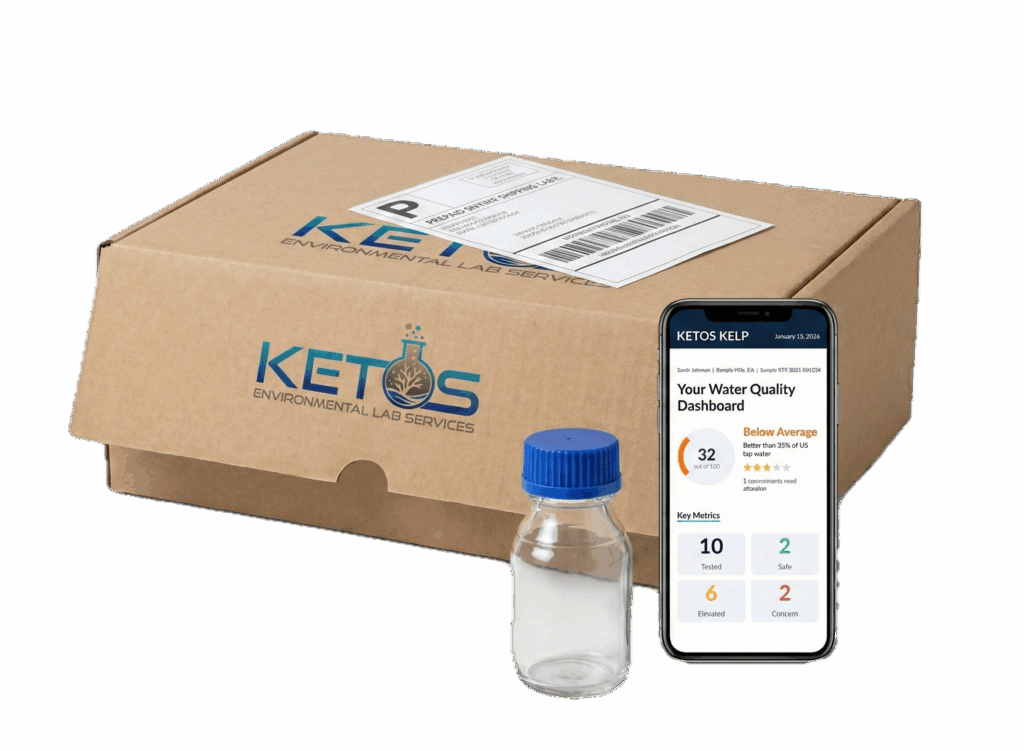
Collect a sample at the tap in the bottle the lab sends, ship it back, and get results by compound in parts per trillion. The choice that matters most is between a lab analysis and a screening product.
KETOS runs these analyses through KELP, which uses EPA-certified methodology with documented chain of custody. Results arrive digitally within 5 to 7 business days of the lab receiving your sample. In the South Bay you can also drop a sample at the lab in Sunnyvale.
| Your situation | KELP package | What it covers | Price |
|---|---|---|---|
| Renters and first-time testers | Basic PFAS Screen | 3 PFAS plus 6 other parameters | $280 |
| Homeowners and families who want full PFAS coverage | Home Safety | 18 PFAS plus metals and water chemistry | $549 |
| Well owners, homes near industrial sites, home buyers | Ultimate | 25 PFAS plus full metals and alkalinity | $699 |
Every package ships with a prepaid return label. Compare them on the PFAS water test page.
Point-of-use filtration lowers PFAS at the tap, and some filter types perform far better than others. The EPA names reverse osmosis, granular activated carbon, and ion exchange as the treatment technologies that reduce PFAS in drinking water.
A second test after installation confirms how well the filter is working on your water.
The EPA publishes separate methods for drinking water and for everything else. The right method depends on the sample.
| Method | Sample type | PFAS measured | Status |
|---|---|---|---|
| EPA 533 | Drinking water | 25 PFAS, including short-chain compounds | Used for UCMR 5 and drinking water compliance |
| EPA 537.1 | Drinking water | 18 PFAS | Used for UCMR 5 and drinking water compliance |
| EPA 1633A | Wastewater, surface water, groundwater, soil, sediment, biosolids, landfill leachate, fish tissue | 40 PFAS | Final December 2024; proposed for Clean Water Act use in 40 CFR Part 136, December 2024 |
| EPA 1621 | Wastewater | Total adsorbable organic fluorine (one screening total for all organic fluorine) | Final January 2024; proposed alongside 1633A |
The EPA will require Methods 1633A and 1621 nationally for Clean Water Act compliance once it finalizes them through rulemaking. Source: EPA, CWA analytical methods for PFAS.
Organizations with PFAS obligations usually need two things: a view of PFAS risk around each site, and lab data from sampling.
For project pricing, sample volumes, or a data request, contact the KETOS team.
Four questions readers ask most about PFAS testing.
Lab testing for PFAS in household water starts at $280 through KELP for a 3-compound screen, and panels covering 18 to 25 PFAS cost $549 to $699.
KELP delivers results digitally within 5 to 7 business days of the lab receiving the sample.
Both are drinking water methods. Method 537.1 measures 18 PFAS, and Method 533 measures 25, with better coverage of short-chain PFAS. UCMR 5 used the two methods together to cover 29 compounds.
Federal PFAS limits apply to public water systems, so the decision rests with the well owner. The 2023 USGS study found similar PFAS concentrations in private wells and public supplies, and a lab test at the tap tells you the result for your own well.
Sources: EPA PFAS National Primary Drinking Water Regulation and May 18, 2026 proposed rules; EPA Clean Water Act analytical methods for PFAS (Methods 1633A and 1621); EPA Fifth Unregulated Contaminant Monitoring Rule (UCMR 5); KETOS PRISM analysis of the UCMR 5 record (May 2026); U.S. Geological Survey 2023 national tap water PFAS study; KELP package prices and turnaround from ketos.co, checked September 23, 2026.
Subscribe to our newsletter to stay updated with the latest water insights.
"*" indicates required fields


Copyright © All rights reserved.